Department of Biology and Guangdong Provincial Key Laboratory of Marine Biotechnology, Shantou University, Shantou 515063, China.
STU-UMT Joint Shellfish Research Laboratory, Shantou University, Shantou 515063, China.
Molecules. 2018 Dec 5;23(12):3202. doi: 10.3390/molecules23123202.
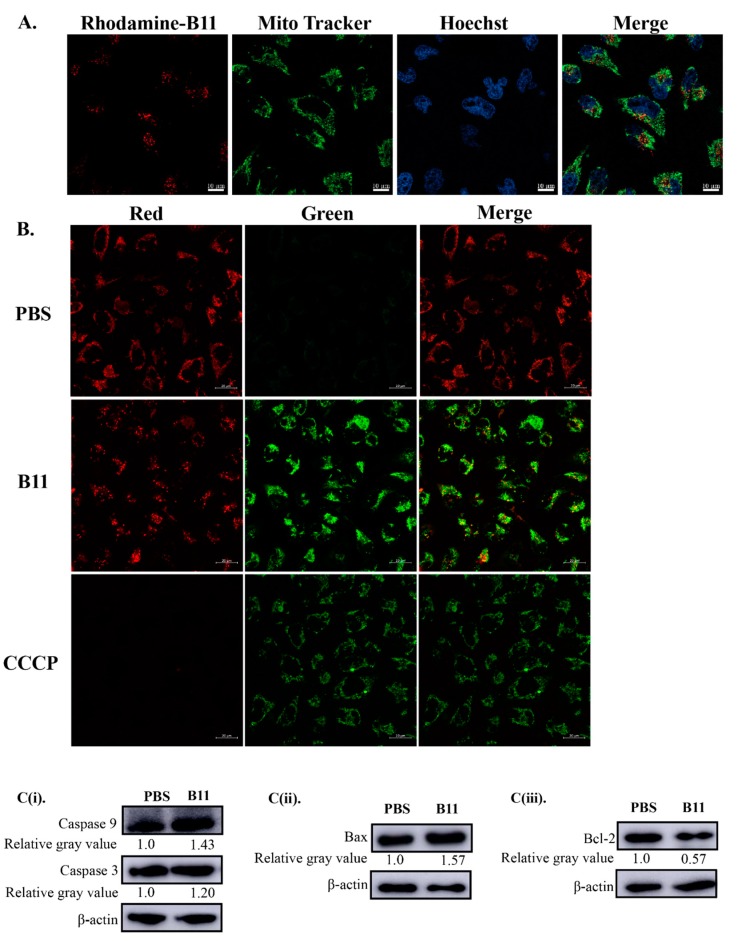
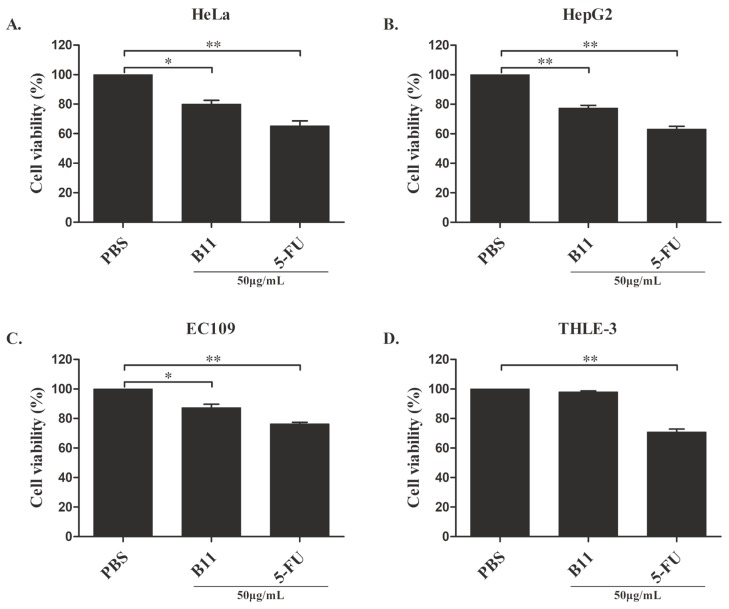
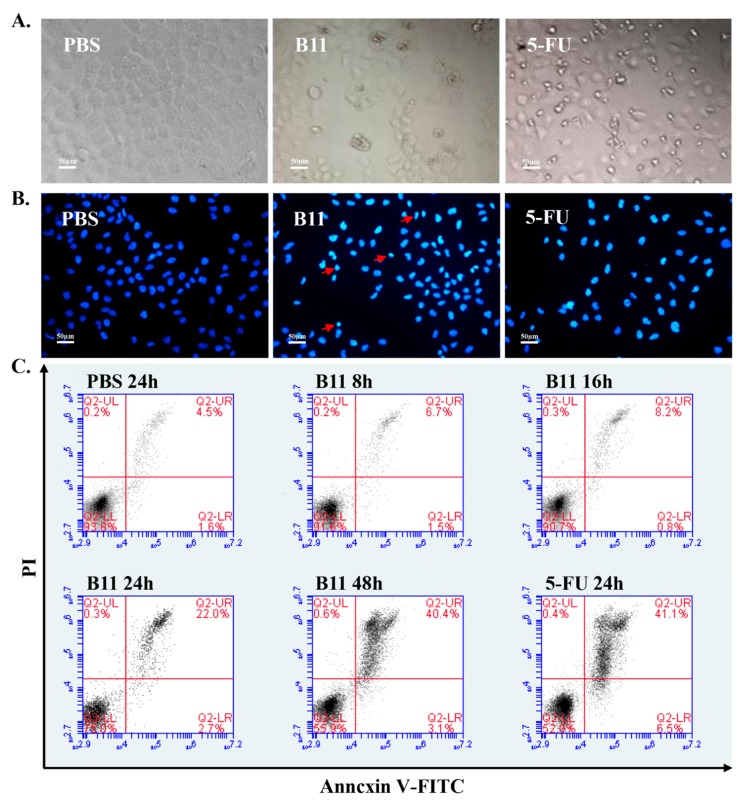
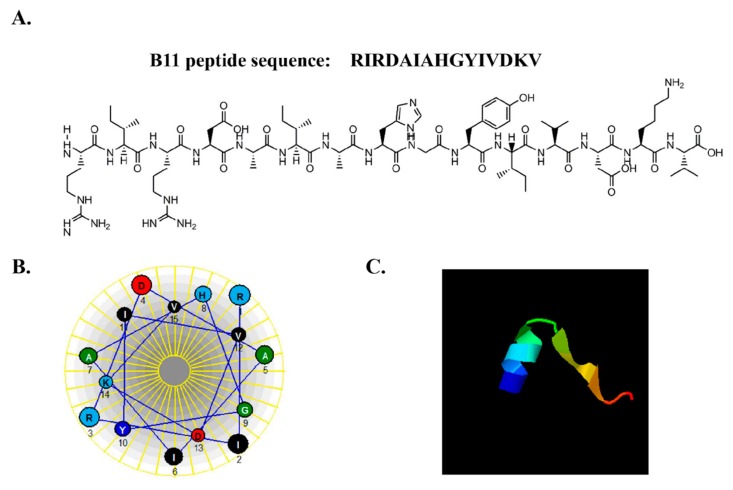
Antimicrobial peptides play important roles in the immune response to pathogens and tumor cells; for this reason, they are being exploited for therapeutic use. In this study, we describe a hemocyanin-derived peptide, denoted B11, which shares similar features with other anticancer peptides and attenuates the proliferation of cancer cells. Cell viability assay revealed that B11 significantly inhibited the proliferation of human cervical (HeLa), human hepatocellular carcinoma (HepG2), and human esophageal cancer (EC109) cancer cell lines, but not normal liver cell lines (T-antigen-immortalized human liver epithelial (THLE) cells or THLE-3), by inducing morphological changes, nuclear condensation, and margination, features which are indicative of apoptosis. Besides, peptide B11-induced apoptosis was confirmed by isothiocyanate-labeled Annexin V/propidium iodide (Annexin V-FITC/PI) double staining of HeLa cells. Moreover, cell uptake studies, confocal microscopy, and Western blot analysis revealed that rhodamine-labeled B11 permeated HeLa cells and localized to the mitochondria, causing mitochondria dysfunction through lost mitochondrial membrane potential, which consequently triggered the induction of apoptosis. Increased expression levels of caspase-9, caspase-3, and Bax (Bcl-2-associated X) proteins, coupled with a decrease in Bcl-2 (B-cell lymphoma 2) protein, confirmed that peptide B11 induced apoptosis via the mitochondrial pathway. Thus, the hemocyanin-derived peptide, B11, inhibits the proliferation of cancer cells by causing mitochondrial dysfunction and inducing apoptotic cell death, for which reason it could be explored as an anticancer peptide.
抗菌肽在免疫反应中对病原体和肿瘤细胞起着重要作用;因此,它们被用于治疗用途。在这项研究中,我们描述了一种血蓝蛋白衍生肽,称为 B11,它与其他抗癌肽具有相似的特征,并能抑制癌细胞的增殖。细胞活力测定表明,B11 通过诱导形态变化、核浓缩和边缘化,显著抑制人宫颈(HeLa)、人肝癌(HepG2)和人食管癌(EC109)癌细胞系的增殖,但对正常肝细胞系(T 抗原-永生化人肝上皮细胞(THLE)或 THLE-3)没有影响,这些特征提示细胞凋亡。此外,肽 B11 诱导的凋亡通过 HeLa 细胞异硫氰酸酯标记的 Annexin V/碘化丙啶(Annexin V-FITC/PI)双重染色得到证实。此外,细胞摄取研究、共聚焦显微镜和 Western blot 分析表明,罗丹明标记的 B11 穿透 HeLa 细胞并定位于线粒体,通过失去线粒体膜电位导致线粒体功能障碍,从而引发细胞凋亡的诱导。天冬氨酸特异性半胱氨酸蛋白酶-9(caspase-9)、天冬氨酸特异性半胱氨酸蛋白酶-3(caspase-3)和 Bax(Bcl-2 相关 X)蛋白表达水平的增加,以及 Bcl-2(B 细胞淋巴瘤 2)蛋白的减少,证实肽 B11 通过线粒体途径诱导细胞凋亡。因此,血蓝蛋白衍生肽 B11 通过引起线粒体功能障碍和诱导细胞凋亡来抑制癌细胞的增殖,因此它可以作为一种抗癌肽进行探索。