Hadda Vijay, Kumar Rohit, Khilnani Gopi Chand, Kalaivani Mani, Madan Karan, Tiwari Pawan, Mittal Saurabh, Mohan Anant, Bhalla Ashu Seith, Guleria Randeep
1Department of Pulmonary Medicine and Sleep Disorders, All India Institute of Medical Sciences, New Delhi, India.
2Department of Biostatistics, All India Institute of Medical Sciences, New Delhi, India.
J Intensive Care. 2018 Dec 12;6:81. doi: 10.1186/s40560-018-0350-4. eCollection 2018.
Data regarding trends of muscle loss on ultrasonography (USG) and its relationship with various outcomes among critically ill patients is limited. This study aimed to describe the trends of loss of muscle thickness of the arm and thigh (assessed using USG) and to determine the relationship between loss of muscle thickness and in-hospital and post-discharge outcomes.
Muscle thickness of 70 patients with sepsis was measured at the level of the mid-arm and mid-thigh using bedside USG on days 1, 3, 5, 7, 10 and 14 and then weekly till discharge or death. Patients were followed up for 90 days after discharge.
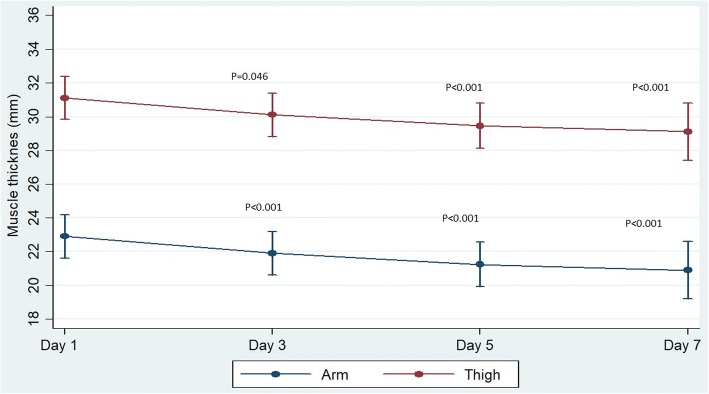
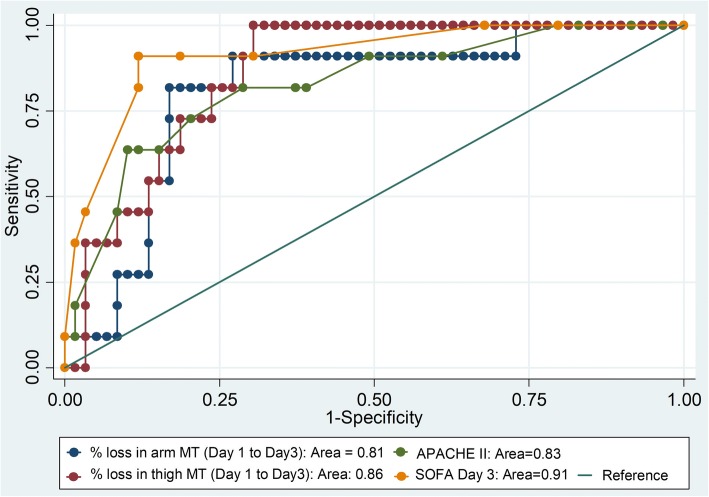
The muscle thickness (mean ± SD) at the level of the mid-arm and mid-thigh on day 1 was 23.13 ± 4.83 mm and 31.21 ± 8.56 mm, respectively. The percentage muscle thickness [median (min, max)] decline at the mid-arm and mid-thigh was 7.61 (- 1.51, 32.05)% and 10.62 (- 1.48, 32.06)%, respectively on day 7 as compared to baseline ( < 0.001). The decline in muscle thickness at the mid-arm and mid-thigh were higher among non-survivors compared to survivors at all time points. Also, the decline in muscle thickness was significantly higher among patients with worse outcome at day 90. Patients with ICU-acquired weakness also had significantly higher decline in muscle thickness ( < 0.05). Early decline (from day 1 to day 3) in muscle thickness was associated with in-hospital mortality. The probability of death by day 14 was higher for patients who had early decline (from day 1 to day 3) in muscle thickness of ≥ 6.59% and ≥ 5.20% at the mid-arm [HR 7.3 (95% CI 1.5, 34.2)] and the mid-thigh [HR 8.1 (95% CI 1.7, 37.9)], respectively. Decline in thickness from day 1 to day 3 was a good predictor of in-hospital mortality with area under the curve (AUC) of 0.81 and 0.86 for arm and thigh muscles, respectively.
Critically ill patients with sepsis exhibit a gradual decline in muscle thickness of both the arm and thigh. Decline in muscle thickness was associated with in-hospital mortality. USG has a potential to identify patients at risk of worse in-hospital and post-discharge outcomes.
关于重症患者超声检查(USG)中肌肉流失趋势及其与各种预后关系的数据有限。本研究旨在描述手臂和大腿肌肉厚度的流失趋势(使用USG评估),并确定肌肉厚度流失与住院期间及出院后预后之间的关系。
在第1、3、5、7、10和14天,使用床边超声对70例脓毒症患者的上臂中部和大腿中部水平的肌肉厚度进行测量,然后每周测量直至出院或死亡。患者出院后随访90天。
第1天上臂中部和大腿中部水平的肌肉厚度(均值±标准差)分别为23.13±4.83mm和31.21±8.56mm。与基线相比,第7天时上臂中部和大腿中部的肌肉厚度百分比[中位数(最小值,最大值)]下降分别为7.61(-1.51,32.05)%和10.62(-1.48,32.06)%(<0.001)。在所有时间点,非幸存者的上臂中部和大腿中部肌肉厚度下降均高于幸存者。此外,在第90天时,预后较差的患者肌肉厚度下降明显更高。患有ICU获得性肌无力的患者肌肉厚度下降也明显更高(<0.05)。肌肉厚度早期下降(从第1天到第3天)与住院死亡率相关。上臂中部肌肉厚度早期下降(从第1天到第3天)≥6.59%和大腿中部≥5.20%的患者在第14天时死亡概率更高,上臂中部[风险比(HR)7.3(95%置信区间1.5,34.2)],大腿中部[HR 8.1(95%置信区间1.7,37.9)]。从第1天到第3天的厚度下降是住院死亡率的良好预测指标,上臂和大腿肌肉的曲线下面积(AUC)分别为0.81和0.86。
重症脓毒症患者的上臂和大腿肌肉厚度均呈逐渐下降趋势。肌肉厚度下降与住院死亡率相关。超声检查有潜力识别住院期间及出院后预后较差风险的患者。