Mogilski Justin K, Welling Lisa L M
Department of Psychology, University of South Carolina Salkehatchie, Walterboro, SC, United States.
Department of Psychology, Oakland University, Rochester, MI, United States.
Front Psychol. 2018 Dec 5;9:2428. doi: 10.3389/fpsyg.2018.02428. eCollection 2018.
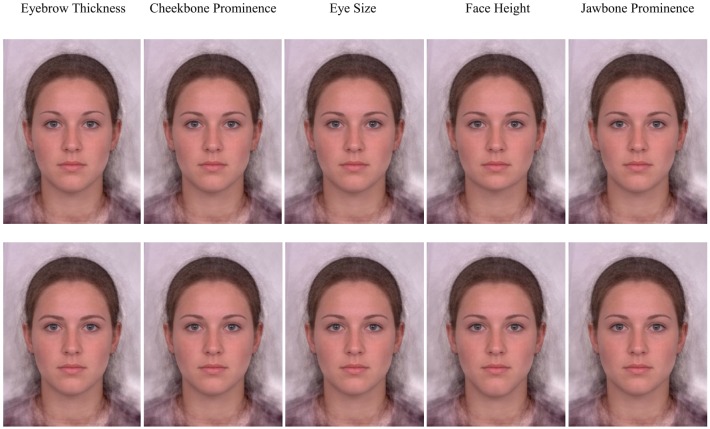
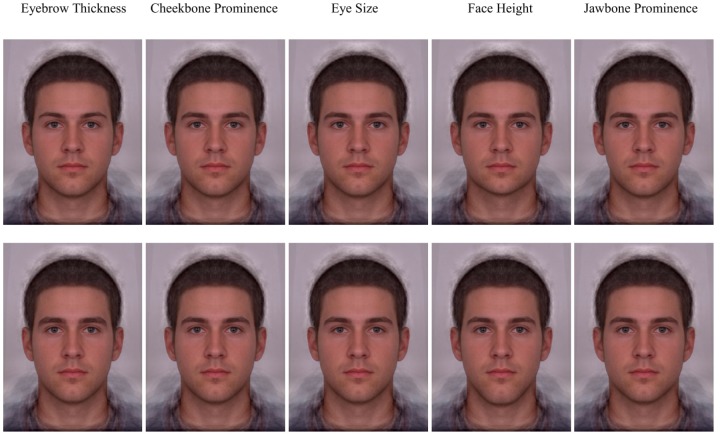
Recent work demonstrates the methodological rigor of a type of data-driven analysis (i.e., conjoint analysis; CA), which accounts for the relative contribution of different facial morphological cues to interpersonal perceptions of romantic partner quality. This study extends this literature by using a conjoint face ranking task to predict the relative contribution of five sexually dimorphic facial shape features (jawbone and cheekbone prominence, eyebrow thickness, eye size, face length) to participants' ( = 922) perceptions of facial attractiveness and sex-typicality (i.e., masculinity/femininity). For overall partner attractiveness, eyebrow thickness and jawbone prominence were relatively more salient than cheekbone prominence and eye size. Interestingly, masculinized (i.e., thicker) eyebrows were marginally more attractive for female than male faces, particularly within a long-term mating context. Masculinized jawbone prominence was more attractive for male than female faces, and feminized jawbone prominence was more attractive for female than male faces. For perceptions of masculinity, eyebrow thickness, jawbone prominence, and facial height were relatively more salient than cheekbone prominence and eye size, although facial height was more important for female than male faces, and jawbone prominence was marginally more important for male than female faces. These findings highlight the prominence of eyebrows, the jawline, and facial height during perception of facial attractiveness and masculinity - though it should be noted that many of these differences were small to moderate in effect size. Findings are interpreted in the context of prior research, and future directions for studying why these facial traits exhibit superior signaling capacity are discussed.
近期的研究工作证明了一种数据驱动分析方法(即联合分析;CA)的方法严谨性,该方法解释了不同面部形态线索对浪漫伴侣质量人际感知的相对贡献。本研究通过使用联合面部排名任务来扩展这一文献,以预测五种两性异形面部形状特征(颌骨和颧骨突出度、眉毛厚度、眼睛大小、面部长度)对参与者(=922)对面部吸引力和性别典型性(即男性气质/女性气质)的感知的相对贡献。对于整体伴侣吸引力而言,眉毛厚度和颌骨突出度比颧骨突出度和眼睛大小相对更显著。有趣的是,男性化(即更厚)的眉毛对女性面孔比男性面孔略微更具吸引力,特别是在长期交配背景下。男性化的颌骨突出度对男性面孔比女性面孔更具吸引力,而女性化的颌骨突出度对女性面孔比男性面孔更具吸引力。对于男性气质的感知,眉毛厚度、颌骨突出度和面部高度比颧骨突出度和眼睛大小相对更显著,尽管面部高度对女性面孔比男性面孔更重要,而颌骨突出度对男性面孔比女性面孔略微更重要。这些发现突出了眉毛、下颌线和面部高度在面部吸引力和男性气质感知过程中的突出作用——不过应该注意的是,这些差异中的许多在效应大小上较小到中等。研究结果在先前研究的背景下进行了解释,并讨论了研究这些面部特征为何表现出卓越信号传递能力的未来方向。