Sommers-Spijkerman Marion, Trompetter Hester, Schreurs Karlein, Bohlmeijer Ernst
Centre for eHealth and Well-being Research, Department of Psychology, Health and Technology, University of Twente, Enschede, Netherlands.
Center of Research on Psychological and Somatic Disorders, Department of Medical and Clinical Psychology, Tilburg University, Tilburg, Netherlands.
Front Psychol. 2018 Dec 5;9:2442. doi: 10.3389/fpsyg.2018.02442. eCollection 2018.
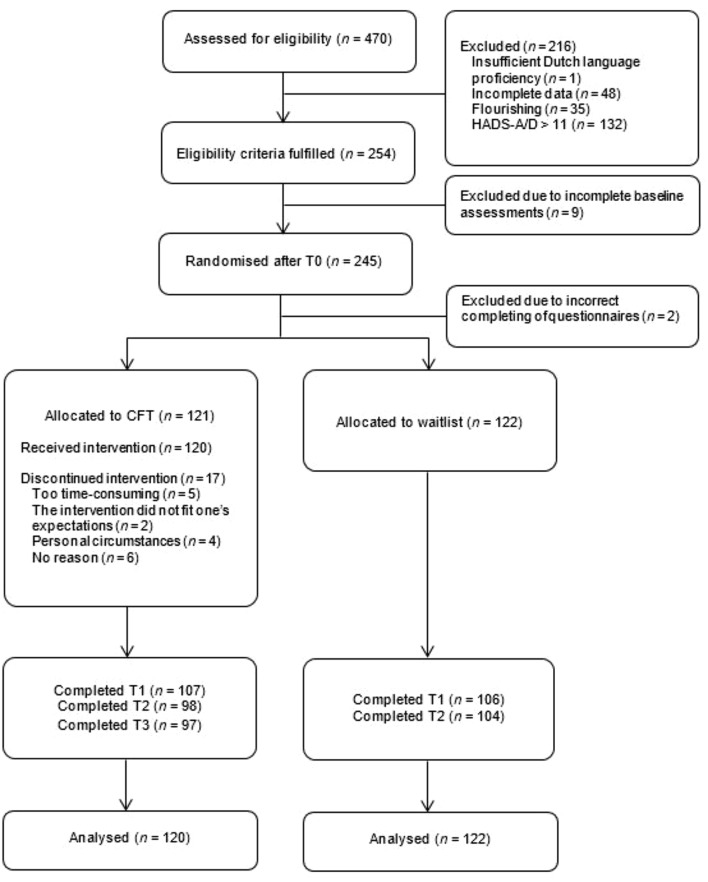
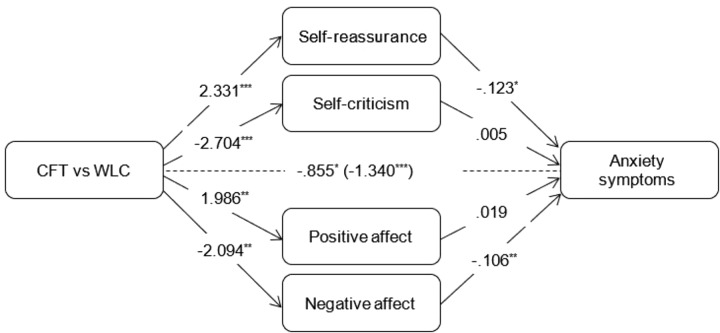
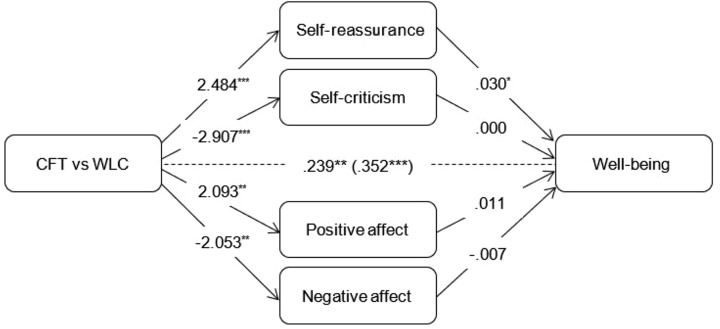
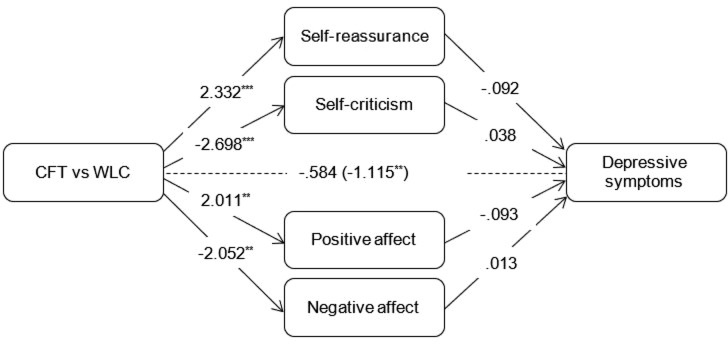
The working mechanisms of compassion-focused therapy (CFT) remain understudied. Drawing on the theoretical model underlying CFT, we examined four putative working mechanisms - self-reassurance, self-criticism, positive/negative affect - in relation to changes in well-being and psychological distress. Data of a waitlist randomised controlled trial ( = 242) investigating the effectiveness of a self-help CFT-intervention in a non-clinical sample were analysed. Using single and multiple mediation models, we assessed if changes in self-reassurance, self-criticism and positive/negative affect during the intervention (3-month interval) mediated changes in well-being and depressive/anxiety symptoms from baseline to follow-up (6-month interval) compared to the waitlist condition. For each outcome, single analyses revealed that the effects of CFT were significantly mediated by self-reassurance and self-criticism. The mediating role of affect differed across outcomes. In combined models, self-reassurance emerged as a significant mediator for well-being and anxiety symptoms. Additionally, positive and negative affect were found significant mediators of the effects on depressive and anxiety symptoms, respectively. This study provides preliminary empirical evidence that CFT operates through cultivating self-reassurance, reducing self-criticism and regulating positive and negative affect in a non-clinical sample. To advance the development of CFT, further exploration of therapeutic change processes and their interplay is needed.
以慈悲为中心的疗法(CFT)的作用机制仍未得到充分研究。基于CFT的理论模型,我们研究了四种假定的作用机制——自我安慰、自我批评、积极/消极情绪——与幸福感和心理困扰变化的关系。分析了一项等待名单随机对照试验(n = 242)的数据,该试验在非临床样本中研究了自助式CFT干预的有效性。使用单中介和多中介模型,我们评估了与等待名单条件相比,干预期间(3个月间隔)自我安慰、自我批评和积极/消极情绪的变化是否介导了从基线到随访(6个月间隔)的幸福感和抑郁/焦虑症状的变化。对于每个结果,单因素分析表明,CFT的效果显著由自我安慰和自我批评介导。情绪的中介作用因结果而异。在综合模型中,自我安慰成为幸福感和焦虑症状的显著中介因素。此外,积极情绪和消极情绪分别被发现是对抑郁和焦虑症状影响的显著中介因素。本研究提供了初步的实证证据,表明CFT通过在非临床样本中培养自我安慰、减少自我批评和调节积极情绪与消极情绪来发挥作用。为了推进CFT的发展,需要进一步探索治疗变化过程及其相互作用。