• 文献检索
  • 文档翻译
  • 深度研究
  • 学术资讯
  • Suppr Zotero 插件Zotero 插件
  • 邀请有礼
  • 套餐&价格
  • 历史记录
应用&插件
Suppr Zotero 插件Zotero 插件浏览器插件Mac 客户端Windows 客户端微信小程序
定价
高级版会员购买积分包购买API积分包
服务
文献检索文档翻译深度研究API 文档MCP 服务
关于我们
关于 Suppr公司介绍联系我们用户协议隐私条款
关注我们

Suppr 超能文献

核心技术专利:CN118964589B侵权必究
粤ICP备2023148730 号-1Suppr @ 2026

文献检索

告别复杂PubMed语法,用中文像聊天一样搜索,搜遍4000万医学文献。AI智能推荐,让科研检索更轻松。

立即免费搜索

文件翻译

保留排版,准确专业,支持PDF/Word/PPT等文件格式,支持 12+语言互译。

免费翻译文档

深度研究

AI帮你快速写综述,25分钟生成高质量综述,智能提取关键信息,辅助科研写作。

立即免费体验

自身免疫性脑炎患者需 ICU 治疗的管理和预后标志物。

Management and prognostic markers in patients with autoimmune encephalitis requiring ICU treatment.

机构信息

Hans-Berger-Department of Neurology (J.S., D.B., C.G., O.W.W., A.G.), Jena University Hospital; Department of Neurology (H.B.H., S.T.G.), University Hospital Erlangen; Department of Neurology and Neurophysiology (H.F), University Hospital Freiburg; Department of Neurology (N.M., A.D.), University Hospital Münster; Department of Neurology (H.P., L.-T.L), Charité University Medicine Berlin; Department of Neurology (K.F.), Bezirksklinikum Regensburg; Neuroimmunology Section (F.L., G.N.), Institute of Clinical Chemistry and Department of Neurology, University Hospital Schleswig-Holstein, Kiel; Department of Neurology (I.S.), University Hospital Giessen; Center for Neurology and Psychiatrics (C.D.), University Hospital Köln; Department of Neurology (J.B.), University Hospital Heidelberg; Department of Neurology (J.B.), Klinikum Kassel; Department of Neurology (J.L.), University Hospital Ulm; Institute of Clinical Neuroimmunology (F.T.), Ludwig-Maximillians-University München; Department of Neurology (A.K.), Martha Maria Hospital Halle; Department of Neurology (A.J.), Dortmund Hospital; Department of Neurology (M.R.), Medical Faculty, Heinrich Heine University Düsseldorf; Department of Neurology (K.-W.S.), University Hospital Hannover; Department of Neurology (C.U.), Hospital Ludwigshafen; Institute of Medical Statistics, Computer and Data Sciences (A.S), Jena University Hospital; and Center for Sepsis Control and Care (A.S., C.G.), Jena University Hospital, Germany.

出版信息

Neurol Neuroimmunol Neuroinflamm. 2018 Oct 30;6(1):e514. doi: 10.1212/NXI.0000000000000514. eCollection 2019 Jan.

DOI:10.1212/NXI.0000000000000514
PMID:30568992
原文链接:https://pmc.ncbi.nlm.nih.gov/articles/PMC6278855/
Abstract

OBJECTIVE

To assess intensive care unit (ICU) complications, their management, and prognostic factors associated with outcomes in a cohort of patients with autoimmune encephalitis (AE).

METHODS

This study was an observational multicenter registry of consecutively included patients diagnosed with AE requiring Neuro-ICU treatment between 2004 and 2016 from 18 tertiary hospitals. Logistic regression models explored the influence of complications, their management, and diagnostic findings on the dichotomized (0-3 vs 4-6) modified Rankin Scale score at hospital discharge.

RESULTS

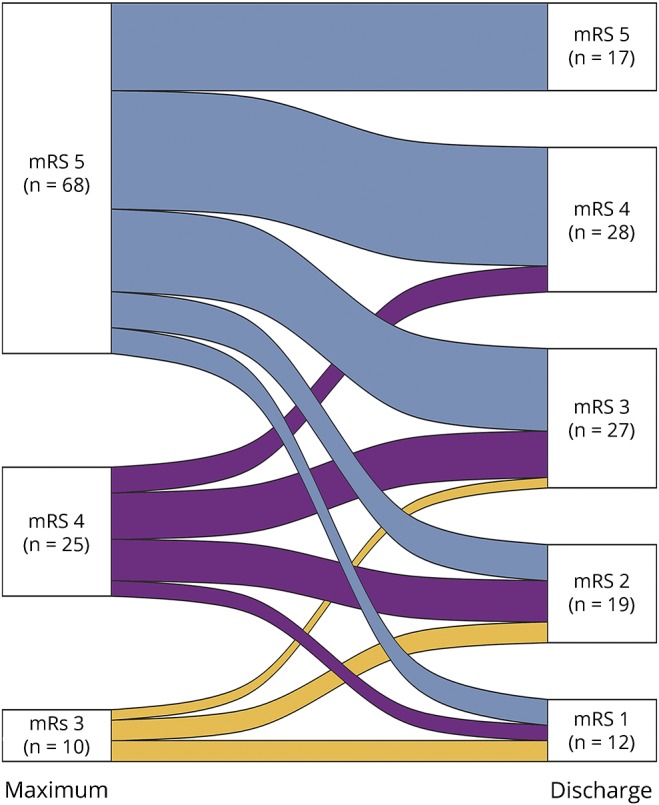
Of 120 patients with AE (median age 43 years [interquartile range 24-62]; 70 females), 101 developed disorders of consciousness, 54 autonomic disturbances, 42 status epilepticus, and 39 severe sepsis. Sixty-eight patients were mechanically ventilated, 85 patients had detectable neuronal autoantibodies, and 35 patients were seronegative. Worse neurologic outcome at hospital discharge was associated with necessity of mechanical ventilation (sex- and age-adjusted OR 6.28; 95% CI, 2.71-15.61) tracheostomy (adjusted OR 6.26; 95% CI, 2.68-15.73), tumor (adjusted OR 3.73; 95% CI, 1.35-11.57), sepsis (adjusted OR 4.54; 95% CI, 1.99-10.43), or autonomic dysfunction (adjusted OR 2.91; 95% CI, 1.24-7.3). No significant association was observed with autoantibody type, inflammatory changes in CSF, or pathologic MRI.

CONCLUSION

In patients with AE, mechanical ventilation, sepsis, and autonomic dysregulation appear to indicate longer or incomplete convalescence. Classic ICU complications better serve as prognostic markers than the individual subtype of AE. Increased awareness and effective management of these AE-related complications are warranted, and further prospective studies are needed to confirm our findings and to develop specific strategies for outcome improvement.

摘要

目的

评估重症监护病房(ICU)并发症、管理及其与预后相关的因素,以此分析自身免疫性脑炎(AE)患者队列的结局。

方法

本研究是一项观察性、多中心登记研究,连续纳入了 2004 年至 2016 年期间,18 家三级医院收治的需要神经重症监护治疗的自身免疫性脑炎患者。使用逻辑回归模型探讨并发症、管理及其诊断发现对出院时(0-3 分与 4-6 分)改良 Rankin 量表评分的影响。

结果

120 例 AE 患者(中位年龄 43 岁[四分位间距 24-62];70 例女性)中,101 例出现意识障碍,54 例出现自主神经功能障碍,42 例癫痫发作,39 例严重脓毒症。68 例患者需要机械通气,85 例患者可检测到神经元自身抗体,35 例患者为血清阴性。出院时神经功能结局较差与机械通气(校正后 OR 6.28;95%CI,2.71-15.61)、气管切开(校正后 OR 6.26;95%CI,2.68-15.73)、肿瘤(校正后 OR 3.73;95%CI,1.35-11.57)、脓毒症(校正后 OR 4.54;95%CI,1.99-10.43)或自主神经功能障碍(校正后 OR 2.91;95%CI,1.24-7.3)有关。未观察到自身抗体类型、CSF 炎症改变或病理性 MRI 与结局之间存在显著相关性。

结论

在 AE 患者中,机械通气、脓毒症和自主神经功能障碍似乎表明康复时间更长或不完整。经典 ICU 并发症比 AE 的特定亚型更能作为预后标志物。需要提高对这些 AE 相关并发症的认识并进行有效管理,还需要进一步的前瞻性研究来证实我们的发现,并制定改善结局的具体策略。
https://cdn.ncbi.nlm.nih.gov/pmc/blobs/56bc/6278855/456eb4c85556/NEURIMMINFL2018017582f1.jpg

相似文献

1
Management and prognostic markers in patients with autoimmune encephalitis requiring ICU treatment.自身免疫性脑炎患者需 ICU 治疗的管理和预后标志物。
Neurol Neuroimmunol Neuroinflamm. 2018 Oct 30;6(1):e514. doi: 10.1212/NXI.0000000000000514. eCollection 2019 Jan.
2
[Autoimmune encephalitis-Challenges and management in intensive medical care].[自身免疫性脑炎——重症医疗中的挑战与管理]
Nervenarzt. 2023 Feb;94(2):113-119. doi: 10.1007/s00115-022-01423-x. Epub 2023 Jan 18.
3
Clinical characteristics and outcomes of patients with antibody-related autoimmune encephalitis presenting with disorders of consciousness: A prospective cohort study.抗体相关自身免疫性脑炎伴意识障碍患者的临床特征和转归:一项前瞻性队列研究。
Immun Inflamm Dis. 2024 Sep;12(9):e70019. doi: 10.1002/iid3.70019.
4
[Intensive care aspects of autoimmune encephalitis].[自身免疫性脑炎的重症监护要点]
Med Klin Intensivmed Notfmed. 2019 Oct;114(7):620-627. doi: 10.1007/s00063-019-0604-5. Epub 2019 Aug 27.
5
Autoimmune encephalitis: A costly condition.自身免疫性脑炎:一种代价高昂的病症。
Neurology. 2019 Feb 26;92(9):e964-e972. doi: 10.1212/WNL.0000000000006990. Epub 2019 Jan 23.
6
Peripheral Immune Cell Ratios and Clinical Outcomes in Seropositive Autoimmune Encephalitis: A Study by the Australian Autoimmune Encephalitis Consortium.外周免疫细胞比值与血清阳性自身免疫性脑炎的临床结局:澳大利亚自身免疫性脑炎联盟的一项研究。
Front Immunol. 2021 Jan 14;11:597858. doi: 10.3389/fimmu.2020.597858. eCollection 2020.
7
Study on clinical features and factors related to long-term outcomes of antibody-negative autoimmune encephalitis.抗体阴性自身免疫性脑炎的临床特征及与长期预后相关因素的研究。
Ann Clin Transl Neurol. 2024 May;11(5):1325-1337. doi: 10.1002/acn3.52049. Epub 2024 Apr 21.
8
Glioblastoma as differential diagnosis of autoimmune encephalitis.胶质母细胞瘤作为自身免疫性脑炎的鉴别诊断。
J Neurol. 2018 Mar;265(3):669-677. doi: 10.1007/s00415-018-8767-1. Epub 2018 Jan 30.
9
Analysis of Clinical Characteristics and Poor Prognostic Predictors in Patients With an Initial Diagnosis of Autoimmune Encephalitis.自身免疫性脑炎初始诊断患者的临床特征分析及不良预后预测指标
Front Immunol. 2019 Jun 7;10:1286. doi: 10.3389/fimmu.2019.01286. eCollection 2019.
10
Autoimmune encephalitis in a tertiary hospital in the Philippines.菲律宾一家三级医院的自身免疫性脑炎。
J Clin Neurosci. 2021 Aug;90:191-198. doi: 10.1016/j.jocn.2021.05.052. Epub 2021 Jun 10.

引用本文的文献

1
Clinical Features and Outcomes in Adult Patients with Autoimmune Encephalitis Requiring Intensive Care: A Retrospective Cohort Study.需要重症监护的自身免疫性脑炎成年患者的临床特征与转归:一项回顾性队列研究
Neurocrit Care. 2025 Sep 16. doi: 10.1007/s12028-025-02374-2.
2
Autoimmune encephalitis.自身免疫性脑炎
Nat Rev Dis Primers. 2025 Sep 11;11(1):65. doi: 10.1038/s41572-025-00650-1.
3
Bickerstaff encephalitis: a comprehensive narrative review of pathophysiology, clinical features, and global health considerations.比克斯特费尔德脑炎:病理生理学、临床特征及全球健康考量的全面叙述性综述

本文引用的文献

1
Metabolic topography of autoimmune non-paraneoplastic encephalitis.自身免疫性非副肿瘤性脑炎的代谢地形图
Neuroradiology. 2018 Feb;60(2):189-198. doi: 10.1007/s00234-017-1956-2. Epub 2017 Dec 18.
2
Risk Factors for Intensive Care Unit Admission in Patients with Autoimmune Encephalitis.自身免疫性脑炎患者入住重症监护病房的危险因素
Front Immunol. 2017 Jul 28;8:835. doi: 10.3389/fimmu.2017.00835. eCollection 2017.
3
Autoantibodies to Synaptic Receptors and Neuronal Cell Surface Proteins in Autoimmune Diseases of the Central Nervous System.
Ann Med Surg (Lond). 2025 Jul 16;87(8):5122-5131. doi: 10.1097/MS9.0000000000003587. eCollection 2025 Aug.
4
Comorbidities and Their Influence on Outcomes and Infectious Complications in Autoimmune Encephalitis: A Multicenter Cohort Study.自身免疫性脑炎的合并症及其对结局和感染并发症的影响:一项多中心队列研究
Neurol Neuroimmunol Neuroinflamm. 2025 Sep;12(5):e200434. doi: 10.1212/NXI.0000000000200434. Epub 2025 Jul 7.
5
Clinical spectrum and long-term outcomes of antibody-negative severe autoimmune encephalitis: a retrospective study.抗体阴性的严重自身免疫性脑炎的临床谱及长期预后:一项回顾性研究。
Front Immunol. 2025 May 15;16:1591771. doi: 10.3389/fimmu.2025.1591771. eCollection 2025.
6
Clinical Description and Acute Outcomes of Cryptogenic Encephalitis in the Intensive Care Unit.重症监护病房中隐源性脑炎的临床描述及急性转归
Neurocrit Care. 2025 May 29. doi: 10.1007/s12028-025-02287-0.
7
Predicting intrathecal immunoglobulin synthesis in the ICU: a comparative study of IgG-based indexes.预测重症监护病房中的鞘内免疫球蛋白合成:基于IgG指标的比较研究
Ann Intensive Care. 2025 Apr 30;15(1):60. doi: 10.1186/s13613-025-01475-7.
8
Prediction model for severe autoimmune encephalitis: a tool for risk assessment and individualized treatment guidance.重症自身免疫性脑炎的预测模型:一种风险评估及个体化治疗指导工具
Front Neurol. 2025 Mar 18;16:1575835. doi: 10.3389/fneur.2025.1575835. eCollection 2025.
9
Management of severe acute encephalopathy in the ICU: an expert consensus statement from the french society of intensive care medicine.重症监护病房中严重急性脑病的管理:法国重症医学学会专家共识声明
Ann Intensive Care. 2025 Mar 21;15(1):37. doi: 10.1186/s13613-025-01436-0.
10
Anti-metabotropic glutamate receptor 5 coexistent anti-N-methyl-D-aspartate receptor encephalitis: a case report and literature review.抗代谢型谷氨酸受体5共存抗N-甲基-D-天冬氨酸受体脑炎:一例报告及文献复习
Front Immunol. 2025 Feb 14;16:1436246. doi: 10.3389/fimmu.2025.1436246. eCollection 2025.
中枢神经系统自身免疫性疾病中针对突触受体和神经元细胞表面蛋白的自身抗体。
Physiol Rev. 2017 Apr;97(2):839-887. doi: 10.1152/physrev.00010.2016.
4
Ovarian teratoma development after anti-NMDA receptor encephalitis treatment.抗N-甲基-D-天冬氨酸受体脑炎治疗后的卵巢畸胎瘤发育
Brain Dev. 2017 May;39(5):448-451. doi: 10.1016/j.braindev.2016.12.003. Epub 2016 Dec 28.
5
Risk factors for mortality in patients with anti-NMDA receptor encephalitis.抗N-甲基-D-天冬氨酸受体脑炎患者的死亡危险因素。
Acta Neurol Scand. 2017 Oct;136(4):298-304. doi: 10.1111/ane.12723. Epub 2016 Dec 27.
6
Autoimmune Encephalitis at the Neurological Intensive Care Unit: Etiologies, Reasons for Admission and Survival.神经重症监护病房中的自身免疫性脑炎:病因、入院原因及生存率
Neurocrit Care. 2017 Aug;27(1):82-89. doi: 10.1007/s12028-016-0370-7.
7
Incidence of severe sepsis and septic shock in German intensive care units: the prospective, multicentre INSEP study.德国重症监护病房严重脓毒症和脓毒性休克的发生率:前瞻性、多中心 INSEP 研究。
Intensive Care Med. 2016 Dec;42(12):1980-1989. doi: 10.1007/s00134-016-4504-3. Epub 2016 Sep 29.
8
Anti-N-methyl-D-aspartate receptor encephalitis: a common cause of encephalitis in the intensive care unit.抗N-甲基-D-天冬氨酸受体脑炎:重症监护病房脑炎的常见病因。
Neurol Sci. 2016 Dec;37(12):1993-1998. doi: 10.1007/s10072-016-2702-y. Epub 2016 Sep 12.
9
Anti-N-Methyl-d-Aspartate Receptor Encephalitis in Adult Patients Requiring Intensive Care.抗 N-甲基-D-天冬氨酸受体脑炎患者的重症监护。
Am J Respir Crit Care Med. 2017 Feb 15;195(4):491-499. doi: 10.1164/rccm.201603-0507OC.
10
A clinical approach to diagnosis of autoimmune encephalitis.自身免疫性脑炎的临床诊断方法
Lancet Neurol. 2016 Apr;15(4):391-404. doi: 10.1016/S1474-4422(15)00401-9. Epub 2016 Feb 20.