Houtepen Lotte C, Heron Jon, Suderman Matthew J, Tilling Kate, Howe Laura D
MRC Integrative Epidemiology Unit, University of Bristol, Bristol, BS8 2BN, UK.
Wellcome Open Res. 2018 Aug 30;3:106. doi: 10.12688/wellcomeopenres.14716.1. eCollection 2018.
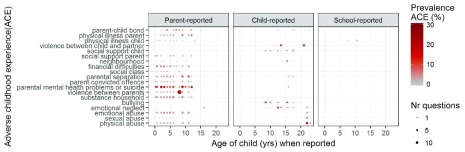
Exposure to adverse childhood experiences (ACEs) is a risk factor for poor later life health. Here, we describe the ACE variables measured in the children of the Avon Longitudinal Study of Parents and Children (ALSPAC) study, and a method used to derive summary measures and deal with missing data in them. The ALSPAC data catalogue (59 608 variables) was searched in September 2017 for measures on adversity exposure between birth and 18 years. 6140 adversity questions were then screened for conforming to our ACE definitions and suitability for dichotomisation. This screening identified 541 questions on ten 'classic' ACEs (sexual, physical or emotional abuse, emotional neglect, substance abuse by the parents, parental mental illness or suicide attempt, violence between parents, parental separation, bullying and parental criminal conviction) and nine additional ACEs (bond between parent and child, satisfaction with neighbourhood, social support for the parent, social support for the child, physical illness of a parent, physical illness of the child, financial difficulties, low social class and violence between child and partner). These were used to derive a binary construct for exposure to each ACE. Finally, as cumulative measures of childhood adversity, different combinations of the 19 ACE constructs were summed to give total adversity scores. An appropriate strategy for multiple imputation was developed to deal with the complex patterns of missing data. The ACE constructs and ACE-scores for exposure between birth and 16 years had prevalence estimates that were comparable to previous reports (for instance 4% sexual abuse, 18% physical abuse, 25% bullied, 32% parental separation). ACE constructs, derived using a pragmatic approach to handle the high dimensional ALSPAC data, can be used in future analyses on childhood adversity in ALSPAC children.
童年不良经历(ACEs)是日后健康状况不佳的一个风险因素。在此,我们描述了在阿冯纵向父母与儿童研究(ALSPAC)中对儿童测量的ACE变量,以及一种用于得出汇总指标并处理其中缺失数据的方法。2017年9月,我们在ALSPAC数据目录(59608个变量)中搜索了出生至18岁期间的逆境暴露测量指标。然后,对6140个逆境问题进行筛选,看其是否符合我们的ACE定义以及是否适合进行二分法处理。此次筛选确定了关于10种“经典”ACEs(性虐待、身体虐待或情感虐待、情感忽视、父母滥用药物、父母精神疾病或自杀未遂、父母间暴力、父母分居、欺凌和父母刑事定罪)以及9种额外ACEs(亲子关系、对邻里的满意度、对父母的社会支持、对儿童的社会支持、父母身体疾病、儿童身体疾病、经济困难、社会阶层低以及儿童与伴侣间暴力)的541个问题。这些问题被用于得出每个ACE暴露的二元结构。最后,作为童年逆境的累积指标,将19种ACE结构的不同组合相加得出总逆境得分。我们制定了一种合适的多重插补策略来处理复杂的缺失数据模式。出生至16岁期间暴露的ACE结构和ACE得分的患病率估计与先前报告相当(例如,4%遭受性虐待,18%遭受身体虐待,25%受欺凌,32%父母分居)。使用实用方法处理高维度ALSPAC数据得出的ACE结构可用于未来对ALSPAC儿童童年逆境的分析。