University College London, UK.
University of Bristol, UK.
J Interpers Violence. 2022 Mar;37(5-6):2218-2241. doi: 10.1177/0886260520935096. Epub 2020 Jul 8.
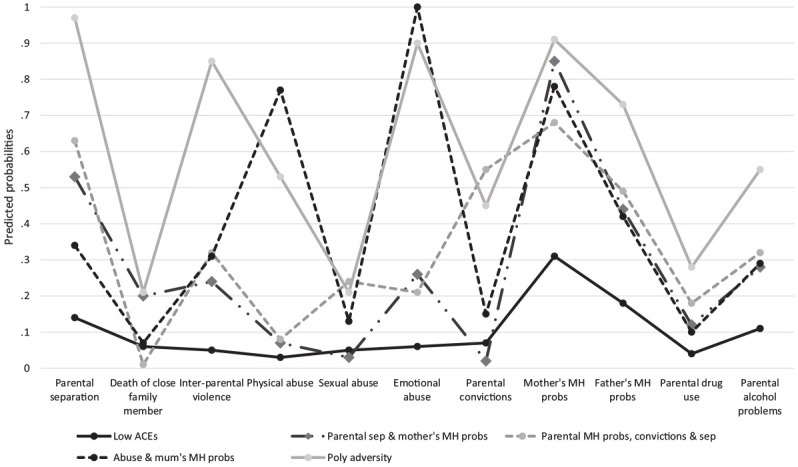
Previous research has demonstrated a graded relationship between the number of Adverse Childhood Experiences reported (an ACE score) and child outcomes. However, ACE scores lack specificity and ignore the patterning of adversities, which are informative for interventions. The aim of the present study was to explore the clustering of ACEs and whether this clustering differs by gender or is predicted by poverty. Data on 8,572 participants of the Avon Longitudinal Study of Parents and Children (ALSPAC) were used. ALSPAC is a regionally representative prenatal cohort of children born between 1991 and 1992 in the Avon region of South-West England. ACEs included parental divorce, death of a close family member, interparental violence, parental mental health problems, parental alcohol misuse, parental drug use, parental convictions, and sexual, emotional, and physical abuse, between birth and 19 years. Latent class analysis was used to derive ACE clusters and associations between poverty, gender, and the derived classes tested using multinomial logistic regression. Five latent classes were identified: "Low ACEs" (55%), "Parental separation and mother's mental health problems" (18%), "Parental mental health problems, convictions and separation" (15%), "Abuse and mental health problems" (6%), and "Poly adversity" (6%). Death of a close family member and sexual abuse did not cluster with other adversities. The clustering did not differ by gender. Poverty was strongly related to both individual ACEs and clusters. These findings demonstrate that ACEs cluster in specific patterns and that poverty is strongly related to this. Therefore, reducing child poverty might be one strategy for reducing ACEs.
先前的研究表明,报告的不良童年经历(ACE 得分)数量与儿童的结果之间存在等级关系。然而,ACE 得分缺乏特异性,忽略了逆境的模式,而这些模式对于干预措施是有意义的。本研究的目的是探讨 ACE 的聚类情况,以及这种聚类是否因性别而异,或者是否可以通过贫困情况来预测。本研究使用了 8572 名阿冯纵向父母和儿童研究(ALSPAC)参与者的数据。ALSPAC 是一个区域代表性的产前队列,研究对象为 1991 年至 1992 年期间在英格兰西南部阿冯地区出生的儿童。ACE 包括父母离婚、近亲死亡、父母间暴力、父母心理健康问题、父母酗酒、父母吸毒、父母犯罪以及性、情感和身体虐待,发生在出生至 19 岁期间。采用潜在类别分析来推导 ACE 聚类,并使用多项逻辑回归检验贫困、性别与推导类别的关联。确定了五个潜在类别:“低 ACE 类”(55%)、“父母离异和母亲心理健康问题”(18%)、“父母心理健康问题、犯罪和离异”(15%)、“虐待和心理健康问题”(6%)和“多逆境”(6%)。近亲死亡和性虐待没有与其他逆境聚类。聚类在性别上没有差异。贫困与个体 ACE 和聚类都有很强的关系。这些发现表明 ACE 以特定的模式聚类,而贫困与 ACE 密切相关。因此,减少儿童贫困可能是减少 ACE 的一种策略。