McAdam Kevin, Enos Trevor, Goss Carol, Kimpton Harriet, Faizi Arif, Edwards Steve, Wright Christopher, Porter Andrew, Rodu Brad
Group Research & Development, British American Tobacco, Regents Park Road, Southampton, SO15 8TL, UK.
, 3810 St. Antoine W, Montreal, QC, H4C 1B4, Canada.
Chem Cent J. 2018 Dec 20;12(1):142. doi: 10.1186/s13065-018-0506-2.
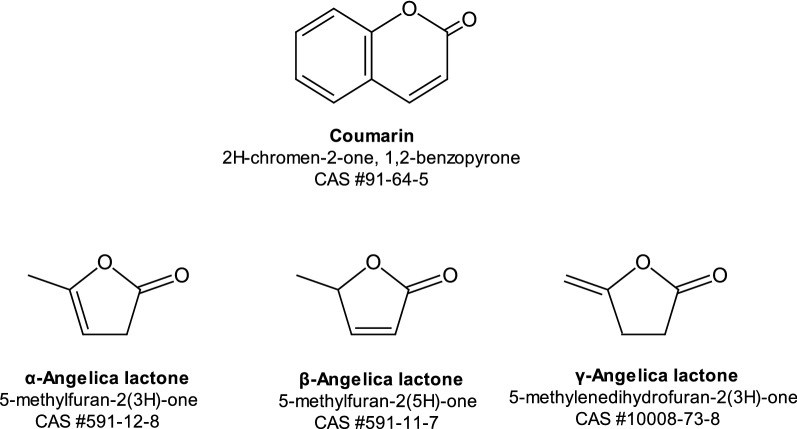
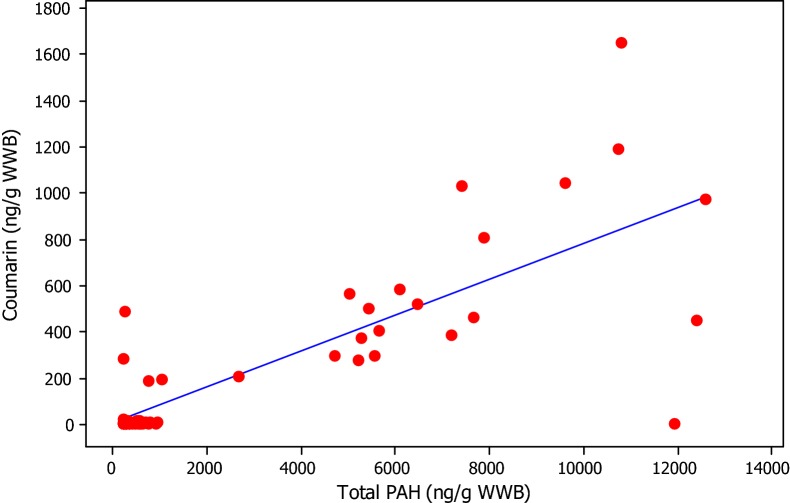
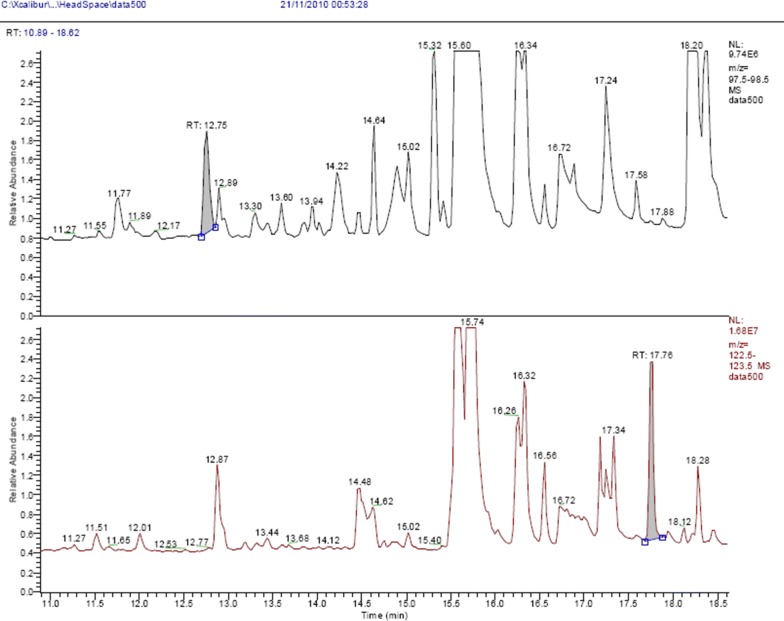
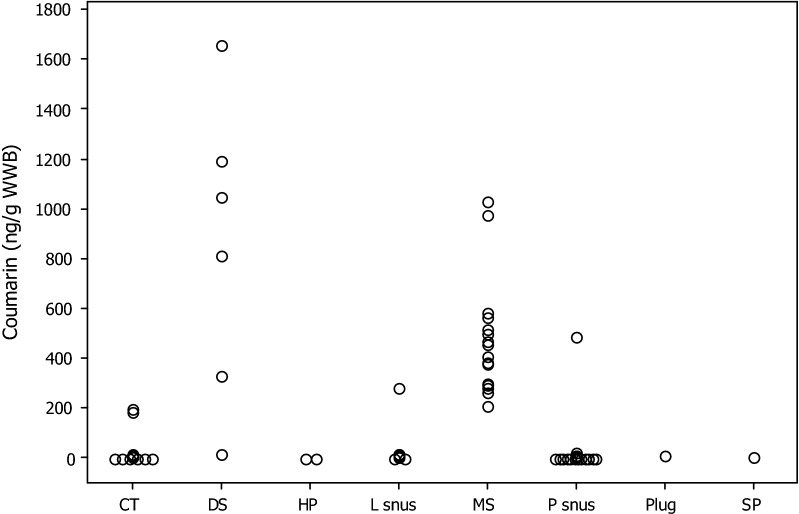
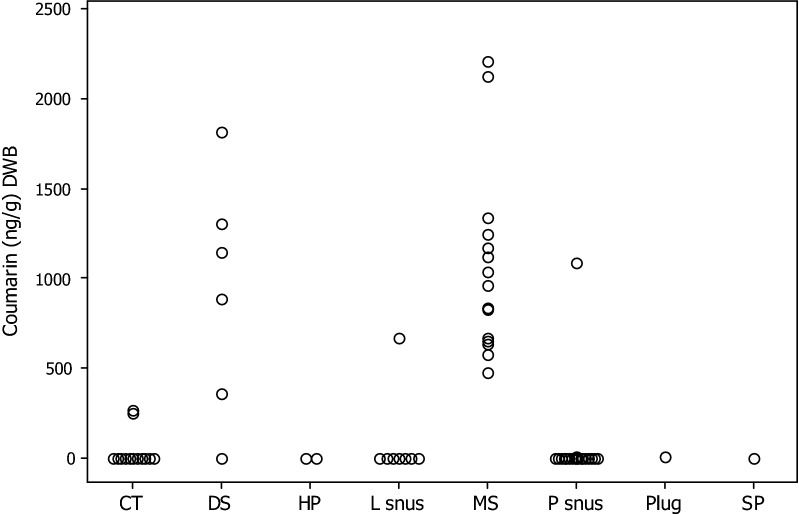
Differences in health risks between different styles of smokeless tobacco products (STPs) have prompted interest in their relative levels of toxic chemicals. We report here the development of methods for the analysis of STPs for coumarin and for α-angelica lactone (α-AL), both of which have been included in various published lists of tobacco toxicants. We have also determined the concentrations of these lactones in commercial STPs from the US and Sweden, representing 80-90% of the 2010 market share for all the major STP categories in these two countries: 65 products (plus two reference products) for coumarin and 66 commercial products for α-AL. For coumarin, methanol extracts of the STPs were analysed by HPLC/MS/MS. The lower limit of quantification (LOQ) and limit of detection (LOD) were, respectively, 100 and 30 ng coumarin/g of STP on a wet weight basis (WWB). Alpha-AL was determined via direct headspace GC/MS. The LOQ and LOD were 65 and 30 ng/g WWB respectively. Coumarin was detected In 3/33 Swedish snus, 5/13 US chewing tobaccos, 16/16 moist snuffs and 5/6 dry snuffs. Concentrations in those samples with quantifiable coumarin contents ranged from 186 to 1656 ng/g WWB. Concentrations of coumarin measured in this study were consistent with levels naturally found in tobacco. None of the STPs analysed would significantly contribute to coumarin exposure in consumers compared with dietary sources, and estimated exposure levels were 1000× lower than the European Food Safety Authority Tolerable Daily Intake. Hence the relevance of coumarin to the toxicity of STPs and its inclusion in the FDA's list of harmful and potentially harmful compounds list is questionable. Measurements of α-AL in these STPs found that the majority did not have quantifiable contents, however, for three STPs concentrations of α-AL were above the LOQ (116-140 ng/g WWB) and for four other STPs concentrations of α-AL could be estimated between the LOD and LOQ. Beta-angelica lactone was tentatively identified in three of the STPs but the levels could not be reliably quantified. The levels of α-AL in tobacco products are reported here for the first time, but the relevance of α-AL to the toxicity of STPs is also highly questionable given that it has GRAS status as a permitted food additive.
不同类型无烟烟草制品(STPs)之间健康风险的差异引发了人们对其有毒化学物质相对含量的关注。我们在此报告了分析STPs中香豆素和α-当归内酯(α-AL)的方法的开发情况,这两种物质均已被列入各种已发表的烟草毒物清单中。我们还测定了来自美国和瑞典的商业STPs中这些内酯的浓度,这些产品占这两个国家2010年所有主要STP类别市场份额的80 - 90%:分析香豆素的有65种产品(外加两种参考产品),分析α-AL的有66种商业产品。对于香豆素,通过HPLC/MS/MS分析STPs的甲醇提取物。以湿重计(WWB),定量下限(LOQ)和检测限(LOD)分别为100 ng香豆素/g STP和30 ng香豆素/g STP。α-AL通过直接顶空气相色谱/质谱法测定。LOQ和LOD分别为65 ng/g WWB和30 ng/g WWB。在33种瑞典口含烟中的3种、13种美国嚼烟中的5种、16种湿鼻烟和6种干鼻烟中的5种中检测到了香豆素。那些香豆素含量可定量的样品中的浓度范围为186至1656 ng/g WWB。本研究中测得的香豆素浓度与烟草中天然存在的水平一致。与饮食来源相比,所分析的任何一种STP对消费者香豆素暴露的贡献都不显著,估计暴露水平比欧洲食品安全局的每日可耐受摄入量低1000倍。因此,香豆素与STPs毒性的相关性以及它被列入美国食品药品监督管理局的有害和潜在有害化合物清单的合理性值得怀疑。对这些STPs中α-AL的测量发现,大多数产品的含量不可定量,然而,有三种STP的α-AL浓度高于LOQ(116 - 140 ng/g WWB),另外四种STP的α-AL浓度可在LOD和LOQ之间估计。在三种STP中初步鉴定出了β-当归内酯,但无法可靠地定量其含量。本文首次报告了烟草制品中α-AL的含量,但鉴于α-AL作为一种允许的食品添加剂具有一般认为安全(GRAS)地位,它与STPs毒性的相关性也非常值得怀疑。