Department of Sport Science and Kinesiology, University of Salzburg, Salzburg, Austria.
Xlab, Center for Healthy Aging, Department of Biomedical Sciences, University of Copenhagen, Copenhagen, Denmark.
Scand J Med Sci Sports. 2019 Apr;29 Suppl 1(Suppl 1):7-16. doi: 10.1111/sms.13368.
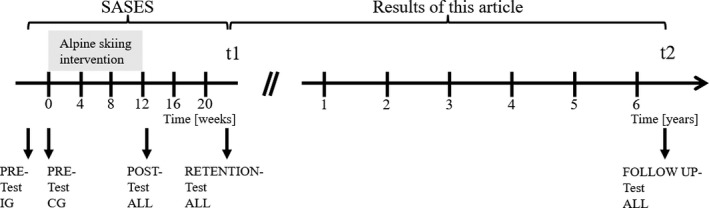
This article aims to (a) describe the study design of a 6-year follow-up multidisciplinary research project on aging, (b) report the psychosocial characteristics of the sample in detail, and (c) evaluate aging-related changes of health, physical activity, and psychosocial characteristics in 10 young-old (age at pre-test: M ± SD = 63.2 ± 1.5) and 12 old-old (age at pre-test: M ± SD = 69 ± 2) individuals. Both age groups consist of individuals displaying a high health status, a high extent of physical activity, high levels of psychosocial properties in the dimensions of well-being, life satisfaction, self-concept, body image, self-esteem, and self-efficacy, as well as a low general depression index. Psychosocial characteristics demonstrated a stable pattern over a period of nearly 6 years in both age groups with the exceptions of physical activity, satisfaction with children, general depression, and self-efficacy. Furthermore, physical self-concept decreased in old-old adults, whereas the young-olds showed no change. We assume that a high psychosocial status and a physically active lifestyle play an important role for mastering aging successfully in two life phases, each of which has its own challenges for older individuals. The decline in the physical self-concept of old-olds is interpreted as a first sign of subjective aging. Its association with losses in physical performance should be addressed in future studies. Finally, aging-related changes should be monitored on an individual level in order to capture the complex dynamic of aging that is not considered in analyses of between-person differences or averages.
(a) 描述一项为期 6 年的老年多学科研究项目的研究设计;(b) 详细报告样本的社会心理特征;(c) 评估 10 名年轻老年人(预测试时年龄:M ± SD = 63.2 ± 1.5)和 12 名年老老年人(预测试时年龄:M ± SD = 69 ± 2)个体的健康、身体活动和社会心理特征与衰老相关的变化。两个年龄组均由健康状况良好、身体活动程度高、幸福感、生活满意度、自我概念、身体形象、自尊和自我效能等维度的社会心理属性水平高以及一般抑郁指数低的个体组成。在近 6 年的时间里,两个年龄组的社会心理特征都呈现出稳定的模式,除了身体活动、对孩子的满意度、一般抑郁和自我效能。此外,老年老年人的身体自我概念下降,而年轻老年人则没有变化。我们假设,高社会心理状态和积极的生活方式在两个生命阶段成功应对衰老中发挥着重要作用,每个阶段都有其对老年人的挑战。老年老年人身体自我概念的下降被解释为主观衰老的第一个迹象。应在未来的研究中解决其与身体机能下降的关系。最后,应在个体层面上监测与衰老相关的变化,以捕捉衰老的复杂动态,而这在个体间差异或平均值的分析中是无法考虑到的。