Department of Hematology and Central Hematology Laboratory, Inselspital, Bern University Hospital, University of Bern, Bern, Switzerland.
Department for BioMedical Research, University of Bern, Bern, Switzerland.
J Thromb Haemost. 2019 Feb;17(2):306-318. doi: 10.1111/jth.14365.
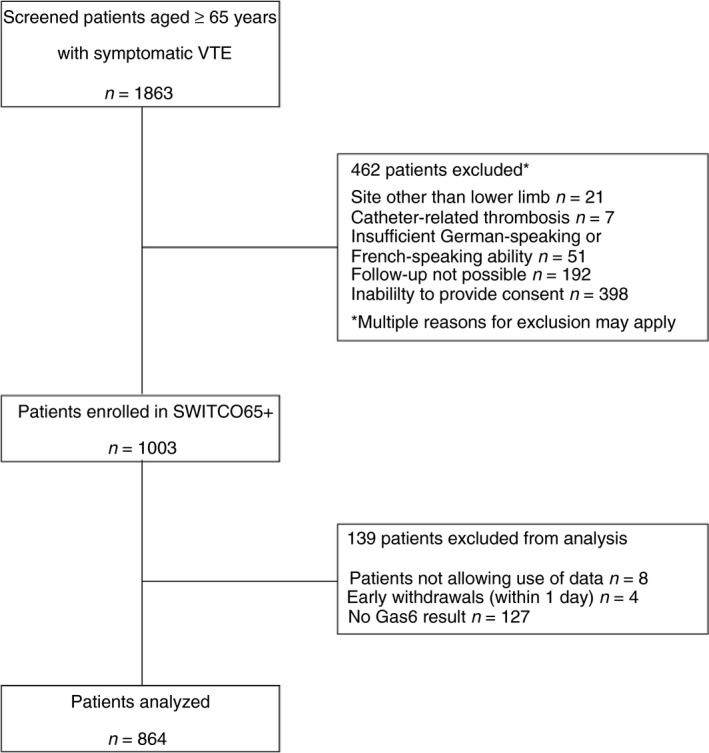
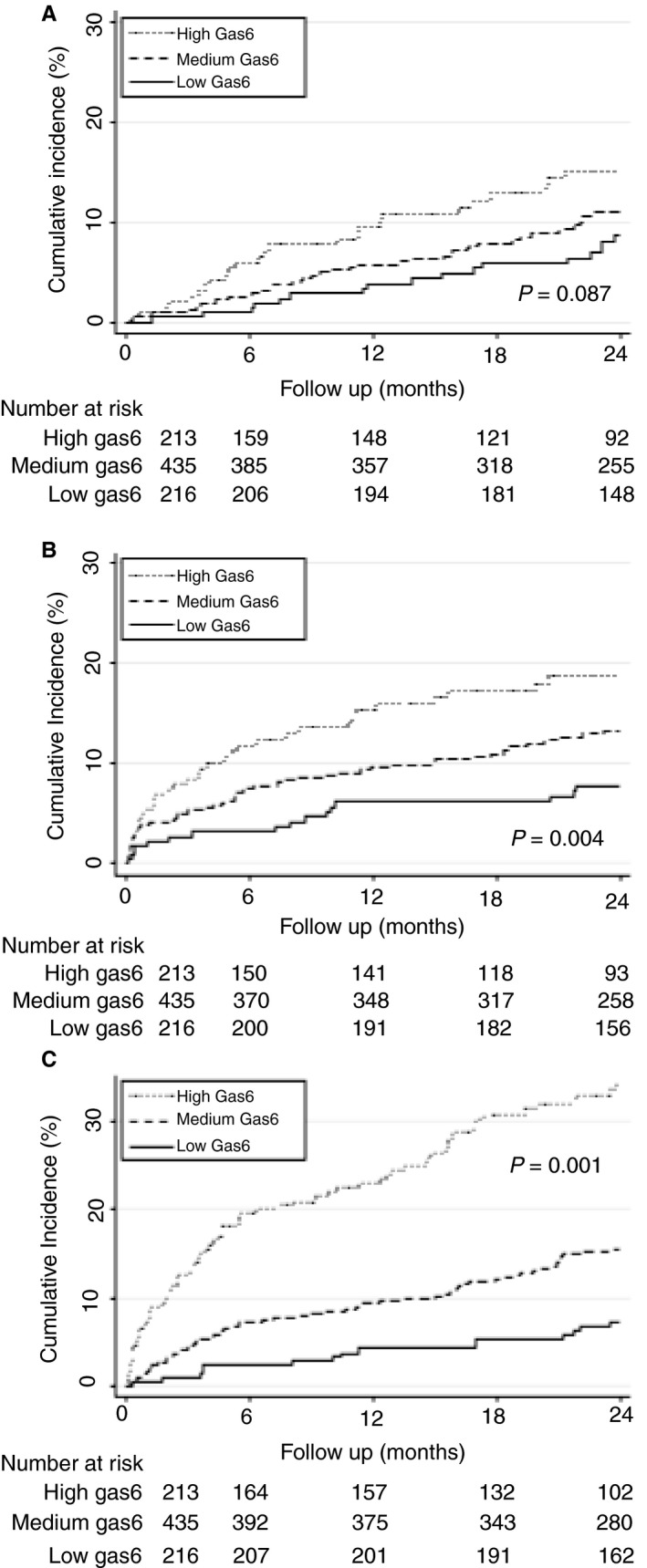
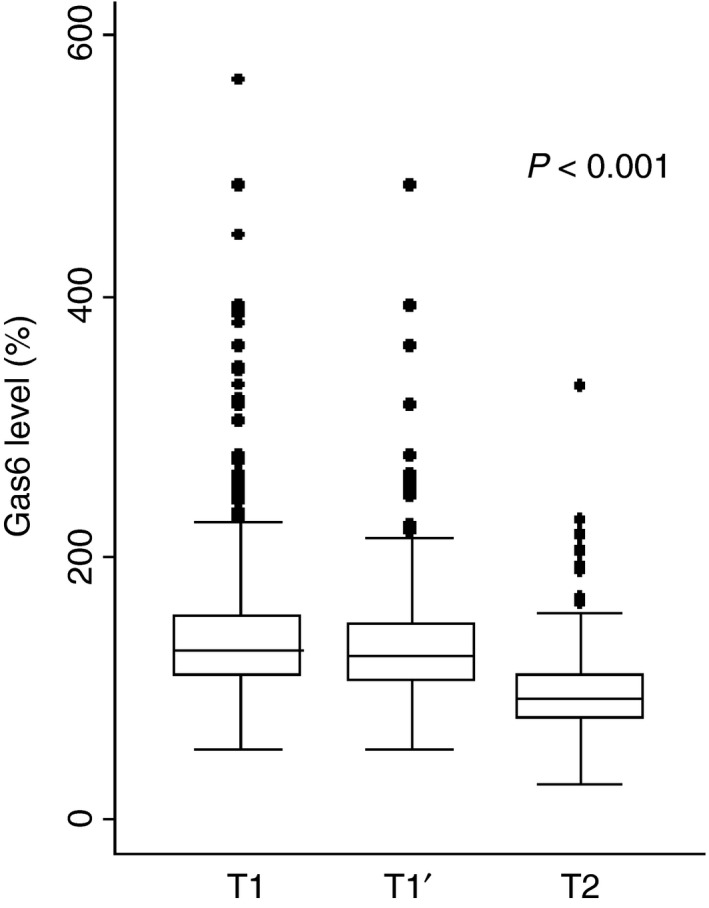
Essentials Predictive ability of pro-hemostatic Gas6 for recurrent venous thromboembolism (VTE) is unknown. We measured Gas6 levels in 864 patients with VTE over 3 years. High Gas6 (> 157%) at diagnosis is associated with VTE recurrence, major bleeding and mortality. Gas6 plasma levels measured 12 months after the index VTE are discriminatory for VTE recurrence. SUMMARY: Background Growth arrest-specific gene 6 (Gas6) is a prohemostatic protein with an unknown predictive ability for recurrent venous thromboembolism (VTE). In the elderly, VTE results in higher mortality but does not have a higher rate of recurrence than in younger patients. Consequently, anticoagulation management in the elderly is challenging. Objective To prospectively investigate the performance of Gas6 in predicting VTE recurrence, major bleeding and mortality in the elderly. Methods Consecutive patients aged ≥ 65 years with acute VTE were followed for a period of 3 years. Primary outcomes were symptomatic VTE recurrence, major bleeding, and mortality. Plasma Gas6 was measured with ELISA. Results Gas6 levels were measured in 864 patients at the time of the index VTE (T1) and, in 70% of them, also 12 months later (T2). The Gas6 level at T1 was discriminatory for VTE recurrence (C-statistic, 0.56; 95% confidence interval [CI] 0.51-0.62), major bleeding (0.60, 95% CI 0.55-0.65) and mortality (0.69, 95% CI 0.65-0.73) up to 36 months. VTE recurrence up to 24 months after T2 was discriminated by the Gas6 level at T2 (0.62, 95% CI 0.54-0.71). High Gas6 levels (> 157%) and continuous Gas6 levels at T1 were associated with VTE recurrence up to 6 months and 12 months, respectively. Conclusions In elderly patients, a high Gas6 level is associated with higher risks of VTE recurrence, major bleeding, and death. These findings support further studies to assess the performance of Gas6 in adjusting the length of anticoagulation.
Gas6 对复发性静脉血栓栓塞症(VTE)的预测能力尚不清楚。我们在 3 年内对 864 例 VTE 患者进行了 Gas6 水平测定。诊断时高 Gas6(>157%)与 VTE 复发、大出血和死亡率相关。VTE 指数后 12 个月测量的 Gas6 血浆水平可区分 VTE 复发。
背景生长停滞特异性基因 6(Gas6)是一种促凝蛋白,其对复发性静脉血栓栓塞症(VTE)的预测能力尚不清楚。在老年人中,VTE 导致更高的死亡率,但复发率并不高于年轻患者。因此,老年人的抗凝管理具有挑战性。
目的前瞻性研究 Gas6 对预测老年人 VTE 复发、大出血和死亡率的作用。
方法连续纳入年龄≥65 岁的急性 VTE 患者,随访 3 年。主要结局为症状性 VTE 复发、大出血和死亡率。采用 ELISA 法测定血浆 Gas6。
结果在 864 例 VTE 患者(T1)时测量了 Gas6 水平,其中 70%的患者在 T1 后 12 个月(T2)也测量了 Gas6 水平。T1 时的 Gas6 水平对 VTE 复发(C 统计量为 0.56;95%置信区间 [CI]0.51-0.62)、大出血(0.60,95%CI0.55-0.65)和死亡率(0.69,95%CI0.65-0.73)具有预测价值,可预测 36 个月。T2 时的 Gas6 水平可区分 T2 后 24 个月内的 VTE 复发(0.62,95%CI0.54-0.71)。T1 时高 Gas6 水平(>157%)和连续 Gas6 水平与 T1 后 6 个月和 12 个月的 VTE 复发相关。
结论在老年患者中,高 Gas6 水平与 VTE 复发、大出血和死亡风险增加相关。这些发现支持进一步研究评估 Gas6 在调整抗凝时间长度方面的性能。