Advanced Analytics Department, Intel, 94 Em Hamoshavot Road, Petah Tikva, Israel.
Department of Public Health Sciences, Medical University of South Carolina, 135 Cannon St., Suite 303, PO Box 250835, Charleston, SC, 29425, USA.
BMC Med Inform Decis Mak. 2018 Dec 20;18(1):138. doi: 10.1186/s12911-018-0714-7.
A growing number of clinical trials use various sensors and smartphone applications to collect data outside of the clinic or hospital, raising the question to what extent patients comply with the unique requirements of remote study protocols. Compliance is particularly important in conditions where patients are motorically and cognitively impaired. Here, we sought to understand patient compliance in digital trials of two such pathologies, Parkinson's disease (PD) and Huntington disease (HD).
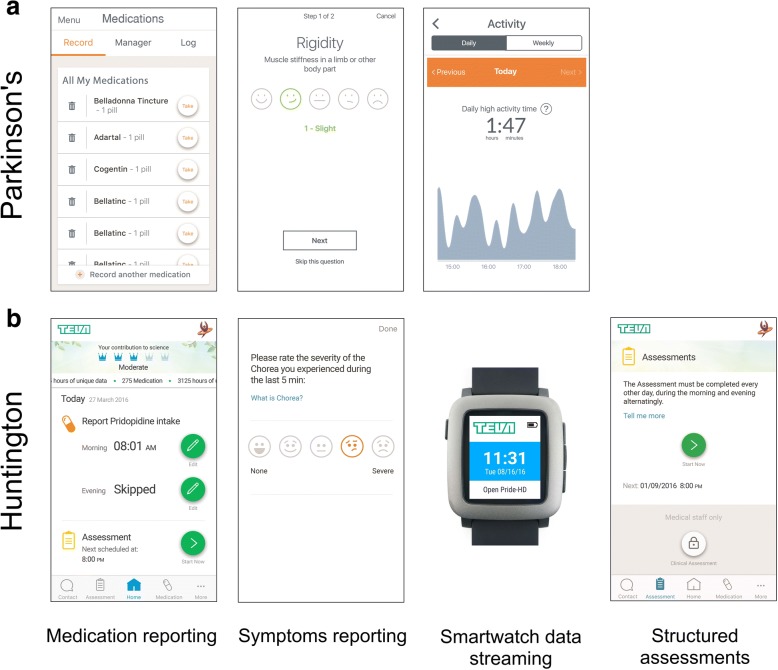
Patient compliance was assessed in two remote, six-month clinical trials of PD (n = 51, Clinician Input Study funded by the Michael J. Fox Foundation for Parkinson's Research) and HD (n = 17, sponsored by Teva Pharmaceuticals). We monitored four compliance metrics specific to remote studies: smartphone app-based medication reporting, app-based symptoms reporting, the duration of smartwatch data streaming except while charging, and the performance of structured motor tasks at home.
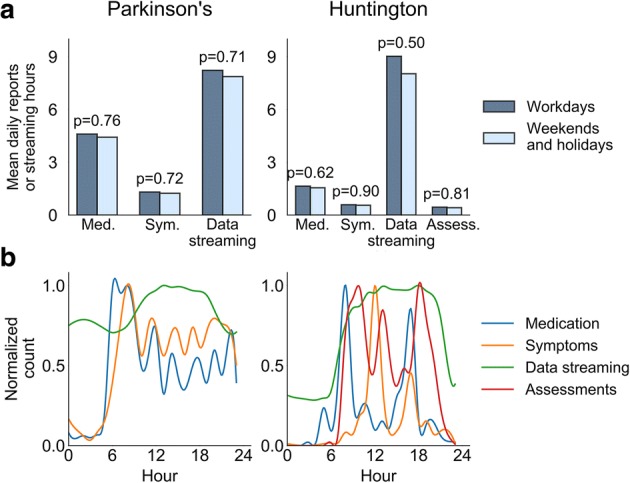
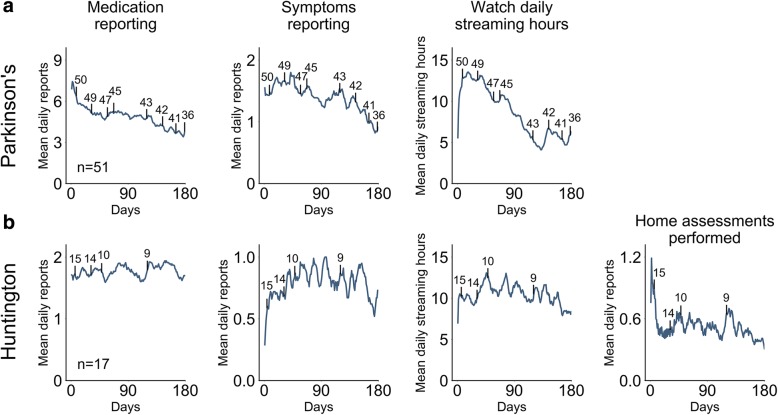
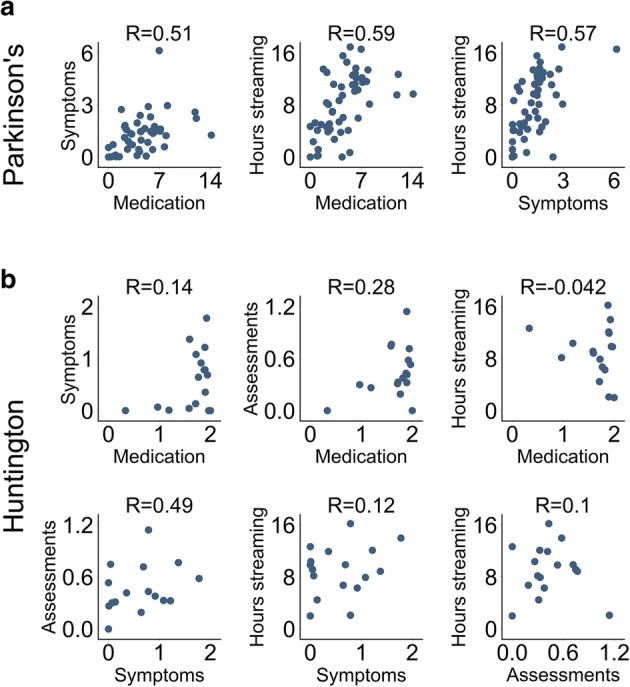
While compliance over time differed between the PD and HD studies, both studies maintained high compliance levels for their entire six month duration. None (- 1%) to a 30% reduction in compliance rate was registered for HD patients, and a reduction of 34 to 53% was registered for the PD study. Both studies exhibited marked changes in compliance rates during the initial days of enrollment. Interestingly, daily smartwatch data streaming patterns were similar, peaking around noon, dropping sharply in the late evening hours around 8 pm, and having a mean of 8.6 daily streaming hours for the PD study and 10.5 h for the HD study. Individual patients tended to have either high or low compliance across all compliance metrics as measured by pairwise correlation. Encouragingly, predefined schedules and app-based reminders fulfilled their intended effect on the timing of medication intake reporting and performance of structured motor tasks at home.
Our findings suggest that maintaining compliance over long durations is feasible, promote the use of predefined app-based reminders, and highlight the importance of patient selection as highly compliant patients typically have a higher adherence rate across the different aspects of the protocol. Overall, these data can serve as a reference point for the design of upcoming remote digital studies.
Trials described in this study include a sub-study of the Open PRIDE-HD Huntington's disease study (TV7820-CNS-20016), which was registered on July 7th, 2015, sponsored by Teva Pharmaceuticals Ltd., and registered on Clinicaltrials.gov as NCT02494778 and EudraCT as 2015-000904-24 .
越来越多的临床试验使用各种传感器和智能手机应用程序在诊所或医院外收集数据,这引发了一个问题,即患者在多大程度上遵守远程研究方案的独特要求。在患者运动和认知能力受损的情况下,依从性尤其重要。在这里,我们试图了解两种此类疾病帕金森病(PD)和亨廷顿病(HD)的数字试验中的患者依从性。
我们评估了两项为期六个月的 PD(由迈克尔·J·福克斯帕金森病研究基金会资助的“临床医生输入研究”,n=51)和 HD(由 Teva 制药公司赞助,n=17)远程临床试验中的患者依从性。我们监测了四项特定于远程研究的依从性指标:基于智能手机应用程序的药物报告、基于应用程序的症状报告、智能手表数据流式传输的持续时间(除充电时间外)以及在家中执行结构化运动任务的情况。
尽管 PD 和 HD 研究中的随时间变化的依从性不同,但这两项研究在整个六个月的时间内都保持了较高的依从性水平。HD 患者的依从率没有减少(-1%),而 PD 研究的依从率减少了 34%至 53%。两项研究在入组的最初几天内都表现出明显的依从率变化。有趣的是,日常智能手表数据流式传输模式相似,中午左右达到峰值,晚上 8 点左右急剧下降,PD 研究的平均每日流式传输时间为 8.6 小时,HD 研究为 10.5 小时。对于所有的依从性指标,个别患者往往表现出要么高要么低的依从性,这可以通过两两相关来衡量。令人鼓舞的是,预定的计划和基于应用程序的提醒履行了它们对药物摄入报告时间和在家中执行结构化运动任务的影响。
我们的研究结果表明,长时间保持依从性是可行的,促进了基于应用程序的预定提醒的使用,并强调了患者选择的重要性,因为依从性高的患者通常在协议的不同方面都有更高的依从率。总体而言,这些数据可以作为未来远程数字研究设计的参考点。
本研究中描述的试验包括 Teva 制药公司赞助的 Open PRIDE-HD 亨廷顿病研究(TV7820-CNS-20016)的子研究,该研究于 2015 年 7 月 7 日注册,在 Clinicaltrials.gov 上注册为 NCT02494778,在 EudraCT 上注册为 2015-000904-24。