Sun Zuoli, Jiang Tianhe, Wu Yan, Ma Chao, He Yi, Yang Jian
The National Clinical Research Center for Mental Disorders, Beijing Key Laboratory of Mental Disorders, Beijing Anding Hospital, Capital Medical University, Beijing, China.
Key Laboratory for Neurodegenerative Disorders of the Ministry of Education, Capital Medical University, Beijing, China.
Front Psychiatry. 2018 Dec 6;9:675. doi: 10.3389/fpsyt.2018.00675. eCollection 2018.
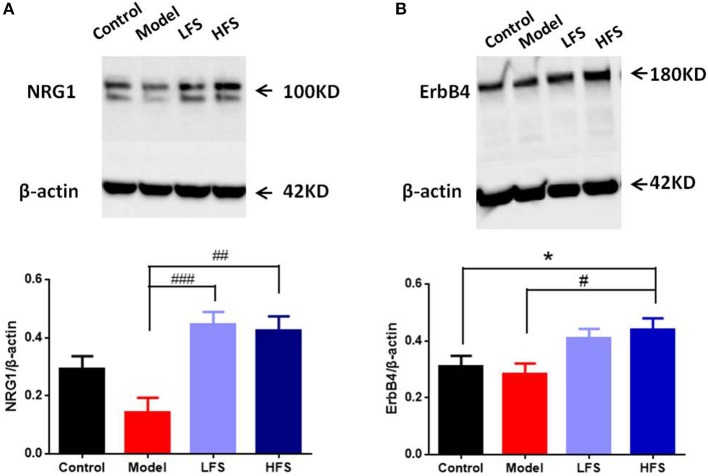
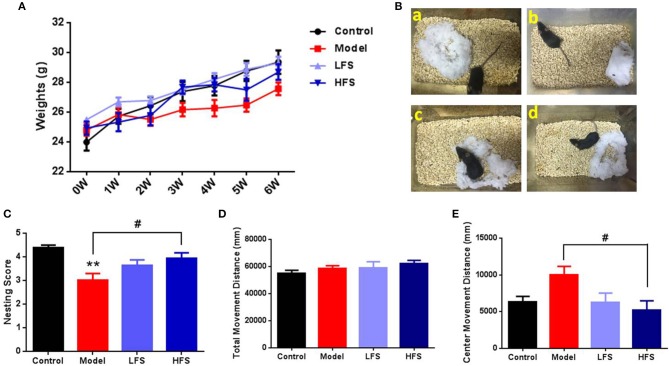
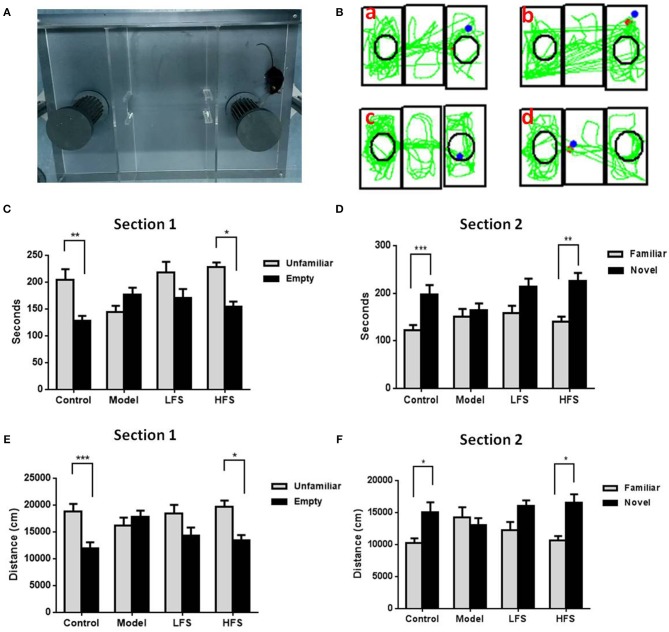
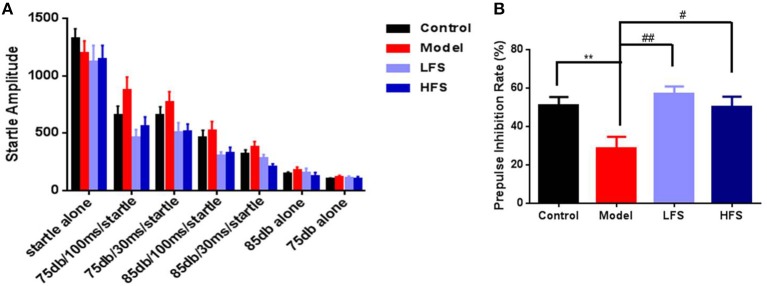
White matter and myelin sheath integrity are disrupted in schizophrenia, and non-invasive magnetic brain stimulation targeting these tracts is a promising new therapeutic approach. In particular, deep-brain reachable low field magnetic stimulation (DMS) could alleviate cognitive impairment and depressive-like behaviors in animal models. In this study, we sought to assess the effects of DMS on myelin sheath damage and schizophrenia-like behaviors in the cuprizone-induced demyelination mouse model. Mice were fed cuprizone (copper ion chelating agent, 0.2% w/w mixed with food) for 6 weeks to induce demyelination. During these 6 weeks, mice were stimulated with either sham, low-frequency (LFS, delta frequency) DMS or high-frequency (HFS, gamma Hz) DMS for 20 min each day. Behavioral tests were conducted 24 h after the final DMS session. The myelin sheath was examined by immunohistochemistry and the expression of neuregulin-1 (NRG1)/ErbB4 in the prefrontal cortex was measured with Western blotting. Six weeks of HFS significantly alleviated schizophrenia-like behaviors in cuprizone mice, including improved nesting, social interaction and sensorimotor gating, while LFS improved sensorimotor gating only. HFS and LFS both repaired the myelin sheath and increased the expression of neuregulin-1 and its receptor ErbB4, in the prefrontal cortex of demyelinated mice. Our findings show that DMS is a potential effective neuromodulation technique for the treatment of schizophrenia. One possible mechanism underlying these therapeutic effects could involve the up-regulation of NRG1/ErbB4 signaling in the prefrontal cortex.
精神分裂症患者的白质和髓鞘完整性受到破坏,针对这些神经束的非侵入性脑磁刺激是一种很有前景的新治疗方法。特别是,深部脑可及低场磁刺激(DMS)可以减轻动物模型中的认知障碍和抑郁样行为。在本研究中,我们试图评估DMS对铜螯合剂诱导的脱髓鞘小鼠模型中髓鞘损伤和精神分裂症样行为的影响。给小鼠喂食铜螯合剂(0.2% w/w与食物混合)6周以诱导脱髓鞘。在这6周内,小鼠每天接受假刺激、低频(LFS,δ频率)DMS或高频(HFS,γ赫兹)DMS刺激20分钟。在最后一次DMS刺激后24小时进行行为测试。通过免疫组织化学检查髓鞘,并通过蛋白质印迹法测量前额叶皮质中神经调节蛋白-1(NRG1)/表皮生长因子受体 erbB4(ErbB4)的表达。六周的高频刺激显著减轻了铜螯合剂处理小鼠的精神分裂症样行为,包括改善筑巢、社交互动和感觉运动门控,而低频刺激仅改善了感觉运动门控。高频刺激和低频刺激均修复了脱髓鞘小鼠前额叶皮质的髓鞘,并增加了神经调节蛋白-1及其受体ErbB4的表达。我们的研究结果表明,DMS是一种治疗精神分裂症的潜在有效神经调节技术。这些治疗效果的一种可能机制可能涉及前额叶皮质中NRG1/ErbB4信号的上调。