Ramshini Effat, Dabiri Shahriar, Arjmand Shokouh, Sepehri Gholamreza, Khaksari Mohammad, Ahmadi-Zeidabadi Meysam, Shabani Mohammad
PhD Candidate, Department of Physiology AND Physiology Research Center, Institute of Basic and Clinical Physiology Sciences, Kerman University of Medical Sciences, Kerman, Iran.
Professor, Department of Pathology, School of Medicine, Kerman University of Medical Sciences, Kerman, Iran.
Addict Health. 2017 Fall;9(4):206-213.
A number of neuroimaging studies on human addicts have revealed that abuse of Methamphetamine (METH) can induce neurodegenerative changes in various brain regions like the cerebral cortex and cerebellum. Although the underlying mechanisms of METH-induced neurotoxicity have been studied, the cellular and molecular mechanisms of METH-induced neurotoxicity remain to be clarified. Previous studies implicated that cannabinoid type 1 receptors (CB1Rs) exert neuroprotective effects on several models of cerebral toxicity, but their role in METH-induced neurotoxicity has been rarely investigated. Moreover, the cerebellum was considered as a potential target to evaluate the effects of cannabinoids on locomotion activity as the CB1Rs are most widely distributed in the molecular layer of cerebellum. Therefore, the present study was carried out to evaluate whether neurodegeneration induced in the cerebellum tissue implicated in locomotion deficit induced by METH.
In the current study, open field test was used to examine locomotor activity. Using hematoxylin and eosin (H&E) staining, morphology of the cerebellar vermis was investigated after repeated exposure to METH. Then, the effects of CB1Rs antagonist [SR17141A, 10 mg/kg, intraperitoneally (IP)] and CB1Rs agonist [WIN55, 212-2 (WIN), 3 mg/kg] against METH-induced neurodegeneration and locomotor deficit were assessed.
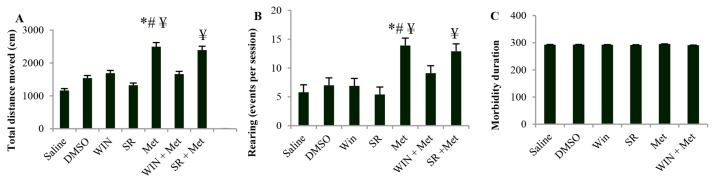
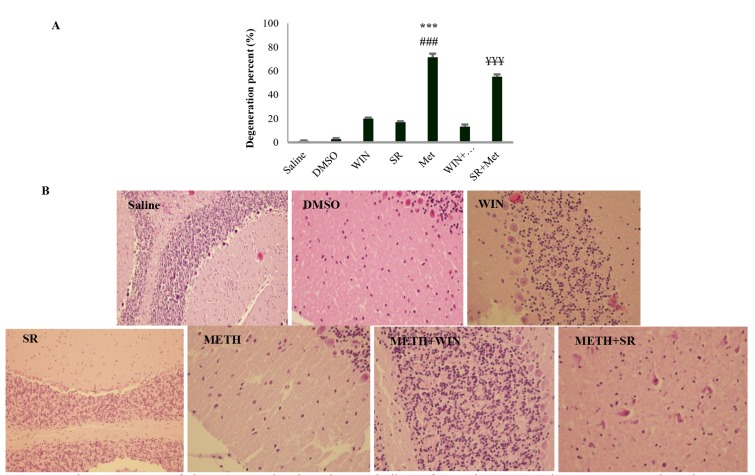
The results of the present study demonstrated that repeated exposure to METH increased cerebellar degeneration level as compared to the saline and dimethyl sulfoxide (DMSO) groups. In addition, METH-treated rats showed hyperactivity as compared to the saline and DMSO groups. Pretreatment with WIN significantly attenuated neurodegeneration and hyperactivity induced by METH.
The findings of this study provided evidence that CB1Rs may serve as a therapeutic strategy for attenuation of METH-induced locomotor deficits.
多项针对人类成瘾者的神经影像学研究表明,滥用甲基苯丙胺(METH)可在大脑皮层和小脑等多个脑区诱发神经退行性变化。尽管已经对METH诱导神经毒性的潜在机制进行了研究,但METH诱导神经毒性的细胞和分子机制仍有待阐明。先前的研究表明,1型大麻素受体(CB1Rs)对几种脑毒性模型具有神经保护作用,但其在METH诱导神经毒性中的作用鲜有研究。此外,由于CB1Rs在小脑分子层中分布最为广泛,小脑被认为是评估大麻素对运动活动影响的潜在靶点。因此,本研究旨在评估METH诱导的小脑组织神经退行性变是否与METH诱导的运动功能障碍有关。
在本研究中,采用旷场试验来检测运动活动。使用苏木精-伊红(H&E)染色,在反复暴露于METH后研究小脑蚓部的形态。然后评估CB1Rs拮抗剂[SR17141A,10mg/kg,腹腔注射(IP)]和CB1Rs激动剂[WIN55,212-2(WIN),3mg/kg]对METH诱导的神经退行性变和运动功能障碍的影响。
本研究结果表明,与生理盐水和二甲基亚砜(DMSO)组相比,反复暴露于METH会增加小脑变性程度。此外,与生理盐水和DMSO组相比,METH处理的大鼠表现出多动。用WIN预处理可显著减轻METH诱导的神经退行性变和多动。
本研究结果提供了证据,表明CB1Rs可能作为一种治疗策略来减轻METH诱导的运动功能障碍。