Truta Teodora Sorana, Boeriu Cristian Marius, Lazarovici Marc, Ban Irina, Petrişor Marius, Copotoiu Sanda-Maria
University of Medicine and Pharmacy Tirgu-Mures, Street Gheorghe Marinescu 38, 540139 Tirgu-Mures, Mures, Romania.
Institut für Notfallmedizin und Medizinmanagement - INM, Klinikum der Universität, Ludwig-Maximilains-Universität München, Schillestraße 53, 80336 München, Germany.
J Crit Care Med (Targu Mures). 2018 Oct 1;4(4):126-136. doi: 10.2478/jccm-2018-0018. eCollection 2018 Oct.
Errors are frequent in health care and Emergency Departments are one of the riskiest areas due to frequent changes of team composition, complexity and variety of the cases and difficulties encountered in managing multiple patients. As the majority of clinical errors are the results of human factors and not technical in nature or due to the lack of knowledge, a training focused on these factors appears to be necessary. Crisis resource management (CRM), a tool that was developed initially by the aviation industry and then adopted by different medical specialties as anesthesia and emergency medicine, has been associated with decreased error rates.
To assess whether a single day CRM training, combining didactic and simulation sessions, improves the clinical performance of an interprofessional emergency medical team.
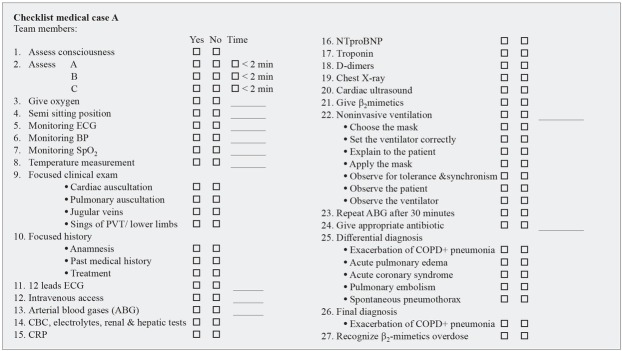
Seventy health professionals with different qualifications, working in an emergency department, were enrolled in the study. Twenty individual interprofessional teams were created. Each team was assessed before and after the training, through two in situ simulated exercises. The exercises were videotaped and were evaluated by two assessors who were blinded as to whether it was the initial or the final exercise. Objective measurement of clinical team performance was performed using a checklist that was designed for each scenario and included essential assessment items for the diagnosis and treatment of a critical patient, with the focus on key actions and decisions. The intervention consisted of a one-day training, combining didactic and simulation sessions, followed by instructor facilitated debriefing. All participants went through this training after the initial assessment exercises.
An improvement was seen in most of the measured clinical parameters.
Our study supports the use of combined CRM training for improving the clinical performance of an interprofessional emergency team. Empirically this may improve the patient outcome.
医疗保健中的错误屡见不鲜,而急诊科是风险最高的领域之一,原因在于团队组成频繁变动、病例复杂多样以及在同时处理多名患者时会遇到困难。由于大多数临床错误是人为因素导致的,而非技术问题或知识欠缺,因此针对这些因素开展培训显得很有必要。危机资源管理(CRM)最初是航空业开发的一种工具,后来被麻醉学和急诊医学等不同医学专业所采用,它与降低错误率相关。
评估结合理论教学与模拟训练的单日CRM培训是否能提高跨专业急诊医疗团队的临床绩效。
招募了70名在急诊科工作、具备不同资质的医疗专业人员。组建了20个跨专业团队。每个团队在培训前后分别通过两次现场模拟演练进行评估。演练过程被录像,由两名评估人员进行评估,这两名评估人员对演练是初始还是最终演练不知情。使用针对每个场景设计的清单对临床团队绩效进行客观测量,清单包括对危急患者进行诊断和治疗的基本评估项目,重点是关键行动和决策。干预措施包括为期一天结合理论教学与模拟训练的培训,随后由教员主持进行总结汇报。所有参与者在初始评估演练后都接受了此次培训。
大多数测量的临床参数都有改善。
我们的研究支持使用CRM综合培训来提高跨专业急诊团队的临床绩效。从经验上看,这可能会改善患者的治疗结果。