Kim Tae Hoon, Rhee Chin Kook, Oh Yeon Mok
Department of Pulmonary and Critical Care Medicine, Asan Medical Center, University of Ulsan College of Medicine, Seoul, Korea.
Department of Internal Medicine, CHA Bundang Medical Center, CHA University, Seongnam, Korea.
Tuberc Respir Dis (Seoul). 2019 Jan;82(1):35-41. doi: 10.4046/trd.2018.0050.
Pulmonary tuberculosis can result in anatomical sequelae, and cause airflow limitation. However, there are no treatment guidelines for patients with a tuberculosis-destroyed lung. Recently, indacaterol effectiveness in chronic obstructive pulmonary disease (COPD) patients with Tuberculosis history (INFINITY) study revealed indacaterol provided bronchodilation and symptom improvement in COPD patients with a tuberculosis-destroyed lung.
We conducted a subgroup analysis of the randomized controlled trial, the INFINITY study, to determine factors associated with indacaterol response in a tuberculosis-destroyed lung with airflow limitation. Data from 68 patients treated with inhaled indacaterol, were extracted and analyzed. Factors associated with the response of forced expiratory volume in one second (FEV₁) to indacaterol treatment, were determined using linear regression analysis.
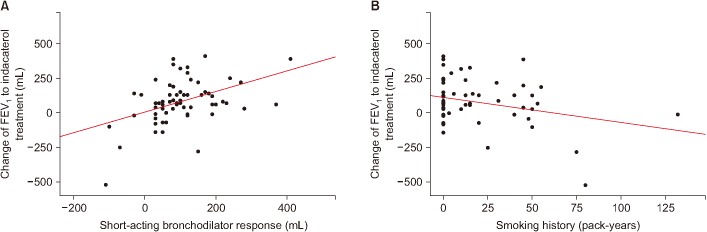
Of 62 patients included, 68% were male, and 52% had history of cigarette smoking. Patients revealed mean FEV₁ of 50.5% of predicted value with mean improvement of 81.3 mL in FEV₁ after indacaterol treatment for 8 weeks. Linear regression analysis revealed factors associated with response of FEV₁ to indacaterol included a short duration of smoking history, and high short-acting bronchodilator response. When patients with history of smoking were excluded, factors associated with response of FEV₁ to indacaterol included high short-acting bronchodilator response, and poor healthrelated quality of life score as measured by St. George's Respiratory Questionnaire for COPD.
In a tuberculosis-destroyed lung with airflow limitation, short-acting bronchodilator response and smoking history can play a critical role in predicting outcomes of indacaterol treatment.
肺结核可导致解剖学后遗症,并引起气流受限。然而,对于肺被结核破坏的患者尚无治疗指南。最近,茚达特罗在有结核病病史的慢性阻塞性肺疾病(COPD)患者中的有效性(INFINITY)研究显示,茚达特罗可使肺被结核破坏的COPD患者的支气管扩张并改善症状。
我们对随机对照试验INFINITY研究进行了亚组分析,以确定在气流受限的肺被结核破坏的情况下与茚达特罗反应相关的因素。提取并分析了68例接受吸入茚达特罗治疗患者的数据。使用线性回归分析确定与一秒用力呼气容积(FEV₁)对茚达特罗治疗反应相关的因素。
纳入的62例患者中,68%为男性,52%有吸烟史。患者的FEV₁平均为预测值的50.5%,茚达特罗治疗8周后FEV₁平均改善81.3 mL。线性回归分析显示,与FEV₁对茚达特罗反应相关的因素包括吸烟史短和短效支气管扩张剂反应高。排除有吸烟史的患者后,与FEV₁对茚达特罗反应相关的因素包括短效支气管扩张剂反应高以及通过圣乔治呼吸问卷评估的慢性阻塞性肺疾病健康相关生活质量评分低。
在气流受限的肺被结核破坏的情况下,短效支气管扩张剂反应和吸烟史对预测茚达特罗治疗效果可能起关键作用。