Centre for Youth Substance Abuse Research, The University of Queensland, Brisbane, QLD, Australia.
School of Public Health, The University of Queensland, Brisbane, QLD, Australia.
Addiction. 2019 Oct;114 Suppl 1(Suppl 1):61-70. doi: 10.1111/add.14537. Epub 2019 Jan 21.
To assess (1) how far smoking patterns, depression and smoking-related beliefs and intentions predict vaping uptake, current vaping and vaping frequency among daily smokers; and (2) how far the aforementioned predictors and baseline vaping frequency predict current vaping among those who reported ever vaped.
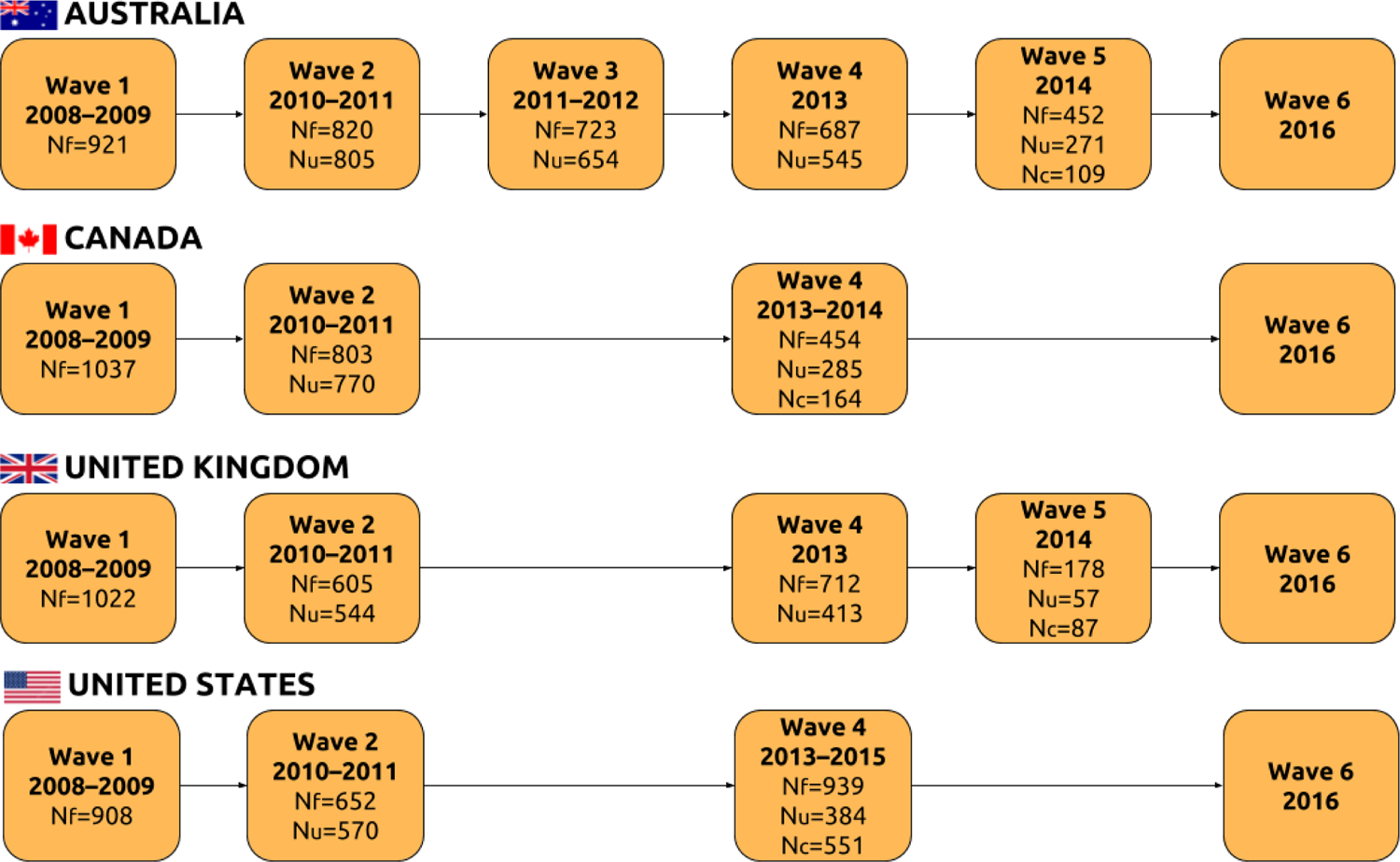
Analysis of data from six waves of a longitudinal survey over 8 years. Longitudinal associations between predictors and outcomes were examined using multi-level models.
United Kingdom, United States, Canada and Australia.
A total of 6296 daily smokers (53% females) who contributed data to at least two consecutive survey waves.
The outcome variables were vaping uptake, vaping frequency and current vaping at follow-up. The key predictor variables, measured in previous waves, were time to first cigarette, cigarettes smoked per day, depressive symptoms, intention to quit smoking, quitting self-efficacy and worry about adverse health effects of smoking.
Number of cigarettes smoked daily was associated with (1) subsequent vaping uptake [odds ratio (OR) = 1.69, 95% confidence interval (CI) = 1.19, 2.39 for 30+ cigarette per day; reference category: 0-10 cigarettes] and (2) a higher frequency of current vaping (OR = 1.97, 95% CI = 1.36, 2.85 for 30+ cigarettes). Intention to quit was associated with a higher frequency of current vaping (OR = 1.48, 95% CI = 1.21, 1.82). Among those who reported ever vaped, higher baseline vaping frequency (OR = 11.98, 95% CI = 6.00, 23.93 for daily vaping at baseline; reference category: vaped less than monthly) predicted current vaping.
Among daily smokers, amount smoked and intention to quit smoking appear to predict subsequent vaping uptake. Vaping frequency at baseline appears to predict current vaping at follow-up.
评估(1)吸烟模式、抑郁以及与吸烟相关的信念和意图在多大程度上预测每日吸烟者的电子烟使用、当前电子烟使用和电子烟使用频率;以及(2)上述预测因素和基线电子烟使用频率在多大程度上预测那些曾报告过使用电子烟的人的当前电子烟使用情况。
对一项为期 8 年的纵向调查的六轮数据进行分析。使用多层次模型检查预测因素与结果之间的纵向关联。
英国、美国、加拿大和澳大利亚。
共有 6296 名每日吸烟者(53%为女性)至少连续参加了两次调查。
随访时的电子烟使用情况、电子烟使用频率和当前电子烟使用情况。主要预测因素是首次吸烟时间、每日吸烟量、抑郁症状、戒烟意愿、戒烟自我效能和对吸烟不良健康影响的担忧,这些因素在之前的调查中进行了测量。
每日吸烟量与(1)随后的电子烟使用情况有关[优势比(OR)=1.69,95%置信区间(CI)=1.19,2.39,每日吸烟量 30 支以上;参考类别:0-10 支]和(2)更高的当前电子烟使用频率(OR=1.97,95%CI=1.36,2.85,每日吸烟量 30 支以上)。戒烟意愿与更高的当前电子烟使用频率有关(OR=1.48,95%CI=1.21,1.82)。在那些报告曾使用过电子烟的人中,更高的基线电子烟使用频率(OR=11.98,95%CI=6.00,23.93,基线时每日使用电子烟;参考类别:每月使用电子烟少于一次)预测当前电子烟使用情况。
在每日吸烟者中,吸烟量和戒烟意愿似乎可以预测随后的电子烟使用情况。基线时的电子烟使用频率似乎可以预测随访时的当前电子烟使用情况。