Gene Therapy and Regulation of Gene Expression Program, Center for Applied Medical Research (CIMA), University of Navarra, IdiSNA, Pamplona, 31008, Spain.
Hospital Universitario de Canarias, Universidad La Laguna, CIBERER, Tenerife, 38320, Spain.
Nat Commun. 2018 Dec 21;9(1):5454. doi: 10.1038/s41467-018-07827-1.
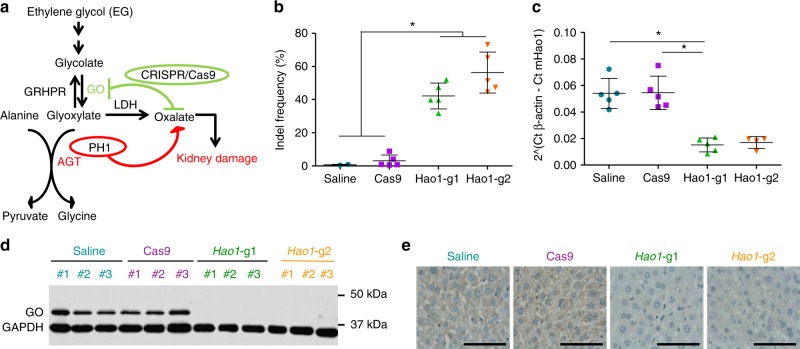
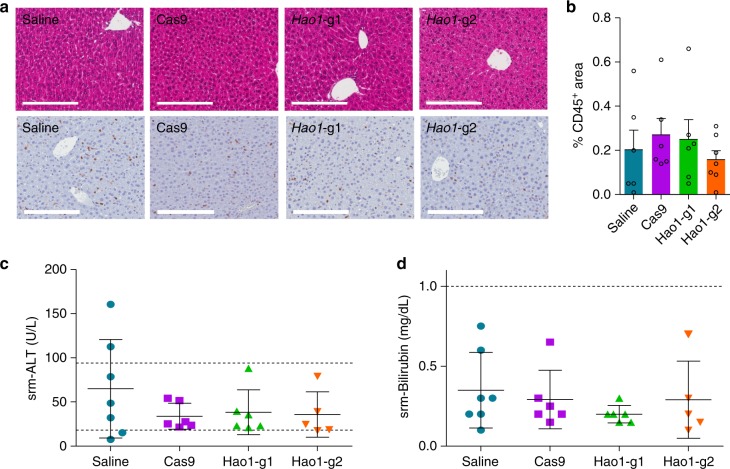
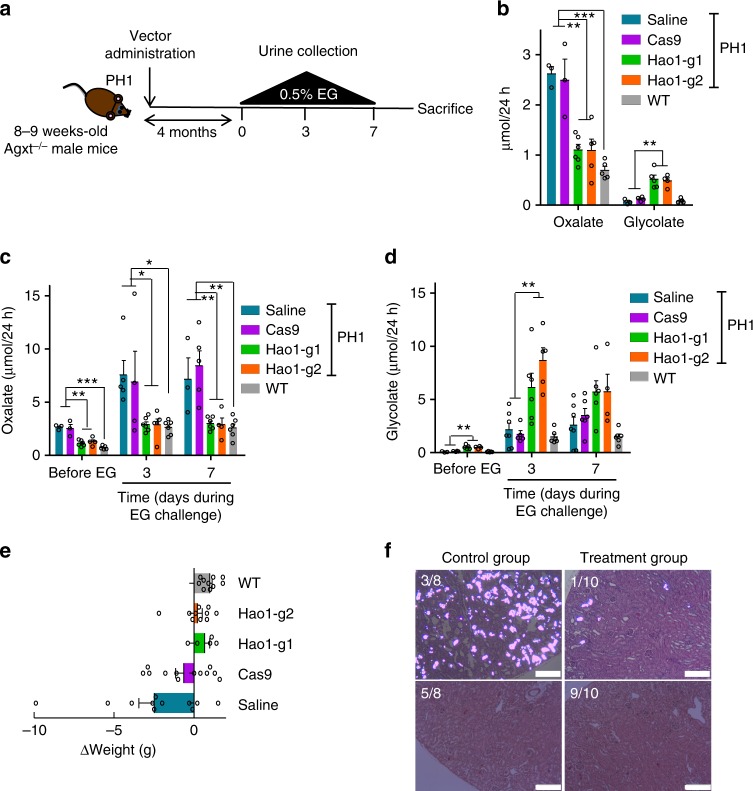
CRISPR/Cas9 technology offers novel approaches for the development of new therapies for many unmet clinical needs, including a significant number of inherited monogenic diseases. However, in vivo correction of disease-causing genes is still inefficient, especially for those diseases without selective advantage for corrected cells. We reasoned that substrate reduction therapies (SRT) targeting non-essential enzymes could provide an attractive alternative. Here we evaluate the therapeutic efficacy of an in vivo CRISPR/Cas9-mediated SRT to treat primary hyperoxaluria type I (PH1), a rare inborn dysfunction in glyoxylate metabolism that results in excessive hepatic oxalate production causing end-stage renal disease. A single systemic administration of an AAV8-CRISPR/Cas9 vector targeting glycolate oxidase, prevents oxalate overproduction and kidney damage, with no signs of toxicity in Agxt1 mice. Our results reveal that CRISPR/Cas9-mediated SRT represents a promising therapeutic option for PH1 that can be potentially applied to other metabolic diseases caused by the accumulation of toxic metabolites.
CRISPR/Cas9 技术为许多未满足的临床需求,包括许多遗传性单基因疾病的新疗法的开发提供了新的方法。然而,体内致病基因的纠正仍然效率低下,特别是对于那些没有纠正细胞选择性优势的疾病。我们认为,针对非必需酶的底物减少疗法 (SRT) 可能是一种有吸引力的替代方法。在这里,我们评估了体内 CRISPR/Cas9 介导的 SRT 治疗原发性高草酸尿症 1 型 (PH1) 的治疗效果,PH1 是一种罕见的乙醛酸代谢功能障碍,导致肝脏草酸过度产生,导致终末期肾病。单次系统给予靶向甘醇酸氧化酶的 AAV8-CRISPR/Cas9 载体可防止草酸过度产生和肾脏损伤,Agxt1 小鼠无毒性迹象。我们的结果表明,CRISPR/Cas9 介导的 SRT 代表了一种有前途的 PH1 治疗选择,可能适用于其他由有毒代谢物积累引起的代谢疾病。