Univ Rennes, EHESP, REPERES (Recherche en pharmaco-épidémiologie et recours aux soins) ⁻ EA 7449, F-35000 Rennes, France.
CHU Pontchaillou, Service de Néphrologie, 35033 Rennes, France.
Int J Environ Res Public Health. 2018 Dec 21;16(1):18. doi: 10.3390/ijerph16010018.
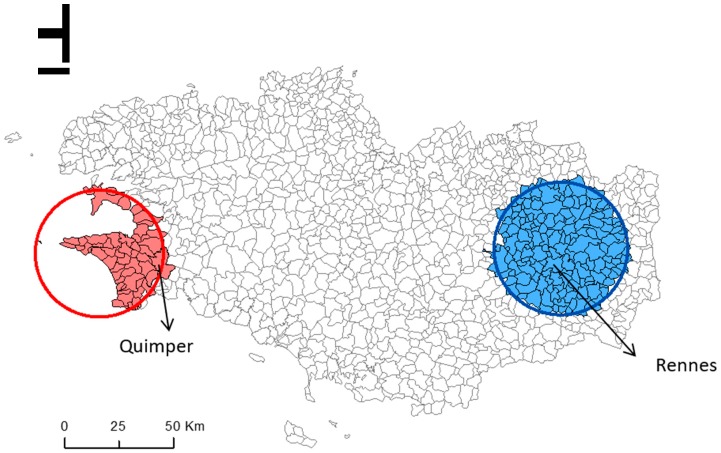
Emergency first dialysis start considerably increases the risk of morbidity and mortality. Our objective was to identify the geographic variations of emergency first dialysis risk in patients with end-stage renal disease in the Bretagne region, France. The spatial scan statistic approach was used to determine the clusters of municipalities with significantly higher or lower risk of emergency first dialysis. Patient data extracted from the REIN registry (sociodemographic, clinical, and biological characteristics) and indicators constructed at the municipality level, were compared between clusters. This analysis identified a cluster of municipalities in western Bretagne with a significantly higher risk (RR = 1.80, = 0.044) and one cluster in the eastern part of the region with a significantly lower risk (RR = 0.59, < 0.01) of emergency first dialysis. The degree of urbanization (the proportion of rural municipalities: 76% versus 66%, < 0.001) and socio-demographic characteristics (the unemployment rate: 11% versus 8%, < 0.001, the percentage of managers in the labor force was lower: 9% versus 13% < 0.001) of the municipalities located in the higher-risk cluster compared with the lower-risk cluster. Our analysis indicates that the patients' clinical status cannot explain the geographic variations of emergency first dialysis incidence in Bretagne. Conversely, where patients live seems to play an important role.
急诊起始透析会显著增加发病率和死亡率。我们的目的是确定法国布列塔尼地区终末期肾病患者急诊起始透析风险的地理变化。采用空间扫描统计方法确定急诊起始透析风险显著较高或较低的市镇集群。从 REIN 登记处提取患者数据(社会人口统计学、临床和生物学特征)和在市镇层面构建的指标,并在集群之间进行比较。该分析确定了布列塔尼西部的一个市镇集群,其急诊起始透析风险显著较高(RR=1.80,=0.044),而该地区东部的一个集群的风险显著较低(RR=0.59,<0.01)。位于高风险集群的市镇的城市化程度(农村市镇的比例:76%比 66%,<0.001)和社会人口统计学特征(失业率:11%比 8%,<0.001,劳动力中管理人员的比例较低:9%比 13%,<0.001)与低风险集群相比。我们的分析表明,患者的临床状况不能解释布列塔尼急诊起始透析发生率的地理变化。相反,患者居住的地方似乎起着重要作用。