Hereditary Cancer Program, Catalan Institute of Oncology, IDIBELL, Hospitalet de Llobregat, Barcelona, Spain.
Program in Molecular Mechanisms and Experimental Therapy in Oncology (Oncobell), IDIBELL, Hospitalet de Llobregat, Barcelona, Spain.
J Med Genet. 2019 Aug;56(8):521-525. doi: 10.1136/jmedgenet-2018-105700. Epub 2018 Dec 22.
Genetic testing of hereditary cancer using comprehensive gene panels can identify patients with more than one pathogenic mutation in high and/or moderate-risk-associated cancer genes. This phenomenon is known as multilocus inherited neoplasia alleles syndrome (MINAS), which has been potentially linked to more severe clinical manifestations.
To determine the prevalence and clinical features of MINAS in a large cohort of adult patients with hereditary cancer homogeneously tested with the same gene panel.
A cohort of 1023 unrelated patients with suspicion of hereditary cancer was screened using a validated panel including up to 135 genes associated with hereditary cancer and phakomatoses.
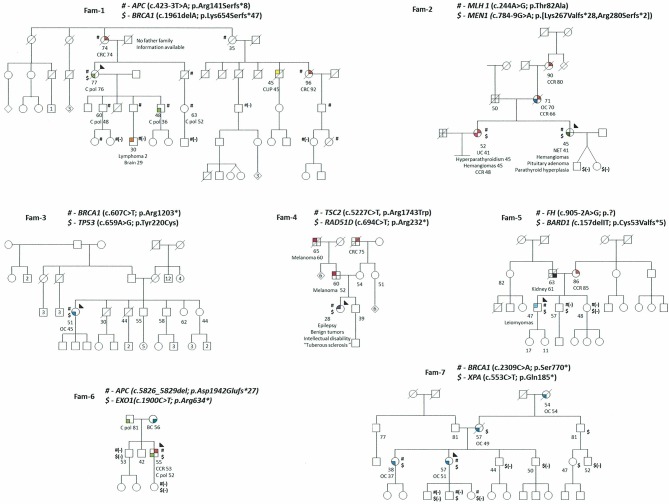
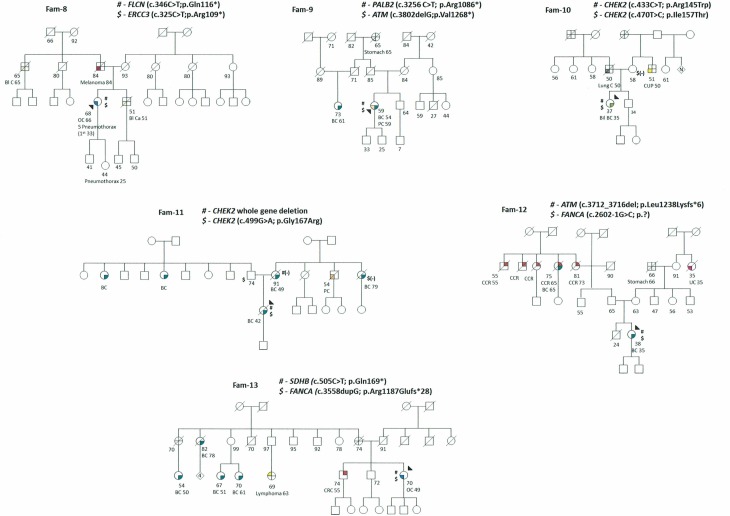
Thirteen (1.37%) patients harbouring two pathogenic mutations in dominant cancer-predisposing genes were identified, representing 5.7% (13/226) of patients with pathogenic mutations. Most (10/13) of these cases presented clinical manifestations associated with only one of the mutations identified. One case showed mutations in and and developed tumours associated with both cancer syndromes. Interestingly, three of the double mutants had a young age of onset or severe breast cancer phenotype and carried mutations in moderate to low-risk DNA damage repair-associated genes; two of them presented biallelic inactivation of . We included these two patients for the sake of their clinical interest although we are aware that they do not exactly fulfil the definition of MINAS since both mutations are in the same gene.
Genetic analysis of a broad cancer gene panel identified the largest series of patients with MINAS described in a single study. Overall, our data do not support the existence of more severe manifestations in double mutants at the time of diagnosis although they do confirm previous evidence of severe phenotype in biallelic and other DNA repair cancer-predisposing genes.
使用全面的基因谱对遗传性癌症进行基因检测,可以识别出多个高风险和/或中风险相关癌症基因中存在致病性突变的患者。这种现象被称为多基因遗传性肿瘤等位基因综合征(MINAS),它与更严重的临床表现有关。
在使用相同基因谱对遗传性癌症的大型成年患者队列中,确定 MINAS 的患病率和临床特征。
对 1023 名疑似遗传性癌症的无亲缘关系患者进行了筛选,使用的是一种经验证的包括多达 135 个与遗传性癌症和神经皮肤综合征相关基因的基因谱。
在 135 个基因中发现了两个显性癌症易感基因中的致病性突变的 13 名(1.37%)患者,占致病性突变患者的 5.7%(13/226)。这些病例中大多数(10/13)仅表现出与其中一种突变相关的临床表现。有一例同时携带 和 突变,发生了两种癌症综合征相关的肿瘤。有趣的是,三个双突变体的发病年龄较早或患有严重的乳腺癌表型,且携带中低风险 DNA 损伤修复相关基因的突变;其中两个表现出 的双等位基因失活。我们纳入了这两名患者,主要是出于临床考虑,尽管我们知道他们并不完全符合 MINAS 的定义,因为两种突变都在同一个基因中。
对广泛的癌症基因谱进行遗传分析,确定了在单一研究中描述的最大系列 MINAS 患者。总体而言,我们的数据并不支持双突变体在诊断时表现出更严重的表现,尽管它们确实证实了以前在双等位基因 和其他 DNA 修复癌症易感基因中严重表型的证据。