Labriaga Wilmart, Song So-Yeon, Park Jin-Hong, Ryu Jae-Jun, Lee Jeong-Yol, Shin Sang-Wan
Department of Prosthodontics, Institute for Clinical Dental Research, Korea University Medical Center, Seoul, Republic of Korea.
J Adv Prosthodont. 2018 Dec;10(6):408-414. doi: 10.4047/jap.2018.10.6.408. Epub 2018 Dec 19.
This study aimed to assess the effect of non-thermal plasma on the shear bond strength of resin cements to polyetherketoneketone (PEKK) in comparison to other surface treatment methods.
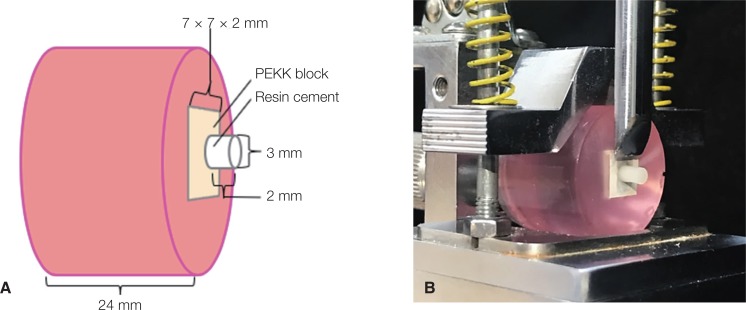
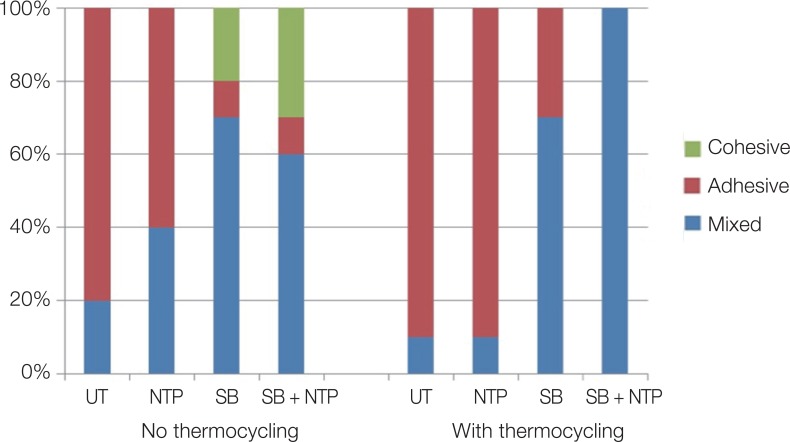
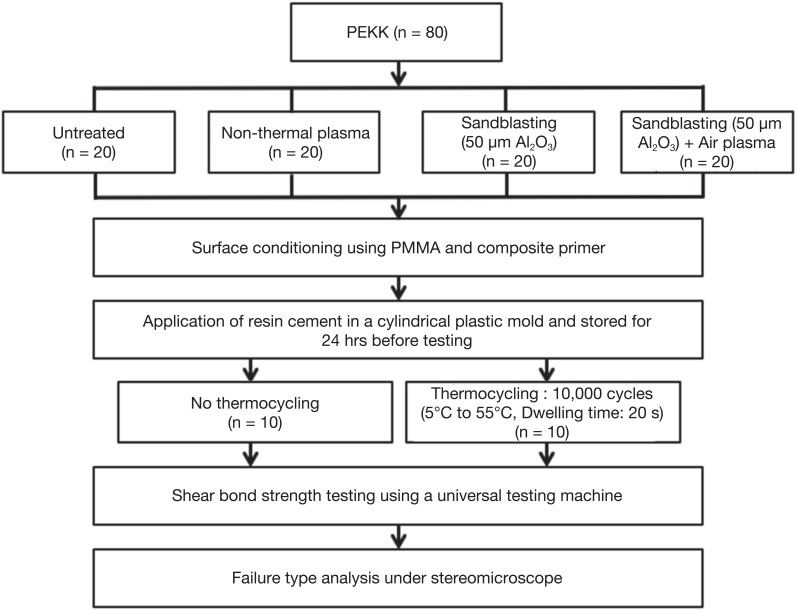
Eighty PEKK discs were subjected to different surface treatments: (1) Untreated (UT); (2) Non-thermal plasma (NTP); (3) Sandblasting with 50 µm AlO particles (SB); and (4) Sandblasting + Non-thermal plasma (SB+NTP). After each surface treatment, the contact angle was measured. Surface conditioning with Visio.Link was applied in all groups after pre-treatment. RelyX Unicem resin cement was bonded onto the PEKK specimens. After fabrication of the specimens, half of each group (n=10) was initially tested, while the other half was subjected to thermocycling (5℃ to 55℃ at 10,000 cycles). Shear bond strength (SBS) testing was performed using a universal testing machine, and failure modes were assessed using stereomicroscopy. The SBS results were analyzed statistically using one-way ANOVA followed by Tukey's post hoc test. Independent t-test was used to examine the effect of thermocycling (<.05).
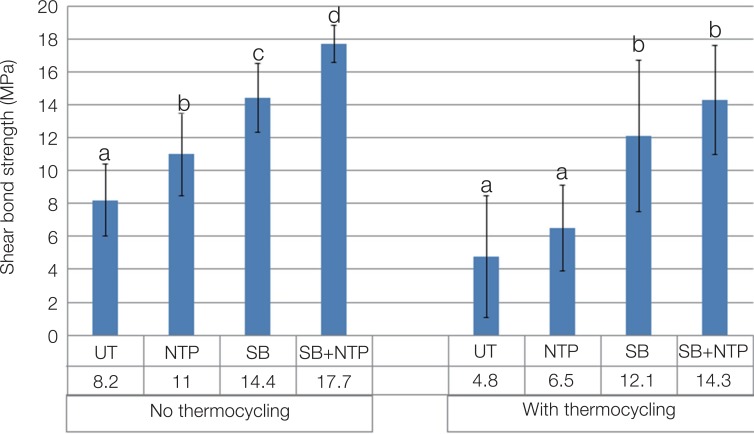
The highest SBS values with or without thermocycling were observed with PEKK specimens that were treated with SB+NTP followed by the SB group. The lowest SBS results were observed in the UT groups.
The shear bond strength between PEKK and resin cements was improved using non-thermal plasma treatment in combination with sandblasting.
本研究旨在评估与其他表面处理方法相比,非热等离子体对树脂水门汀与聚醚酮酮(PEKK)之间剪切粘结强度的影响。
80个PEKK圆盘进行不同的表面处理:(1)未处理(UT);(2)非热等离子体(NTP);(3)用50 µm AlO颗粒喷砂(SB);(4)喷砂+非热等离子体(SB+NTP)。每次表面处理后,测量接触角。预处理后,所有组均采用Visio.Link进行表面预处理。将RelyX Unicem树脂水门汀粘结到PEKK试样上。制备试样后,每组的一半(n=10)最初进行测试,而另一半进行热循环(5℃至55℃,10000次循环)。使用万能试验机进行剪切粘结强度(SBS)测试,并使用立体显微镜评估失效模式。SBS结果采用单因素方差分析,然后进行Tukey事后检验进行统计学分析。使用独立t检验检查热循环的影响(<.05)。
在经过SB+NTP处理的PEKK试样中,观察到无论有无热循环,SBS值最高,其次是SB组。在UT组中观察到最低的SBS结果。
结合喷砂使用非热等离子体处理可提高PEKK与树脂水门汀之间的剪切粘结强度。