Leung Wendy, Baxley Ryan M, Moldovan George-Lucian, Bielinsky Anja-Katrin
Department of Biochemistry, Molecular Biology and Biophysics, University of Minnesota, Minneapolis, MN 55455, USA.
Department of Biochemistry and Molecular Biology, The Pennsylvania State University College of Medicine, Hershey, PA 17033, USA.
Genes (Basel). 2018 Dec 24;10(1):10. doi: 10.3390/genes10010010.
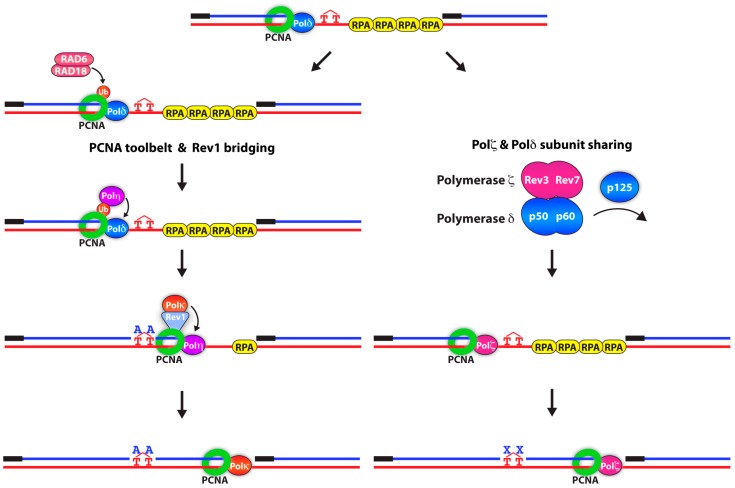
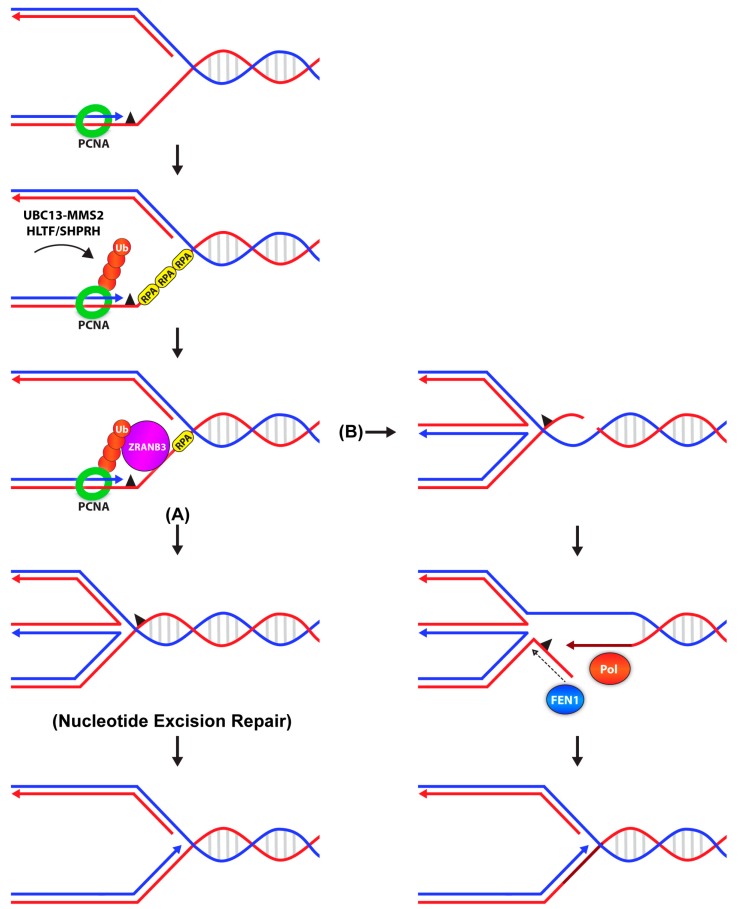
DNA damage is a constant source of stress challenging genomic integrity. To ensure faithful duplication of our genomes, mechanisms have evolved to deal with damage encountered during replication. One such mechanism is referred to as DNA damage tolerance (DDT). DDT allows for replication to continue in the presence of a DNA lesion by promoting damage bypass. Two major DDT pathways exist: error-prone translesion synthesis (TLS) and error-free template switching (TS). TLS recruits low-fidelity DNA polymerases to directly replicate across the damaged template, whereas TS uses the nascent sister chromatid as a template for bypass. Both pathways must be tightly controlled to prevent the accumulation of mutations that can occur from the dysregulation of DDT proteins. A key regulator of error-prone versus error-free DDT is the replication clamp, proliferating cell nuclear antigen (PCNA). Post-translational modifications (PTMs) of PCNA, mainly by ubiquitin and SUMO (small ubiquitin-like modifier), play a critical role in DDT. In this review, we will discuss the different types of PTMs of PCNA and how they regulate DDT in response to replication stress. We will also cover the roles of PCNA PTMs in lagging strand synthesis, meiotic recombination, as well as somatic hypermutation and class switch recombination.
DNA损伤是挑战基因组完整性的持续应激源。为确保我们的基因组能够准确复制,进化出了应对复制过程中遇到的损伤的机制。其中一种机制被称为DNA损伤耐受(DDT)。DDT通过促进损伤绕过,使复制在存在DNA损伤的情况下继续进行。存在两种主要的DDT途径:易出错的跨损伤合成(TLS)和无错误的模板切换(TS)。TLS招募低保真度的DNA聚合酶直接跨越受损模板进行复制,而TS则以新生的姐妹染色单体为模板进行绕过。这两种途径都必须受到严格控制,以防止因DDT蛋白失调而导致的突变积累。易出错与无错误DDT的关键调节因子是复制钳增殖细胞核抗原(PCNA)。PCNA的翻译后修饰(PTM),主要是泛素化和类泛素化修饰(SUMO,小泛素样修饰物),在DDT中起着关键作用。在本综述中,我们将讨论PCNA的不同类型的PTM,以及它们如何响应复制应激来调节DDT。我们还将涵盖PCNA PTM在滞后链合成、减数分裂重组以及体细胞超突变和类别转换重组中的作用。