Genome Integrity and Structural Biology Laboratory, National Institute of Environmental Health Sciences, NIH, DHHS, Research Triangle Park, Durham, NC, 27709, USA.
Integrative Bioinformatics Support Group, National Institute of Environmental Health Sciences, NIH, DHHS, Research Triangle Park, Durham, NC, 27709, USA.
Nat Commun. 2018 Feb 27;9(1):858. doi: 10.1038/s41467-018-03270-4.
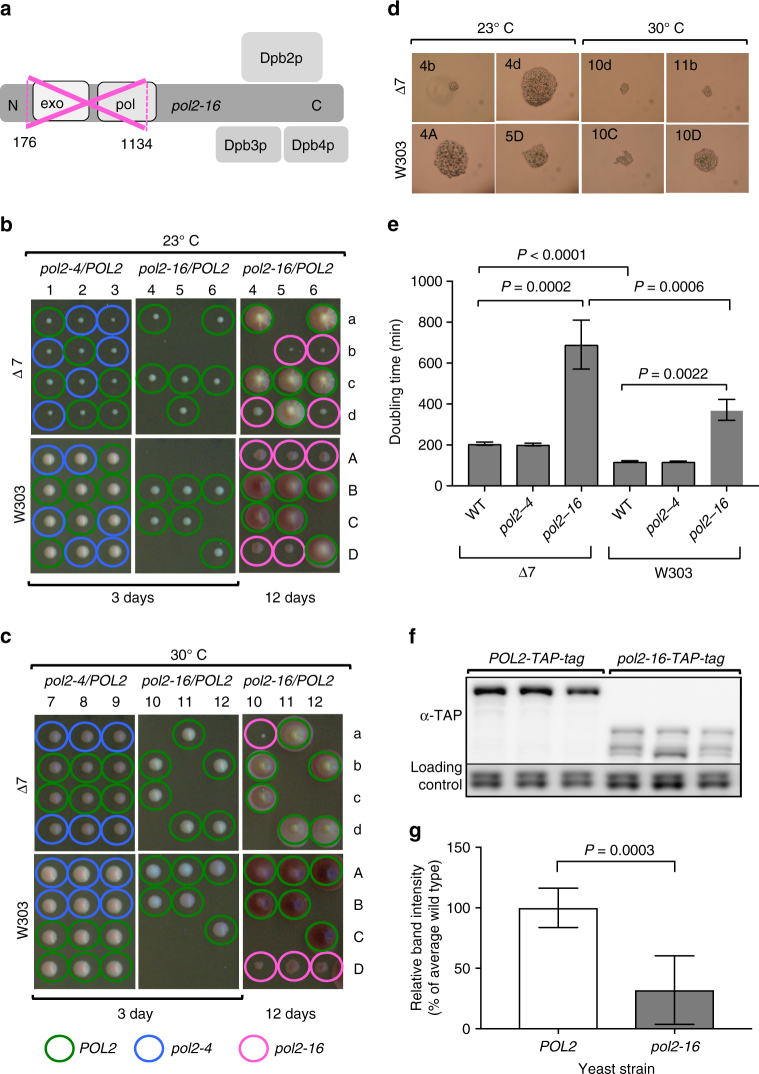
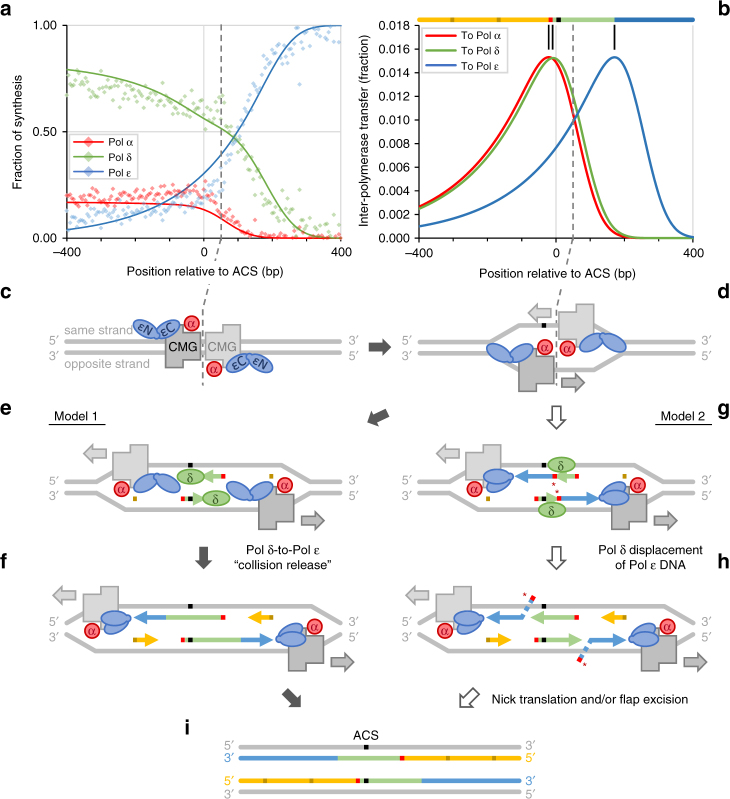
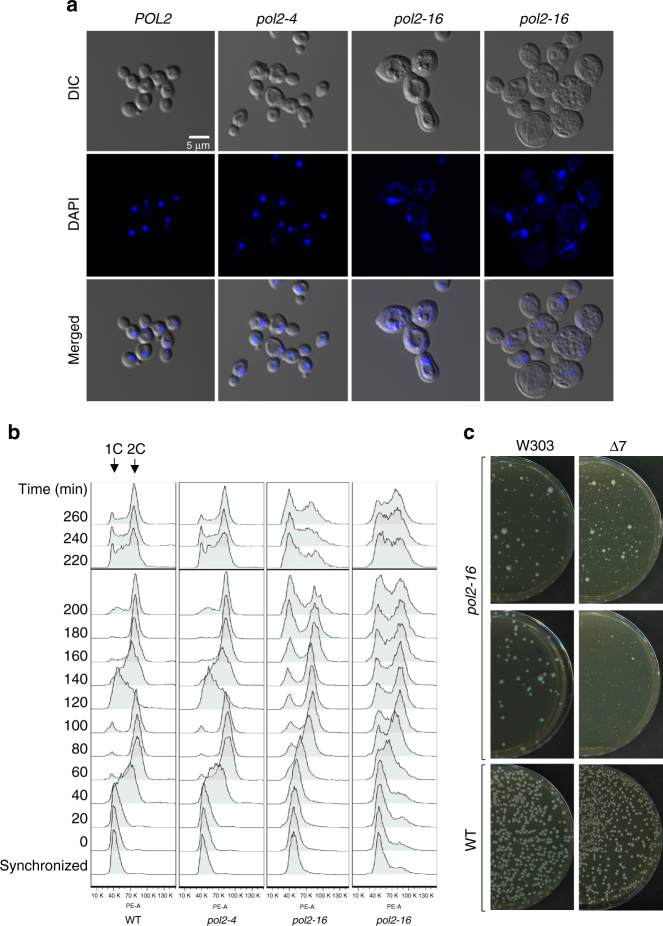
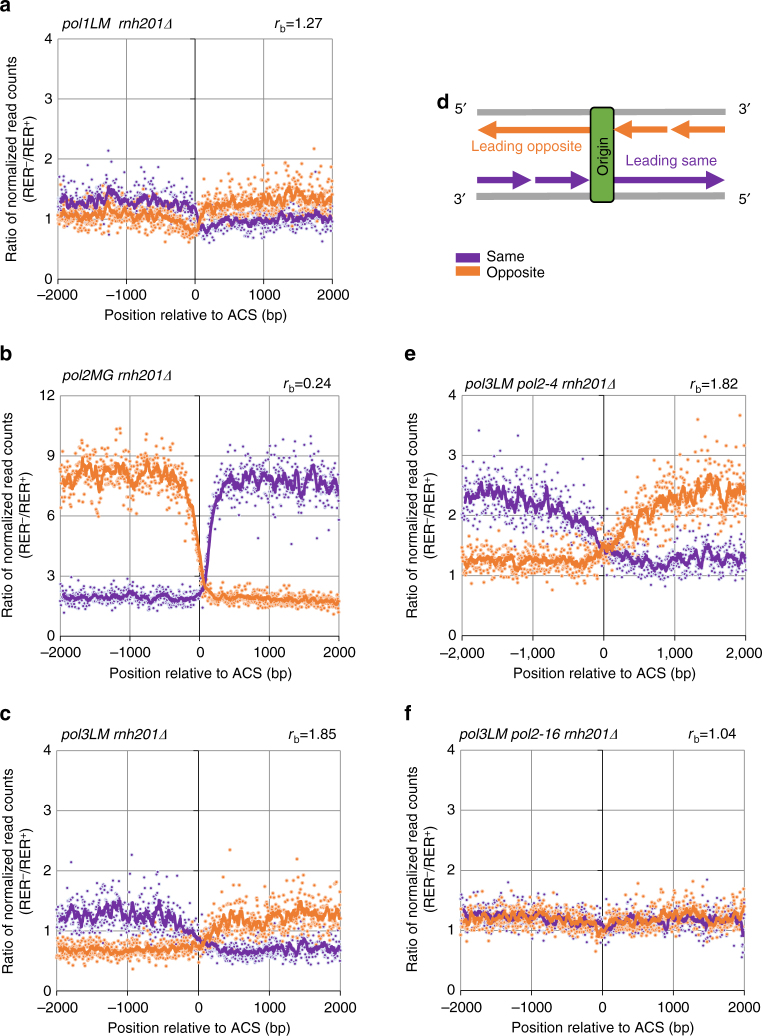
To investigate nuclear DNA replication enzymology in vivo, we have studied Saccharomyces cerevisiae strains containing a pol2-16 mutation that inactivates the catalytic activities of DNA polymerase ε (Pol ε). Although pol2-16 mutants survive, they present very tiny spore colonies, increased doubling time, larger than normal cells, aberrant nuclei, and rapid acquisition of suppressor mutations. These phenotypes reveal a severe growth defect that is distinct from that of strains that lack only Pol ε proofreading (pol2-4), consistent with the idea that Pol ε is the major leading-strand polymerase used for unstressed DNA replication. Ribonucleotides are incorporated into the pol2-16 genome in patterns consistent with leading-strand replication by Pol δ when Pol ε is absent. More importantly, ribonucleotide distributions at replication origins suggest that in strains encoding all three replicases, Pol δ contributes to initiation of leading-strand replication. We describe two possible models.
为了研究体内核 DNA 复制酶学,我们研究了含有 pol2-16 突变的酿酒酵母菌株,该突变使 DNA 聚合酶 ε(Pol ε)的催化活性失活。虽然 pol2-16 突变体能够存活,但它们形成的孢子菌落非常小,倍增时间增加,细胞比正常细胞大,核异常,并且迅速获得抑制突变。这些表型揭示了一种严重的生长缺陷,与仅缺乏 Pol ε 校对(pol2-4)的菌株不同,这与 Pol ε 是用于无应激 DNA 复制的主要前导链聚合酶的观点一致。当 Pol ε 不存在时,核糖核苷酸以与 Pol δ 在前导链复制时一致的模式掺入 pol2-16 基因组中。更重要的是,复制起点处的核糖核苷酸分布表明,在编码所有三种复制酶的菌株中,Pol δ 有助于引发前导链复制。我们描述了两种可能的模型。