Department of Biochemical Science and Technology, National Taiwan University, No. 1, Sec. 4, Roosevelt Road, Taipei, 10617, Taiwan.
BMC Biotechnol. 2018 Dec 27;18(1):81. doi: 10.1186/s12896-018-0492-4.
The methanol-regulated AOX1 promoter (P) is the most widely used promoter in the production of recombinant proteins in the methylotrophic yeast Pichia pastoris. However, as the tight regulation and methanol dependence of P restricts its application, it is necessary to develop a flexible induction system to avoid the problems of methanol without losing the advantages of P. The availability of synthetic biology tools enables researchers to reprogram the cellular behaviour of P. pastoris to achieve this goal.
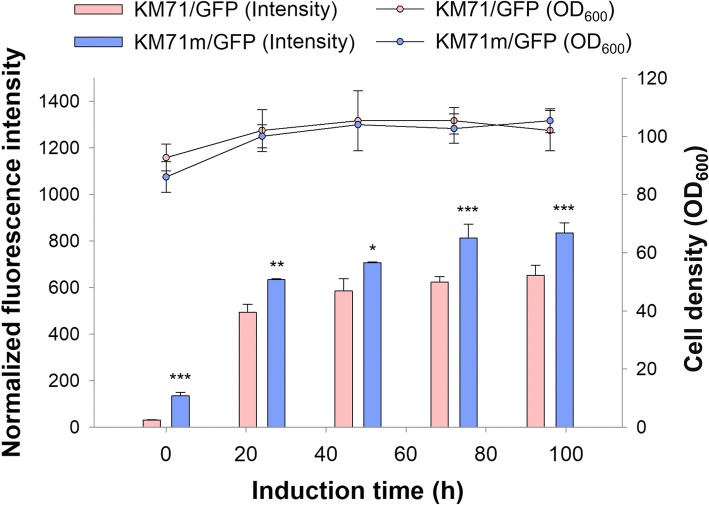
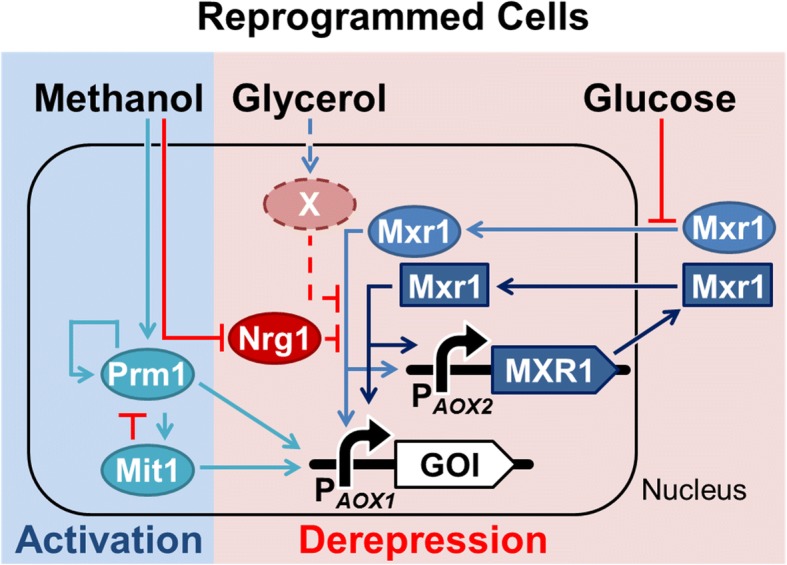
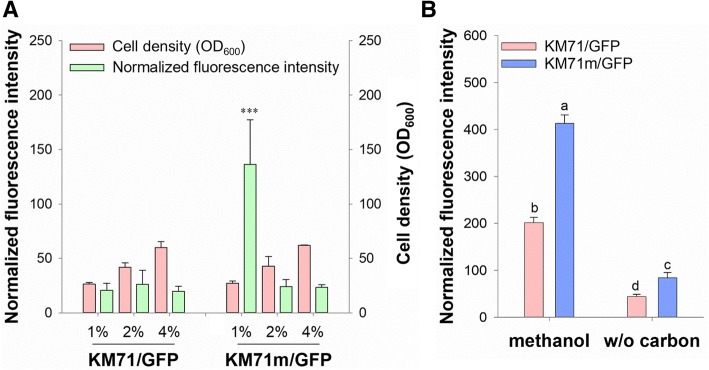
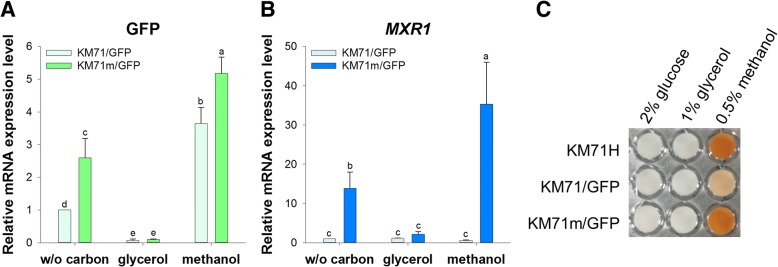
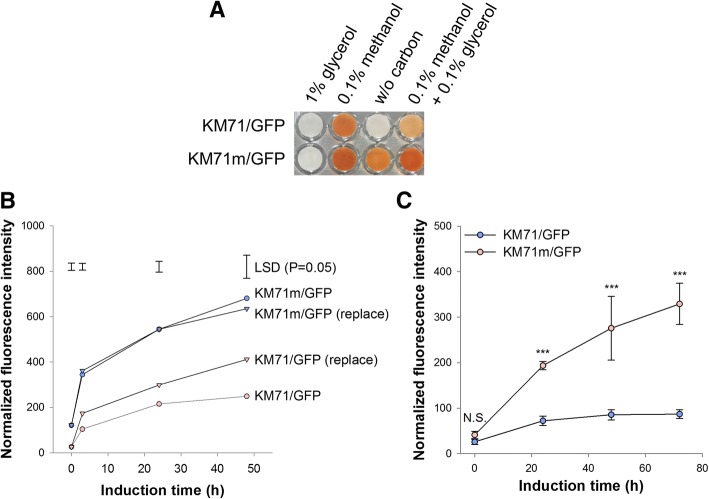
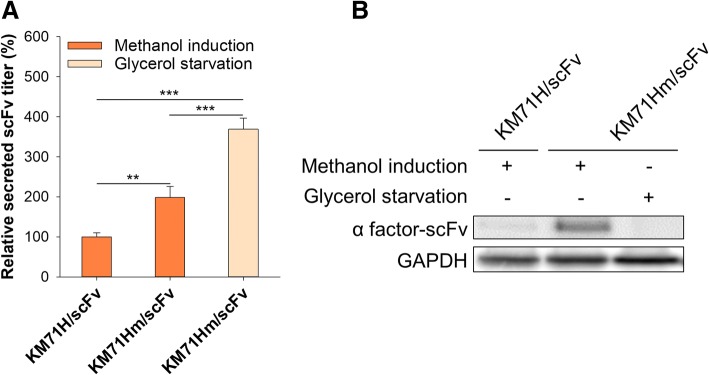
The characteristics of P are highly related to the expression profile of methanol expression regulator 1 (Mxr1). In this study, we applied a biologically inspired strategy to reprogram regulatory networks in P. pastoris. A reprogrammed P. pastoris was constructed by inserting a synthetic positive feedback circuit of Mxr1 driven by a weak AOX2 promoter (P). This novel approach enhanced P efficiency by providing extra Mxr1 and generated switchable Mxr1 expression to allow P to be induced under glycerol starvation or carbon-free conditions. Additionally, the inhibitory effect of glycerol on P was retained because the synthetic circuit was not activated in response to glycerol. Using green fluorescent protein as a demonstration, this reprogrammed P. pastoris strain displayed stronger fluorescence intensity than non-reprogrammed cells under both methanol induction and glycerol starvation. Moreover, with single-chain variable fragment (scFv) as the model protein, increases in extracellular scFv productivity of 98 and 269% were observed in Mxr1-reprogrammed cells under methanol induction and glycerol starvation, respectively, compared to productivity in non-reprogrammed cells under methanol induction.
We successfully demonstrate that the synthetic positive feedback circuit of Mxr1 enhances recombinant protein production efficiency in P. pastoris and create a methanol-free induction system to eliminate the potential risks of methanol.
甲醇调控的 AOX1 启动子(P)是甲醇营养型酵母巴斯德毕赤酵母中生产重组蛋白最广泛使用的启动子。然而,由于 P 的严格调控和甲醇依赖性限制了其应用,因此有必要开发一种灵活的诱导系统,在避免甲醇问题的同时保持 P 的优势。合成生物学工具的可用性使研究人员能够重新编程巴斯德毕赤酵母的细胞行为,以实现这一目标。
P 的特性与甲醇表达调控因子 1(Mxr1)的表达谱高度相关。在本研究中,我们应用了一种受启发于生物学的策略来重新编程巴斯德毕赤酵母的调控网络。通过在弱 AOX2 启动子(P)驱动的甲醇表达调控因子 1 (Mxr1)的合成正反馈回路中插入一个合成的正反馈回路,构建了一个重新编程的巴斯德毕赤酵母。这种新方法通过提供额外的 Mxr1 来增强 P 的效率,并产生可切换的 Mxr1 表达,允许 P 在甘油饥饿或无碳条件下被诱导。此外,由于合成回路没有响应甘油而被激活,因此保留了甘油对 P 的抑制作用。使用绿色荧光蛋白作为演示,与非重新编程细胞相比,在甲醇诱导和甘油饥饿下,这种重新编程的巴斯德毕赤酵母菌株显示出更强的荧光强度。此外,以单链可变片段(scFv)为模型蛋白,与甲醇诱导下非重新编程细胞相比,在 Mxr1 重新编程细胞中,甲醇诱导和甘油饥饿下 scFv 的细胞外产量分别提高了 98%和 269%。
我们成功地证明了 Mxr1 的合成正反馈回路提高了巴斯德毕赤酵母中重组蛋白的生产效率,并创建了一种无甲醇诱导系统,以消除甲醇的潜在风险。