Phillips David E, Adair Tim, Lopez Alan D
Institute for Health Metrics and Evaluation, University of Washington, Seattle, USA.
Melbourne School of Population and Global Health, University of Melbourne, Melbourne, Australia.
Popul Health Metr. 2018 Dec 27;16(1):21. doi: 10.1186/s12963-018-0180-6.
The registration and certification of births has a wide array of individual and societal benefits. While near-universal in some parts of the world, birth registration is less common in many low- and middle-income countries, and the quality of vital statistics vary. We assembled publicly available birth registration records for as many countries as possible into a novel global birth registration database, and we present a systematic assessment of available data.
We obtained 4918 country-years of data from 145 countries covering the period 1948-2015. We compared these to existing estimates of total births to assess completeness of public data and adapted existing methods to evaluate the quality and timeliness of the data.
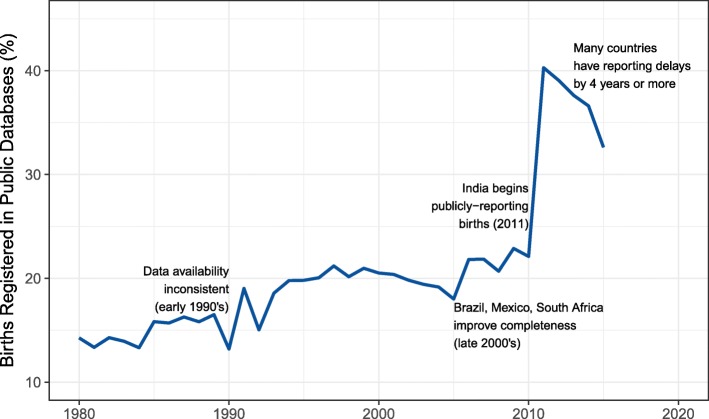
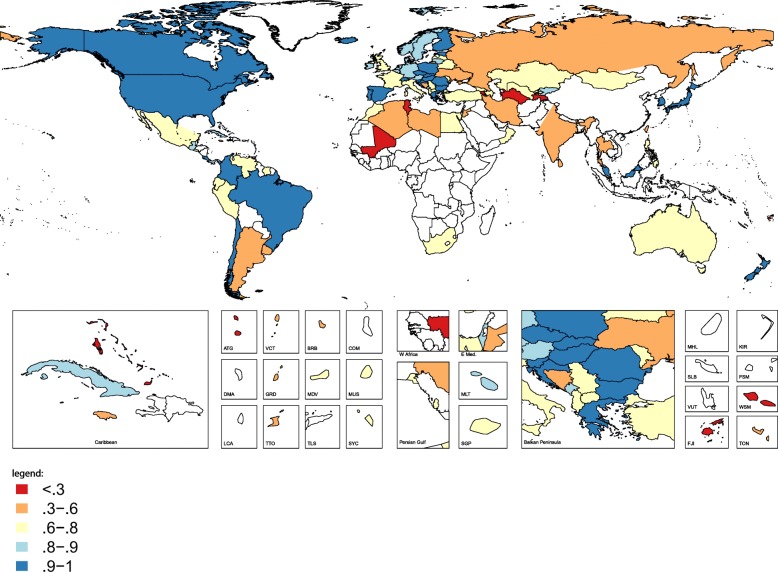
Since 1980, approximately one billion births were registered and shared in public databases. Compared to estimates of fertility, this represents only 40.0% of total births in the peak year, 2011. Approximately 74 million births (53.1%) per year occur in countries whose systems do not systematically register them and release the aggregate records. Considering data quality, timeliness, and completeness in country-years where data are available, only about 12 million births per year (8.6%) occur in countries with high-performing registration systems.
This analysis highlights the gaps in available data. Our objective and low-cost approach to assessing the performance of birth registration systems can be helpful to monitor country progress, and to help national and international policymakers set targets for strengthening birth registration systems.
出生登记与认证具有广泛的个人和社会效益。虽然在世界某些地区已接近普及,但在许多低收入和中等收入国家,出生登记并不常见,且人口动态统计数据的质量参差不齐。我们尽可能多地收集了公开可用的各国出生登记记录,构建了一个全新的全球出生登记数据库,并对现有数据进行了系统评估。
我们获取了145个国家在1948年至2015年期间的4918个国家年度数据。我们将这些数据与现有总出生人数估计值进行比较,以评估公共数据的完整性,并采用现有方法评估数据的质量和及时性。
自1980年以来,约有10亿例出生登记并共享于公共数据库。与生育率估计值相比,这仅占2011年峰值年份总出生人数的40.0%。每年约有7400万例出生(占53.1%)发生在其系统未进行系统登记并公布汇总记录的国家。考虑到有数据可查的国家年度中的数据质量、及时性和完整性,每年仅有约1200万例出生(占8.6%)发生在登记系统表现良好的国家。
该分析凸显了现有数据存在的差距。我们评估出生登记系统性能的客观且低成本方法,有助于监测各国进展,并帮助国家和国际政策制定者设定加强出生登记系统的目标。