Zhu Gui-Qi, Wang Kang, Wang Biao, Zhou Yu-Jie, Yang Yi, Chen Er-Bao, Zhou Zheng-Jun, Zhou Shao-Lai, Shi Ying-Hong, Zhou Jian, Dai Zhi
Liver Cancer Institute, Zhongshan Hospital, Fudan University, Shanghai 200032, China,
State Key Laboratory of Genetic Engineering, Fudan University, Shanghai, 200032, China,
Cancer Manag Res. 2018 Dec 20;11:63-79. doi: 10.2147/CMAR.S186150. eCollection 2019.
To investigate the value of the aspartate aminotransferase-to-platelet ratio index (APRI) and build a new nomogram for hepatocellular carcinoma (HCC) patients undergoing postoperative adjuvant transarterial chemoembolization (PATACE).
We retrospectively reviewed 351 patients with HCC undergoing PATACE. We collected baseline HCC patient characteristics to obtain the risk factors for determining poor disease-free survival (DFS) and early time to recurrence (TTR) after PATACE. The multivariate Cox proportional hazards model was used to build new nomogram based on significant prognostic factors of outcomes.
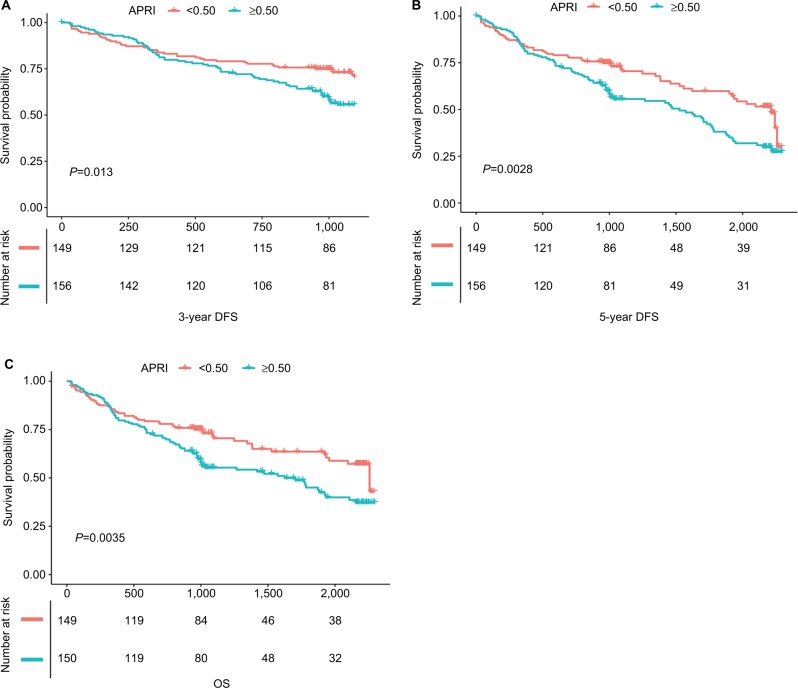
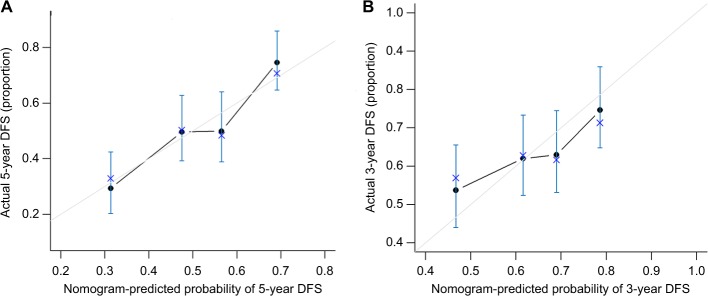
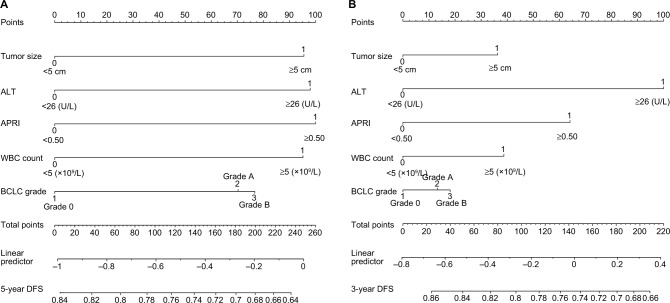
We generated the cutoff value of the APRI as 0.50 using the X-tile to distinguish patients with different outcomes in the whole cohort. Two hundred seventeen patients with high APRI had poorer survival (<0.001) than did 134 patients with low APRI. Furthermore, a nomogram, including tumor size, alanine aminotransferase (ALT) level, white blood cell counts, Barcelona Clinic Liver Cancer grade, and APRI was built for DFS, while factors including hepatitis B surface antigen, tumor size, ALT, microvascular invasion, and APRI was built for TTR. Internal validation with 500 bootstrapped sample sets had a good concordance index of 0.729 for DFS and 0.730 for TTR. Additionally, nomogram based on APRI conferred more prognostic value than previous biomarkers.
High APRI was associated with worse survival and shorter TTR for HCC patients undergoing PATACE. This simple nomogram based on APRI conferred personalized survival and recurrence data for HCC patients undergoing PATACE.
探讨天冬氨酸氨基转移酶与血小板比值指数(APRI)的价值,并为接受术后辅助经动脉化疗栓塞术(PATACE)的肝细胞癌(HCC)患者构建新的列线图。
我们回顾性分析了351例行PATACE的HCC患者。收集HCC患者的基线特征,以获取决定PATACE术后无病生存期(DFS)差和复发时间(TTR)早的危险因素。采用多因素Cox比例风险模型,基于结局的显著预后因素构建新的列线图。
我们使用X-tile软件得出APRI的截断值为0.50,以区分整个队列中不同结局的患者。217例APRI高的患者生存率低于APRI低的134例患者(<0.001)。此外,构建了一个包括肿瘤大小、丙氨酸氨基转移酶(ALT)水平、白细胞计数、巴塞罗那临床肝癌分期和APRI的DFS列线图,以及一个包括乙肝表面抗原、肿瘤大小、ALT、微血管侵犯和APRI的TTR列线图。对500个自抽样样本集进行内部验证,DFS的一致性指数为0.729,TTR的一致性指数为0.730。此外,基于APRI的列线图比以前的生物标志物具有更高的预后价值。
高APRI与接受PATACE的HCC患者较差的生存率和较短的TTR相关。这个基于APRI的简单列线图为接受PATACE的HCC患者提供了个性化的生存和复发数据。