Sung Hyun Hwan, Yu Jiwoong, Kang Su Jeong, Chae Mee Ree, So Insuk, Park Jong Kwan, Lee Sung Won
Department of Urology, Samsung Medical Center, Sungkyunkwan University School of Medicine, Seoul, Korea.
Department of Physiology and Biophysics, Seoul National University College of Medicine, Seoul, Korea.
World J Mens Health. 2019 May;37(2):240-248. doi: 10.5534/wjmh.180082. Epub 2018 Dec 26.
The current study is aimed to assess whether a longer duration of 5α-reductase inhibitor (5α-RI) exposure was associated with higher rate of permanent erectile dysfunction (ED) in a rat model.
Male Sprague-Dawley rats (n=76) were assigned to five groups: (i) normal control group; (ii) dutasteride (0.5 mg/rat/d) for 4-weeks group; (iii) dutasteride for 4-weeks plus 2-weeks of resting group; (iv) dutasteride for 8-weeks group; and (v) dutasteride for 8-weeks plus 2-weeks of resting group. In vivo erectile responses to electrical stimulation, and changes of fibrotic factors and smooth muscle/collagen contents in the corpus cavernosum were evaluated in each group.
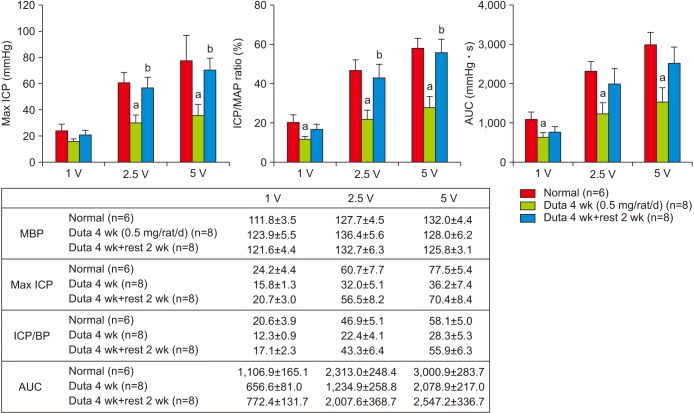
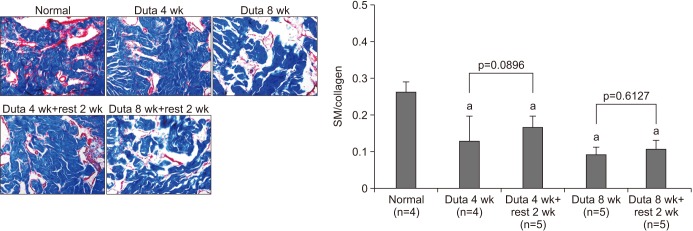
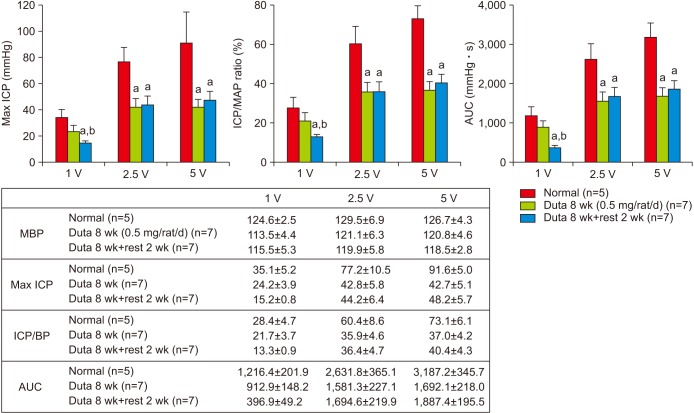
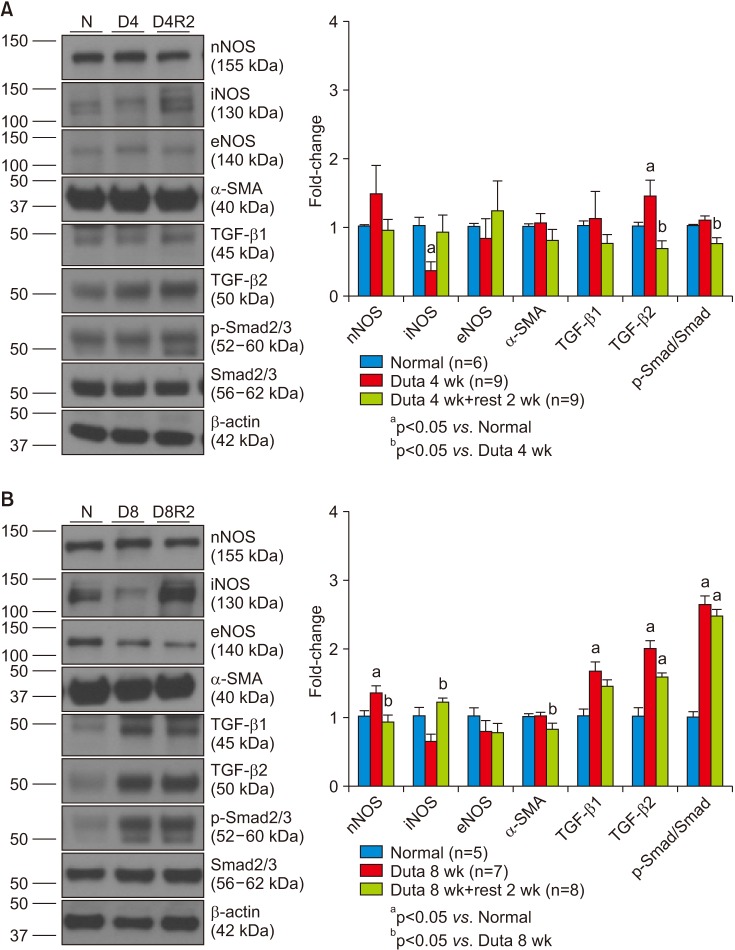
Dutasteride administration for 4 and 8 weeks significantly decreased erectile parameters compared with the control group. Reduced erectile responses were recovered during 2 weeks of drug-free time in the 4-week treatment group, but were not in the 8-week group. Protein levels of fibrosis-related factors transforming growth factor (TGF)-β1, TGF-β2, and p-Smad/Smad (Smad 2/3) in the corpus cavernosum showed no significant change after 4 weeks of dutasteride oral administration, but were enhanced after 8 weeks. Dutasteride markedly decreased smooth muscle content and increased collagen after 4 and 8 weeks of use, but no nuclear size changes; however, neither group showed significant improvement in the smooth muscle to collagen ratio after the rest period.
Our study showed that recovery from ED depended on the duration of medication, and administration of dutasteride for more than 8-weeks in rats could result in irreversible ED even after discontinuation of medication.
本研究旨在评估在大鼠模型中,较长时间暴露于5α-还原酶抑制剂(5α-RI)是否与永久性勃起功能障碍(ED)的更高发生率相关。
将雄性Sprague-Dawley大鼠(n = 76)分为五组:(i)正常对照组;(ii)度他雄胺(0.5 mg/大鼠/天)给药4周组;(iii)度他雄胺给药4周加2周休息组;(iv)度他雄胺给药8周组;(v)度他雄胺给药8周加2周休息组。评估每组大鼠对电刺激的体内勃起反应,以及阴茎海绵体中纤维化因子和平滑肌/胶原蛋白含量的变化。
与对照组相比,度他雄胺给药4周和8周显著降低了勃起参数。在4周治疗组中,停药2周期间勃起反应有所恢复,但8周组未恢复。口服度他雄胺4周后,阴茎海绵体中纤维化相关因子转化生长因子(TGF)-β1、TGF-β2和p-Smad/Smad(Smad 2/3)的蛋白水平无显著变化,但8周后升高。使用度他雄胺4周和8周后,平滑肌含量显著降低,胶原蛋白增加,但细胞核大小无变化;然而,休息期后两组的平滑肌与胶原蛋白比值均未显著改善。
我们的研究表明,ED的恢复取决于用药时间,在大鼠中使用度他雄胺超过8周即使停药后也可能导致不可逆的ED。