Department of Chemistry and Biochemistry, University of California Los Angeles, CA 90095, USA.
Department of Biological Chemistry, The Alexander Silberman Institute of Life Sciences, The Hebrew University of Jerusalem, Jerusalem 91904, Israel.
Nucleic Acids Res. 2019 Feb 20;47(3):1440-1450. doi: 10.1093/nar/gky1277.
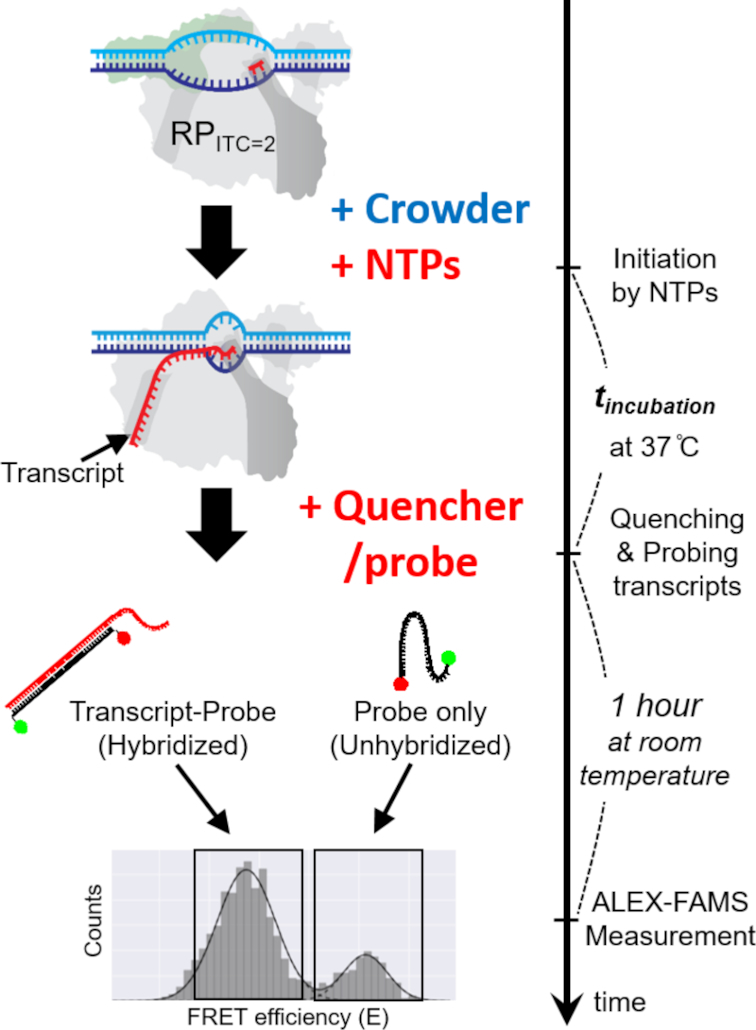
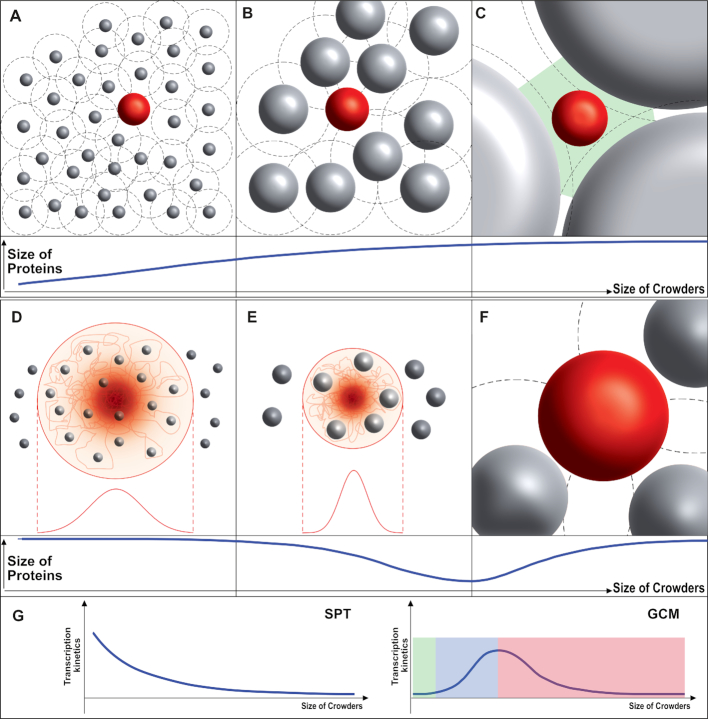
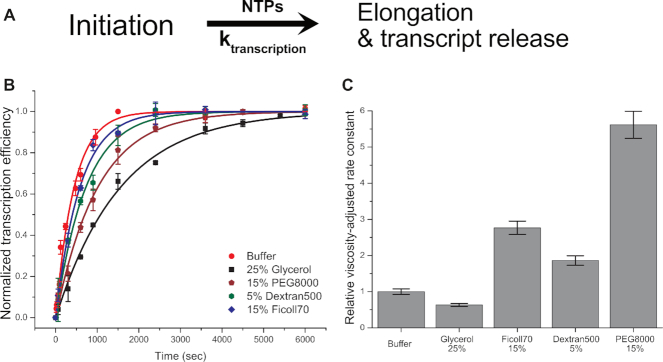
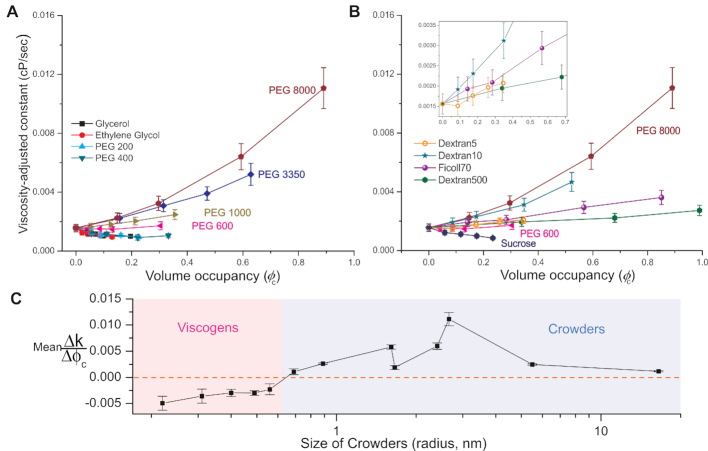
Previous works have reported significant effects of macromolecular crowding on the structure and behavior of biomolecules. The crowded intracellular environment, in contrast to in vitro buffer solutions, likely imparts similar effects on biomolecules. The enzyme serving as the gatekeeper for the genome, RNA polymerase (RNAP), is among the most regulated enzymes. Although it was previously demonstrated that macromolecular crowding affects association of RNAP to DNA, not much is known about how crowding acts on late initiation and promoter clearance steps, which are considered to be the rate-determining steps for many promoters. Here, we demonstrate that macromolecular crowding enhances the rate of late initiation and promoter clearance using in vitro quenching-based single-molecule kinetics assays. Moreover, the enhancement's dependence on crowder size notably deviates from predictions by the scaled-particle theory, commonly used for description of crowding effects. Our findings shed new light on how enzymatic reactions could be affected by crowded conditions in the cellular milieu.
先前的研究报告表明,生物分子的结构和行为受到高分子拥挤的显著影响。与体外缓冲溶液相比,细胞内拥挤的环境可能对生物分子产生类似的影响。作为基因组守门员的酶,RNA 聚合酶(RNAP),是最受调控的酶之一。虽然先前已经证明高分子拥挤会影响 RNAP 与 DNA 的结合,但对于拥挤如何影响后期起始和启动子清除步骤知之甚少,这些步骤被认为是许多启动子的限速步骤。在这里,我们使用基于体外猝灭的单分子动力学测定表明,高分子拥挤会增强后期起始和启动子清除的速率。此外,增强作用对拥挤剂大小的依赖性明显偏离了常用的描述拥挤效应的标度粒子理论的预测。我们的发现为酶促反应如何受到细胞环境中拥挤条件的影响提供了新的视角。