Department of Information Statistics, Kangwon National University, Chuncheon, South Korea.
Statistics Discipline, Division of Sciences and Mathematics, University of Minnesota-Morris, Morris, Minnesota.
Brain Behav. 2019 Jan;9(1):e01191. doi: 10.1002/brb3.1191. Epub 2018 Dec 27.
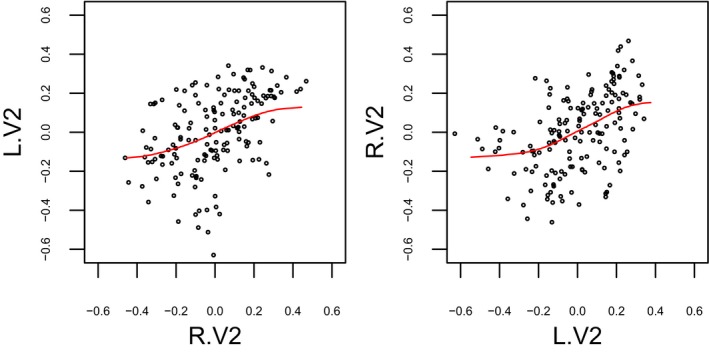
Inferring connectivity between brain regions has been raising a lot of attention in recent decades. Copula directional dependence (CDD) is a statistical measure of directed connectivity, which does not require strict assumptions on probability distributions and linearity.
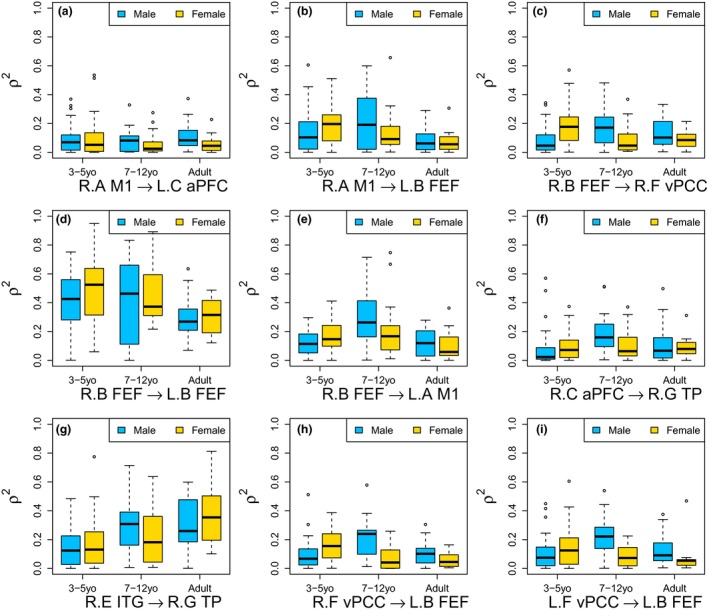
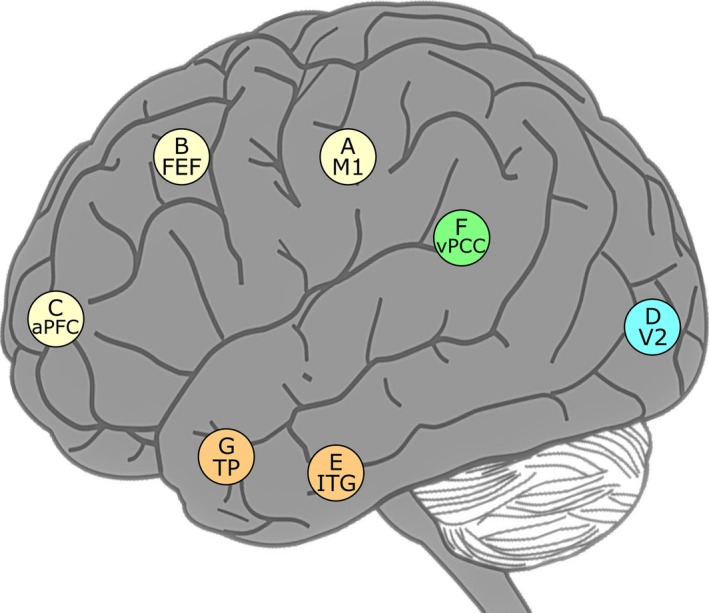
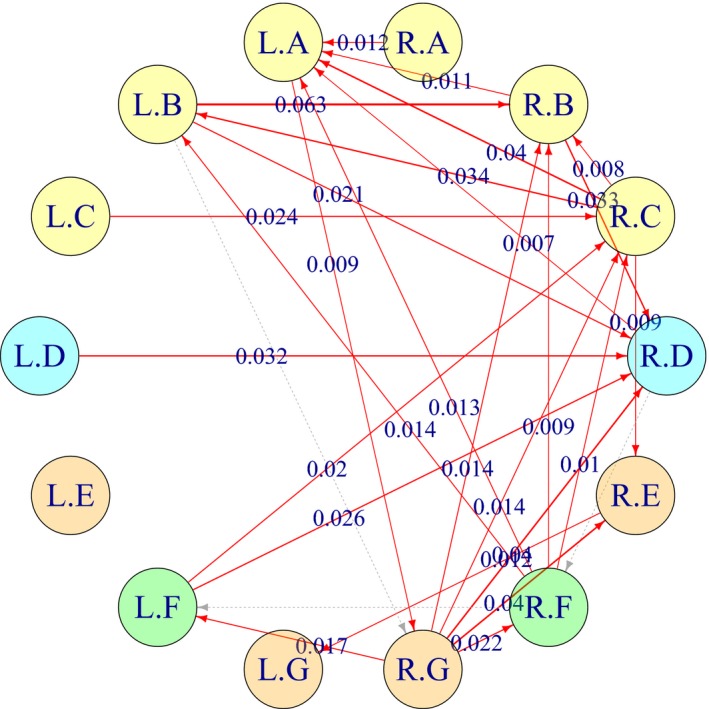
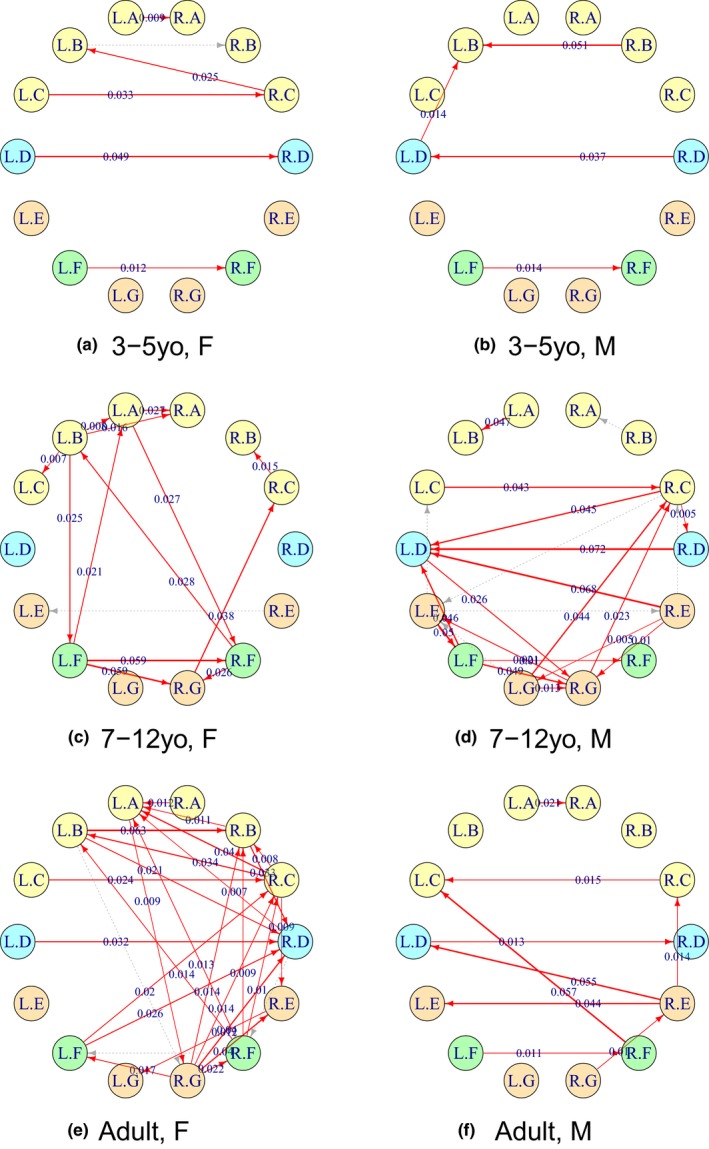
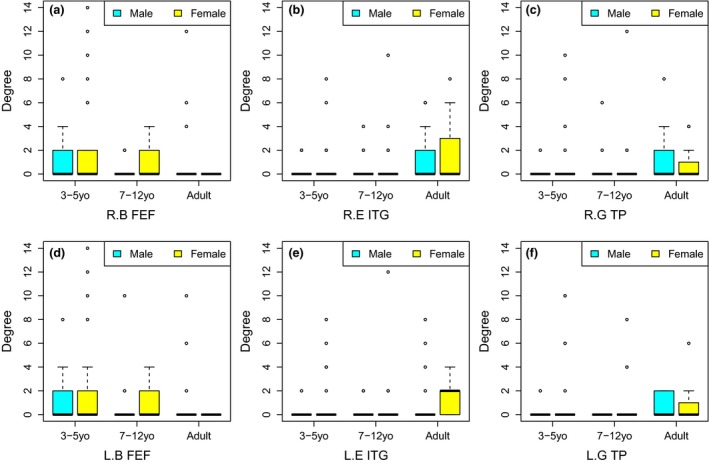
In this work, CDDs between pairs of local brain areas were estimated based on the fMRI responses of human participants watching a Pixar animation movie. A directed connectivity map of fourteen predefined local areas was obtained for each participant, where the network structure was determined by the strengths of the CDDs. A resampling technique was further applied to determine the statistical significance of the connectivity directions in the networks. In order to demonstrate the effectiveness of the suggested method using CDDs, statistical group analysis was conducted based on graph theoretic measures of the inferred directed networks and CDD intensities. When the 129 fMRI participants were grouped by their age (3-5 year-old, 7-12 year-old, adult) and gender (F, M), nonparametric two-way analysis of variance (ANOVA) results could identify which cortical regions and connectivity structures correlated with the two physiological factors.
Especially, we could identify that (a) graph centrality measures of the frontal eye fields (FEF), the inferior temporal gyrus (ITG), and the temporopolar area (TP) were significantly affected by aging, (b) CDD intensities between FEF and the primary motor cortex (M1) and between ITG and TP were highly significantly affected by aging, and (c) CDDs between M1 and the anterior prefrontal cortex (aPFC) were highly significantly affected by gender.
The R source code for fMRI data preprocessing, estimation of directional dependences, network visualization, and statistical analyses are available at https://github.com/namgillee/CDDforFMRI.
近几十年来,推断大脑区域之间的连接性引起了很多关注。Copula 方向依赖性(CDD)是一种用于测量有向连接的统计度量方法,它不需要对概率分布和线性关系进行严格假设。
在这项工作中,根据人类参与者观看皮克斯动画电影时的 fMRI 响应,估计了成对局部脑区之间的 CDD。为每个参与者获得了 14 个预定义的局部区域的有向连接图,其中网络结构由 CDD 的强度决定。进一步应用重采样技术来确定网络中连接方向的统计显著性。为了使用 CDD 证明所提出方法的有效性,基于推断的有向网络和 CDD 强度的图论度量进行了统计组分析。当将 129 名 fMRI 参与者按年龄(3-5 岁、7-12 岁、成人)和性别(F、M)分组时,非参数双向方差分析(ANOVA)结果可以确定哪些皮质区域和连接结构与两个生理因素相关。
特别是,我们可以识别出:(a)额眼区(FEF)、下颞叶(ITG)和颞极区(TP)的图中心性度量受到年龄的显著影响,(b)FEF 与初级运动皮层(M1)之间和 ITG 与 TP 之间的 CDD 强度受到年龄的高度显著影响,(c)M1 与前前额叶皮层(aPFC)之间的 CDD 受到性别高度显著影响。
fMRI 数据预处理、方向依赖性估计、网络可视化和统计分析的 R 源代码可在 https://github.com/namgillee/CDDforFMRI 上获得。