Department of Biochemistry and Molecular Biology, College of Life Science and Technology, Heilongjiang Bayi Agricultural University, Daqing, Heilongjiang 163319, P.R. China.
Department of Grass Science, College of Animal Science and Veterinary Medicine, Heilongjiang Bayi Agricultural University, Daqing, Heilongjiang 163319, P.R. China.
Mol Med Rep. 2019 Mar;19(3):1654-1664. doi: 10.3892/mmr.2018.9785. Epub 2018 Dec 21.
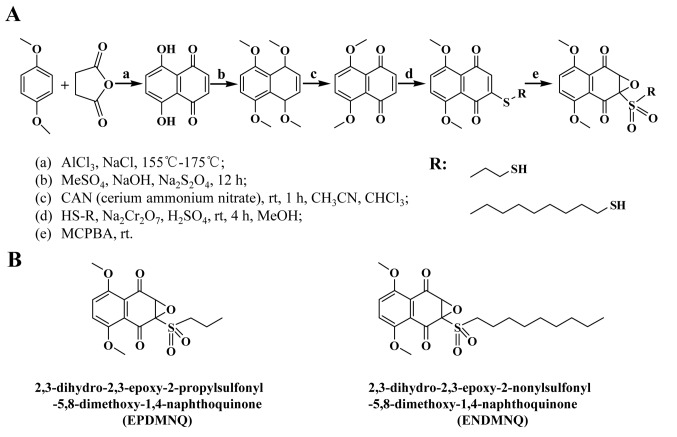
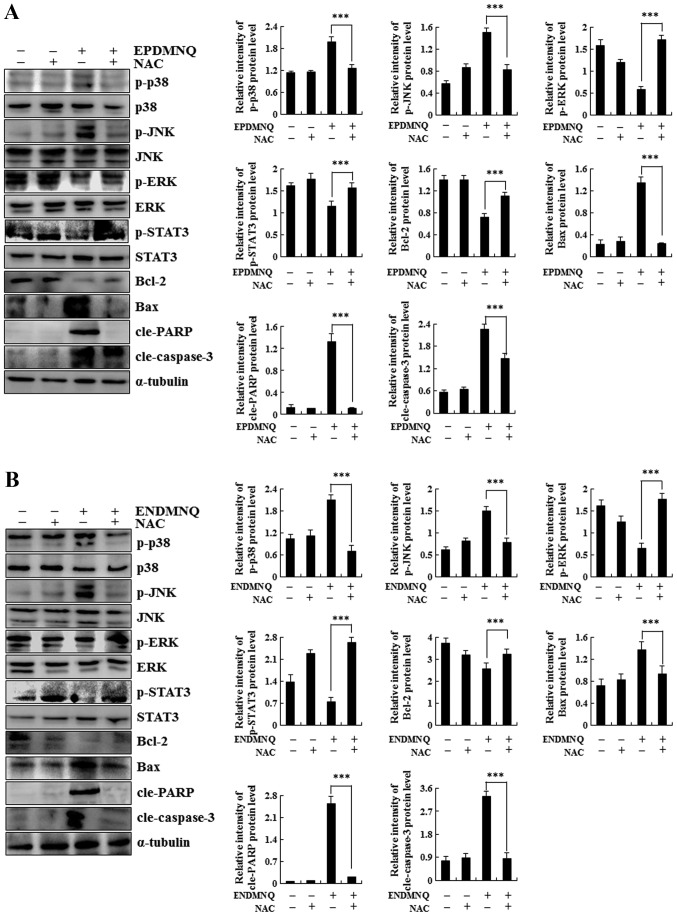
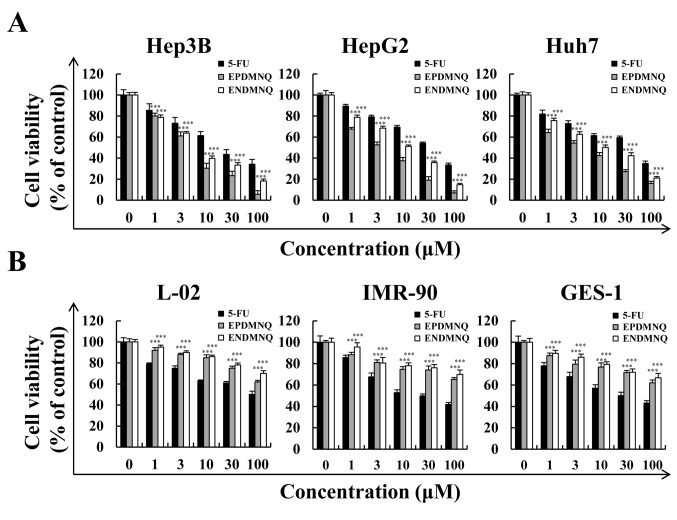
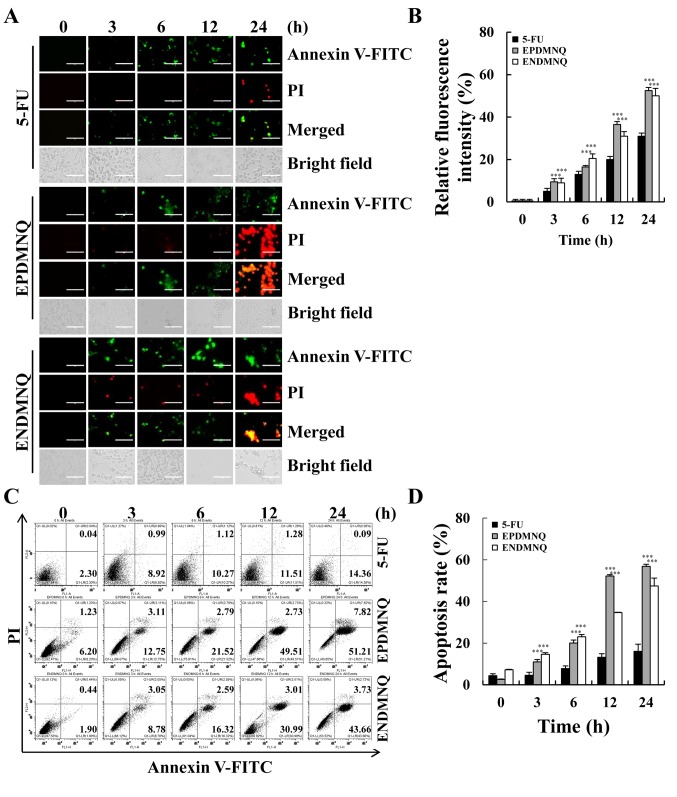
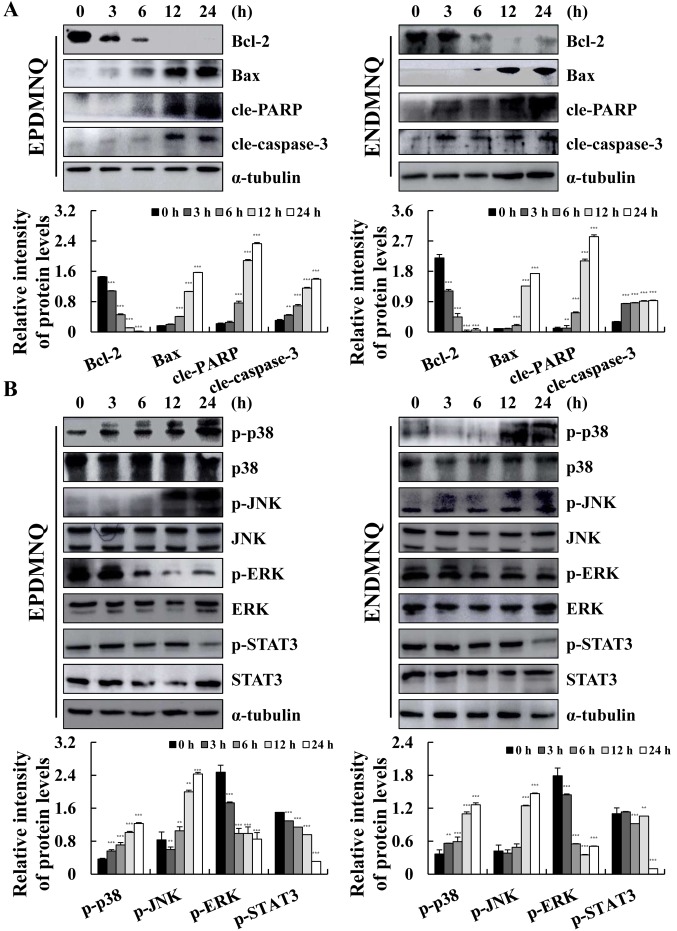
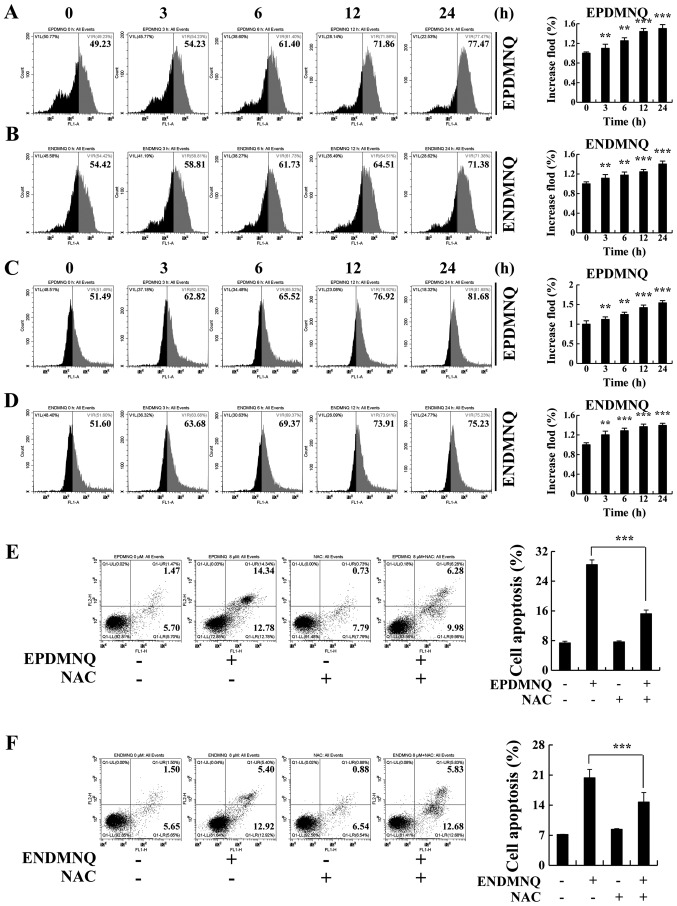
Derivatives of 1,4‑naphthoquinone have excellent anti‑cancer effects, but their use has been greatly limited due to their serious side effects. To develop compounds with decreased side effects and improved anti‑cancer activity, two novel types of 1,4‑naphthoquinone derivatives, 2,3‑dihydro‑2,3‑epoxy‑2‑propylsulfonyl‑5,8‑dimethoxy‑1,4‑naphthoquinone (EPDMNQ) and 2,3‑dihydro‑2,3‑epoxy‑2‑nonylsulfonyl‑5,8‑dimethoxy‑1,4‑naphthoquinone (ENDMNQ) were synthesized and their anti‑tumor activities were investigated. The effects of EPDMNQ and ENDMNQ on cell viability, apoptosis and accumulation of reactive oxygen species (ROS) in liver cancer cells were determined by MTT cell viability assay and flow cytometry. The expression levels of mitochondrial, mitogen activated protein kinase (MAPK) and signal transducer and activator of transcription 3 (STAT3) signaling pathway‑associated proteins in Hep3B liver cancer cells were analyzed by western blot analysis. The results demonstrated that EPDMNQ and ENDMNQ inhibited the proliferation of liver cancer Hep3B, HepG2, and Huh7 cell lines but not that of normal liver L‑02, normal lung IMR‑90 and stomach GES‑1 cell lines. The number of apoptotic cells and ROS levels were significantly increased following treatment with EPDMNQ and ENDMNQ, and these effects were blocked by the ROS inhibitor N‑acetyl‑L‑cysteine (NAC) in Hep3B cells. EPDMNQ and ENDMNQ induced apoptosis by upregulating the protein expression of p38 MAPK and c‑Jun N‑terminal kinase and downregulating extracellular signal‑regulated kinase and STAT3; these effects were inhibited by NAC. The results of the present study demonstrated that EPDMNQ and ENDMNQ induced apoptosis through ROS‑modulated MAPK and STAT3 signaling pathways in Hep3B cells. Therefore, these novel 1,4‑naphthoquinone derivatives may be useful as anticancer agents for the treatment of liver cancer.
1,4-萘醌衍生物具有优异的抗癌作用,但由于其严重的副作用,其应用受到了极大的限制。为了开发副作用降低且抗癌活性提高的化合物,合成了两种新型 1,4-萘醌衍生物 2,3-二氢-2,3-环氧-2-丙基磺酰基-5,8-二甲氧基-1,4-萘醌(EPDMNQ)和 2,3-二氢-2,3-环氧-2-正基磺酰基-5,8-二甲氧基-1,4-萘醌(ENDMNQ),并研究了它们的抗肿瘤活性。通过 MTT 细胞活力测定法和流式细胞术测定 EPDMNQ 和 ENDMNQ 对肝癌细胞活力、细胞凋亡和活性氧(ROS)积累的影响。通过 Western blot 分析检测 Hep3B 肝癌细胞中线粒体、丝裂原活化蛋白激酶(MAPK)和信号转导和转录激活因子 3(STAT3)信号通路相关蛋白的表达水平。结果表明,EPDMNQ 和 ENDMNQ 抑制肝癌 Hep3B、HepG2 和 Huh7 细胞系的增殖,但不抑制正常肝 L-02、正常肺 IMR-90 和胃 GES-1 细胞系的增殖。EPDMNQ 和 ENDMNQ 处理后,细胞凋亡和 ROS 水平显著增加,并且这些作用在 Hep3B 细胞中被 ROS 抑制剂 N-乙酰-L-半胱氨酸(NAC)阻断。EPDMNQ 和 ENDMNQ 通过上调 p38 MAPK 和 c-Jun N-末端激酶的蛋白表达以及下调细胞外信号调节激酶和 STAT3 诱导细胞凋亡,这些作用被 NAC 抑制。本研究结果表明,EPDMNQ 和 ENDMNQ 通过 ROS 调节的 MAPK 和 STAT3 信号通路诱导 Hep3B 细胞凋亡。因此,这些新型 1,4-萘醌衍生物可能可用作肝癌治疗的抗癌药物。