Garaud Thomas, Gervais Christine, Szekely Barbara, Michel-Cherqui Mireille, Dreyfus Jean-François, Fischler Marc
Department of Anesthesiology, Hôpital Foch, Suresnes, France and Université Versailles Saint-Quentin en Yvelines.
Pain Management Unit, Hôpital Foch.
Medicine (Baltimore). 2018 Dec;97(52):e13782. doi: 10.1097/MD.0000000000013782.
Transcutaneous electrical nerve stimulation (TENS) is often used for the treatment of low-back pain (LBP). However, its effectiveness is controversial.
To determine the efficacy of TENS in the treatment LBP when associated to a therapeutic education program (TEP).
Open randomized monocentric study.
University hospital between 2010 and 2014.
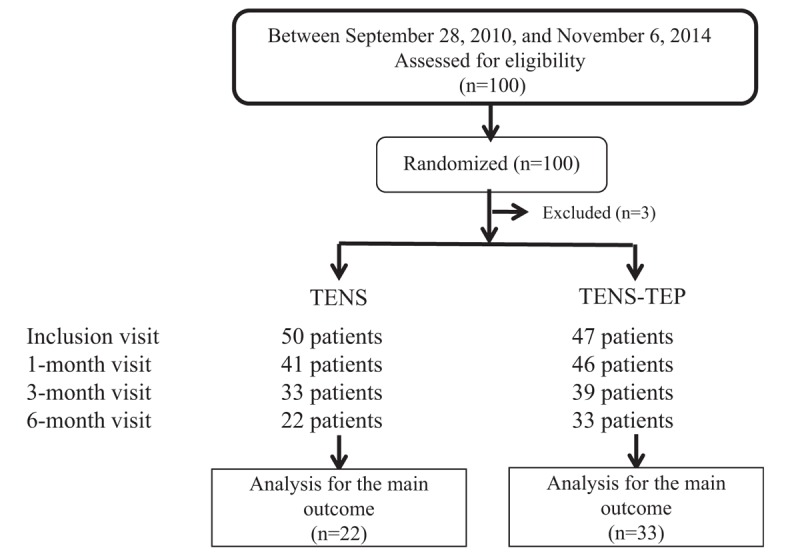
A total of 97 patients suffering from LBP.
Routine care (TENS group) or routine care plus a therapeutic education program (TENS-TEP group) based on consultation support by a pain resource nurse.
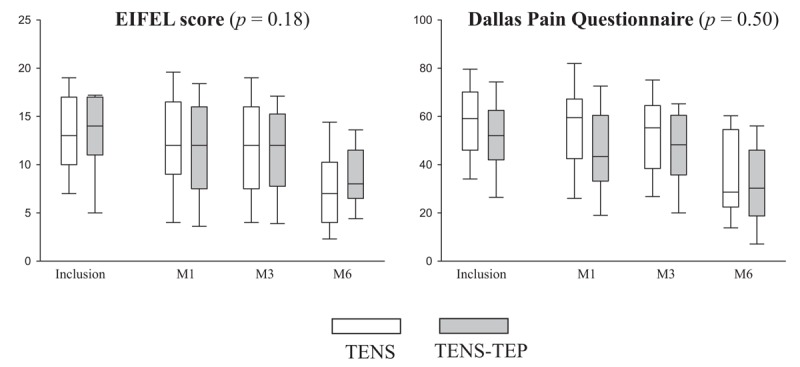
EIFEL and Dallas Pain Questionnaire scores.
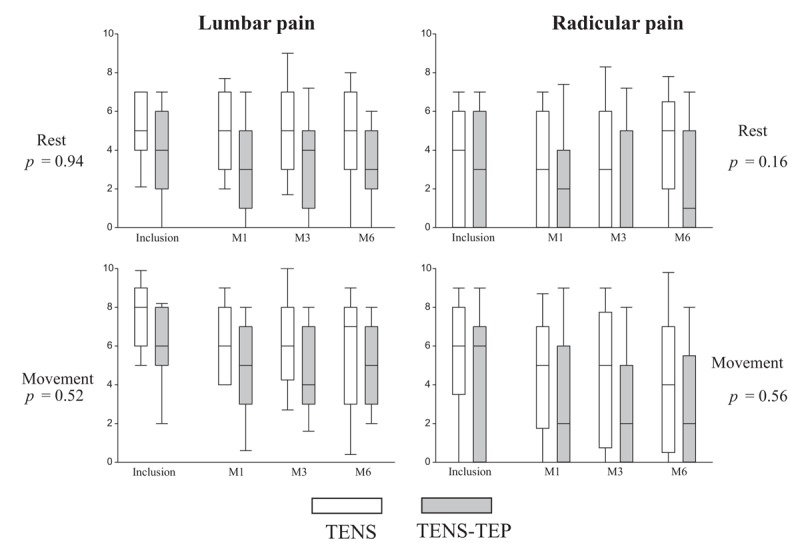
Twenty-two patients (44%) were still assessable at the end-of-study visit, whereas 33 (70%) were assessable at the same time point in the TENS-TEP group (P = .013). The EIFEL score and the Dallas score had a similar evolution over time between groups (P = .18 and P = .50 respectively). Similarly, there were no significant differences between the groups with respect to resting pain scores (P = .94 for back pain and P = .16 for leg pain) and movement pain scores (P = .52 for back pain and P = .56 for leg pain). At Month 6, there was no significant difference between the groups (P = .85) with regard to analgesics and social impact. Two patients presented a serious adverse event during the study (one in each group) but non-attributable to the treatment studied.
This study does not support the use of TENS in the treatment of patients with chronic LBP even though patients benefited from a therapeutic education program by a pain resource nurse. However, the higher number of premature withdrawals in the TENS group may be due to early withdrawal of patients who did not experience improvement of their symptoms.
经皮电刺激神经疗法(TENS)常用于治疗腰痛(LBP)。然而,其疗效存在争议。
确定TENS与治疗性教育计划(TEP)联合应用于治疗LBP的疗效。
开放性随机单中心研究。
2010年至2014年期间的大学医院。
共97例LBP患者。
基于疼痛资源护士的咨询支持,给予常规护理(TENS组)或常规护理加治疗性教育计划(TENS-TEP组)。
EIFEL和达拉斯疼痛问卷评分。
在研究结束访视时,22例患者(44%)仍可评估,而在TENS-TEP组中,33例患者(70%)在同一时间点可评估(P = 0.013)。两组间EIFEL评分和达拉斯评分随时间的变化相似(分别为P = 0.18和P = 0.50)。同样,两组在静息疼痛评分(背痛P = 0.94,腿痛P = 0.16)和运动疼痛评分(背痛P = 0.52,腿痛P = 0.56)方面无显著差异。在第6个月时,两组在镇痛药使用和社会影响方面无显著差异(P =