Dowd Jennifer Beam, Renson Audrey
1Department of Global Health and Social Medicine, King's College London, The Strand, London, WC2R 2LS UK.
2Epidemiology and Biostatistics, CUNY Graduate School of Public Health and Health Policy, 55 W 125th St, New York, NY 10027 USA.
Curr Epidemiol Rep. 2018;5(4):432-441. doi: 10.1007/s40471-018-0167-7. Epub 2018 Sep 20.
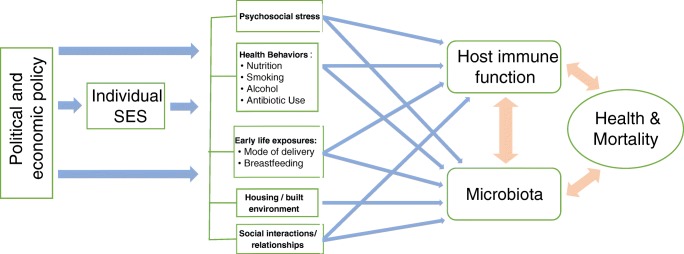
As the science of the microbiome advances, social epidemiologists can contribute to understanding how the broader social environment shapes the microbiome over the life course. This review summarizes current research and describes potential mechanisms of the social epidemiology of the microbiome.
Most existing literature linking the social environment and the microbiome comes from animal models, focused on the impact of social interactions and psychosocial stress. Suggestive evidence of the importance of early life exposures, health behaviors, and the built environment also point to the importance of the social environment for the microbiome in humans.
Social epidemiology as a field is well poised to contribute expertise in theory and measurement of the broader social environment to this new area, and to consider both the upstream and downstream mechanisms by which this environment gets "under the skin" and "into the gut." As population-level microbiome data becomes increasingly available, we encourage investigation of the multi-level determinants of the microbiome and how the microbiome may link the social environment and health.
随着微生物组学的发展,社会流行病学家可以为理解更广泛的社会环境如何在生命历程中塑造微生物组做出贡献。本综述总结了当前的研究,并描述了微生物组社会流行病学的潜在机制。
大多数将社会环境与微生物组联系起来的现有文献来自动物模型,主要关注社会互动和心理社会压力的影响。关于早期生活暴露、健康行为和建筑环境重要性的提示性证据也表明社会环境对人类微生物组的重要性。
社会流行病学作为一个领域,非常有能力为这一新领域贡献有关更广泛社会环境的理论和测量方面的专业知识,并考虑这一环境“深入皮肤”和“进入肠道”的上游和下游机制。随着人群水平的微生物组数据越来越容易获得,我们鼓励对微生物组的多层次决定因素以及微生物组如何将社会环境与健康联系起来进行研究。