Ferré Sergi, Díaz-Ríos Manuel, Salamone John D, Prediger Rui Daniel
Integrative Neurobiology Section, National Institute on Drug Abuse, Intramural Research Program, National Institutes of Health, Baltimore, Maryland.
Department of Anatomy and Neurobiology, Institute of Neurobiology, University of Puerto Rico, Medical Sciences Campus, San Juan, Puerto Rico.
J Caffeine Adenosine Res. 2018 Dec 1;8(4):121-131. doi: 10.1089/caff.2018.0017. Epub 2018 Dec 7.
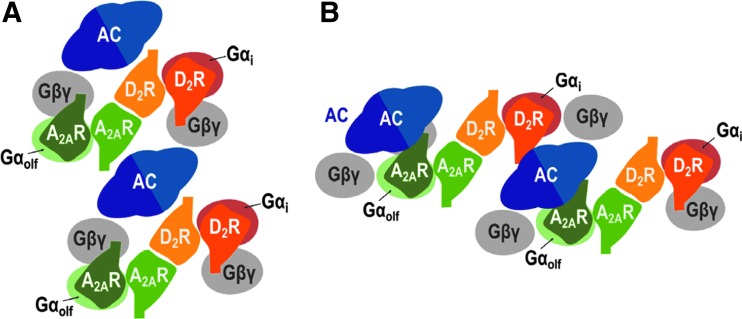
Recent studies on interactions between striatal adenosine and dopamine and one of its main targets, the adenosine A receptor-dopamine D receptor (A2AR-D2R) heteromer, have provided a better understanding of the mechanisms involved in the psychostimulant effects of caffeine and have brought forward new data on the mechanisms of operation of classical orthosteric ligands within G protein-coupled receptor heteromers. The striatal A2AR-D2R heteromer has a tetrameric structure and forms part of a signaling complex that includes a Gs and a Gi protein and the effector adenyl cyclase (subtype AC5). Another target of caffeine, the adenosine A receptor-dopamine D receptor (A1R-D1R) heteromer, seems to have a very similar structure. Initially suggested to be localized in the striatum, the A1R-D1R heteromer has now been identified in the spinal motoneuron and shown to mediate the spinally generated caffeine-induced locomotion. In this study, we review the recently discovered properties of A2AR-D2R and A1R-D1R heteromers. Our studies demonstrate that these complexes are a necessary condition to sustain the canonical antagonistic interaction between a Gs-coupled receptor (A2AR or D1R) and a Gi-coupled receptor (D2R or A1R) at the adenylyl cyclase level, which constitutes a new concept in the field of G protein-coupled receptor physiology and pharmacology. A2AR antagonists targeting the striatal A2AR-D2R heteromer are already being considered as therapeutic agents in Parkinson's disease. In this study, we review the preclinical evidence that indicates that caffeine and A2AR antagonists could be used to treat the motivational symptoms of depression and attention-deficit/hyperactivity disorder, while A1R antagonists selectively targeting the spinal A1R-D1R heteromer could be used in the recovery of spinal cord injury.
近期关于纹状体腺苷与多巴胺及其主要靶点之一——腺苷A2A受体 - 多巴胺D2受体(A2AR - D2R)异聚体之间相互作用的研究,让我们对咖啡因精神兴奋作用所涉及的机制有了更深入的理解,并为G蛋白偶联受体异聚体内经典正构配体的作用机制带来了新数据。纹状体A2AR - D2R异聚体具有四聚体结构,是信号复合物的一部分,该信号复合物包括Gs和Gi蛋白以及效应器腺苷酸环化酶(AC5亚型)。咖啡因的另一个靶点——腺苷A1受体 - 多巴胺D1受体(A1R - D1R)异聚体,似乎具有非常相似的结构。最初认为A1R - D1R异聚体定位于纹状体,现在已在脊髓运动神经元中被鉴定出来,并显示其介导脊髓产生的咖啡因诱导的运动。在本研究中,我们回顾了A2AR - D2R和A1R - D1R异聚体最近发现的特性。我们的研究表明,这些复合物是在腺苷酸环化酶水平维持Gs偶联受体(A2AR或D1R)与Gi偶联受体(D2R或A1R)之间典型拮抗相互作用的必要条件,这在G蛋白偶联受体生理学和药理学领域构成了一个新概念。靶向纹状体A2AR - D2R异聚体的A2AR拮抗剂已被视为帕金森病的治疗药物。在本研究中,我们回顾了临床前证据,这些证据表明咖啡因和A2AR拮抗剂可用于治疗抑郁症和注意力缺陷多动障碍的动机症状,而选择性靶向脊髓A1R - D1R异聚体的A1R拮抗剂可用于脊髓损伤的恢复。