Dalekos George N, Koskinas John, Papatheodoridis George V
Institute of Internal Medicine and Hepatology, Larissa (George N. Dalekos).
Department of Medicine and Research Laboratory of Internal Medicine, University Hospital of Larissa, Larissa (George N. Dalekos).
Ann Gastroenterol. 2019 Jan-Feb;32(1):1-23. doi: 10.20524/aog.2018.0330. Epub 2018 Nov 29.
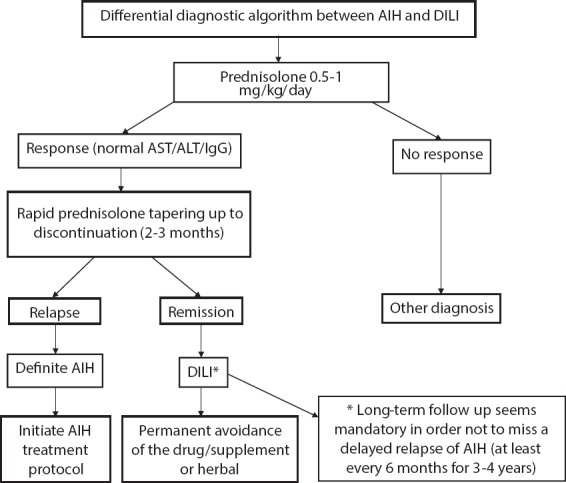
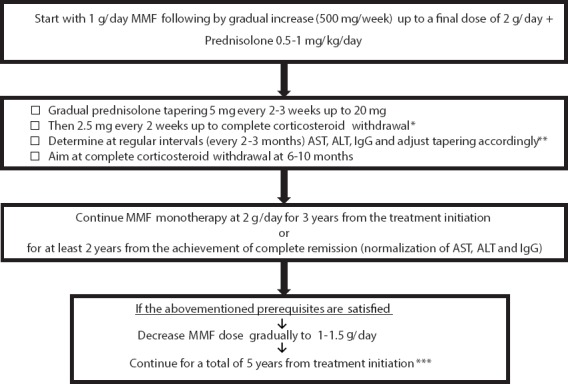
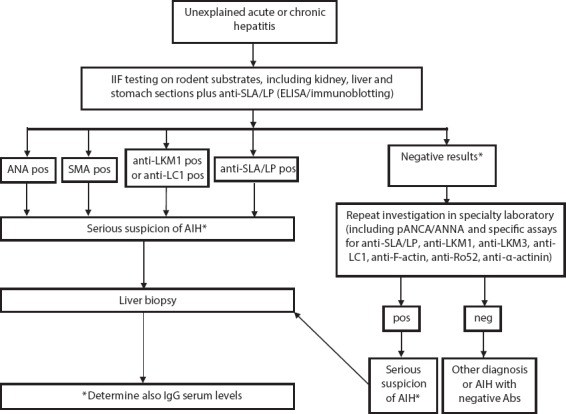
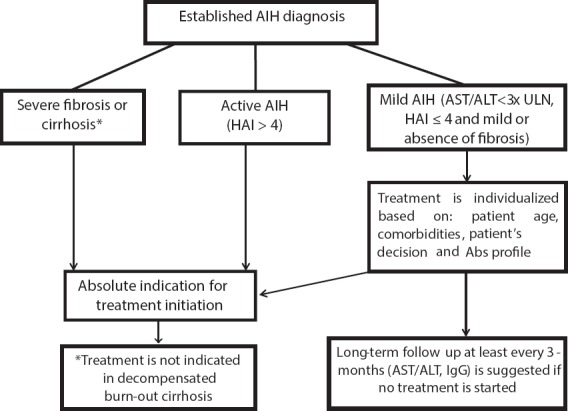
Autoimmune hepatitis (AIH) is a relatively rare acute or chronic liver disease of unknown etiology characterized by large heterogeneity. Its distribution is global, covering all ages, both sexes and all ethnic groups. The aim of the present Clinical Practice Guidelines (CPG) of the Hellenic Association for the Study of the Liver was to provide updated guidance and help to gastroenterologists, hepatologists, internists and general practitioners for AIH diagnosis and management. AIH diagnosis is based on clinicopathological characteristics: namely, polyclonal hypergammaglobulinemia, particularly of immunoglobulin G (IgG), circulating autoantibodies, interface hepatitis on liver histology, absence of viral hepatitis, and a favorable response to immunosuppression. Clinical manifestations at disease onset are variable, ranging from asymptomatic to the acute/severe form. Aminotransferase and bilirubin levels vary, while the presence of hepatitis at the histological level is a prerequisite for diagnosis. Autoantibodies are the hallmark for AIH diagnosis; therefore, the CPG describe the appropriate serological algorithm for their detection. AIH therapy should aim to achieve complete biochemical (normalization of IgG and aminotransferases) and histological remission. All patients who have active disease, even those with cirrhosis, should be treated with individualized and response-guided induction therapy using prednisolone in combination with azathioprine or mycophenolate mofetil as first-line therapy. Immunosuppression should be given for at least 3 years and for at least 2 years after the achievement of complete biochemical response, while a liver biopsy should be recommended before treatment discontinuation. Current CPG are also provided for several specific conditions and difficult-to-treat patients.
自身免疫性肝炎(AIH)是一种病因不明的相对罕见的急性或慢性肝脏疾病,具有高度异质性。其分布全球,涵盖所有年龄、性别和种族群体。希腊肝脏研究协会制定本临床实践指南(CPG)的目的是为胃肠病学家、肝病学家、内科医生和全科医生提供关于AIH诊断和管理的最新指导与帮助。AIH的诊断基于临床病理特征:即多克隆高球蛋白血症,尤其是免疫球蛋白G(IgG)升高、循环自身抗体、肝脏组织学显示界面性肝炎、无病毒性肝炎以及对免疫抑制治疗反应良好。疾病发作时的临床表现各异,从无症状到急性/重症形式。转氨酶和胆红素水平各不相同,而组织学层面存在肝炎是诊断的先决条件。自身抗体是AIH诊断的标志;因此,CPG描述了检测它们的适当血清学算法。AIH治疗应旨在实现完全生化缓解(IgG和转氨酶正常化)和组织学缓解。所有患有活动性疾病的患者,即使是肝硬化患者,都应接受个体化且根据反应指导的诱导治疗,一线治疗采用泼尼松龙联合硫唑嘌呤或霉酚酸酯。免疫抑制治疗应至少持续3年,在实现完全生化反应后至少持续2年,同时在停止治疗前应建议进行肝脏活检。当前的CPG还针对几种特定情况和难治性患者给出了建议。