Kalafateli Maria, Triantos Christos, Tsamandas Athanasios, Dalekos George N
Department of Gastroenterology, University Hospital of Patras, Greece.
Department of Pathology, University Hospital of Patras, Greece.
Eur J Case Rep Intern Med. 2016 Apr 20;3(4):000396. doi: 10.12890/2016_000396. eCollection 2016.
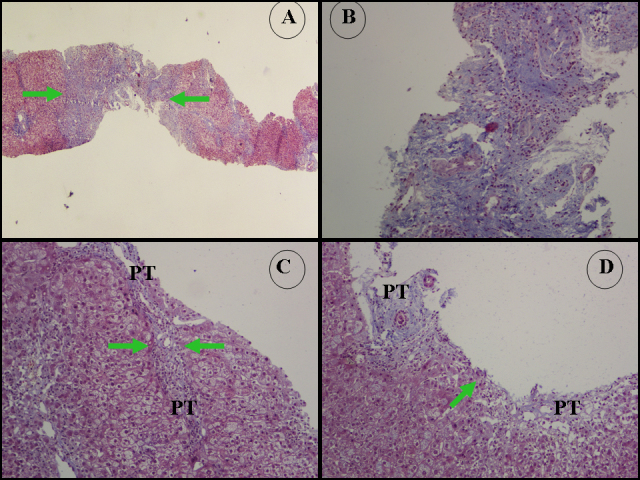
Autoimmune hepatitis (AIH) is a disease of unknown aetiology with drug-induced AIH being the most complex and not fully understood type. We present the case of a 57-year-old female patient with acute icteric hepatitis after interferon-beta-1b (IFNβ-1b) administration for multiple sclerosis (MS). Based on liver autoimmune serology, histology and appropriate exclusion of other liver diseases, a diagnosis of AIH-related cirrhosis was established. Following discontinuation of IFNβ-1b, a complete resolution of biochemical activity indices was observed and the patient remained untreated on her own decision. However, 3 years later, after a course of intravenous methylprednisolone for MS, a new acute transaminase flare was recorded which subsided again spontaneously after 3 weeks. Liver biopsy and elastography showed significant fibrosis regression (F2 fibrosis). To our knowledge, this is the first report showing spontaneous cirrhosis regression in an IFNβ-1b-induced AIH-like syndrome following drug withdrawal, suggesting that cirrhosis might be reversible if the offending fibrogenic stimulus is withdrawn.
Autoimmune hepatitis (AIH) is a very heterogeneous liver disease of unknown aetiology, with drug-induced AIH being the most complex and not fully understood type.Intravenous methylprednisolone pulse administration may reactivate or unmask previously unrecognised or misdiagnosed AIH and therefore liver autoimmune serology should be sought for every patient with acute or chronic hepatitis in the absence of viral, metabolic, genetic and alcoholic causes of liver disease.Spontaneous regression of cirrhosis, although controversial, may occur if the offending fibrogenic stimuli are immediately withdrawn as shown in this case of IFNβ-1b-induced AIH.
自身免疫性肝炎(AIH)是一种病因不明的疾病,药物性AIH是最复杂且尚未完全了解的类型。我们报告了一例57岁女性患者,在使用β-1b干扰素(IFNβ-1b)治疗多发性硬化症(MS)后出现急性黄疸型肝炎。基于肝脏自身免疫血清学、组织学检查以及对其他肝脏疾病的适当排除,确诊为AIH相关肝硬化。停用IFNβ-1b后,生化活性指标完全恢复正常,患者自行决定不再接受治疗。然而,3年后,在接受了一个疗程的静脉注射甲泼尼龙治疗MS后,再次出现急性转氨酶升高,3周后又自行消退。肝脏活检和弹性成像显示纤维化显著消退(F2纤维化)。据我们所知,这是第一份关于药物性AIH样综合征停药后自发性肝硬化消退的报告,提示如果去除致病的纤维化刺激因素,肝硬化可能是可逆的。
自身免疫性肝炎(AIH)是一种病因不明且非常异质性的肝脏疾病,药物性AIH是最复杂且尚未完全了解的类型。静脉注射甲泼尼龙脉冲给药可能会重新激活或暴露先前未被识别或误诊的AIH,因此对于每一位急性或慢性肝炎患者,在排除病毒性、代谢性、遗传性和酒精性肝病病因后,都应进行肝脏自身免疫血清学检查。肝硬化的自发性消退虽然存在争议,但如果像本病例中IFNβ-1b诱导的AIH那样立即去除致病的纤维化刺激因素,可能会发生。