Bruce Spencer A, Wright Jeremy J
Department of Biological Sciences University at Albany - State University of New York Albany New York.
New York State Museum Albany New York.
Ecol Evol. 2018 Nov 14;8(23):11410-11422. doi: 10.1002/ece3.4556. eCollection 2018 Dec.
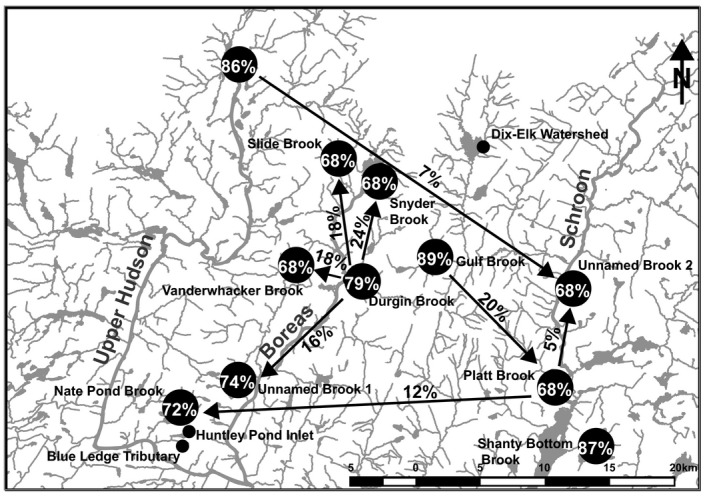
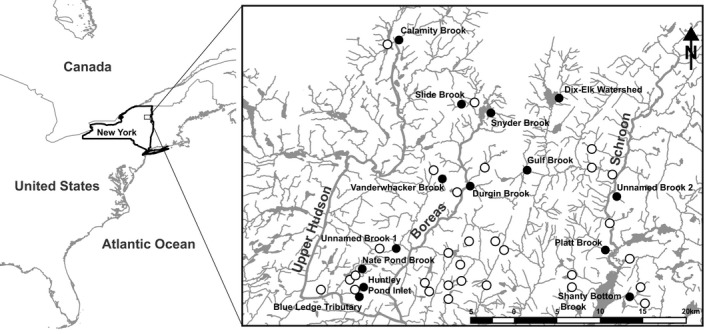
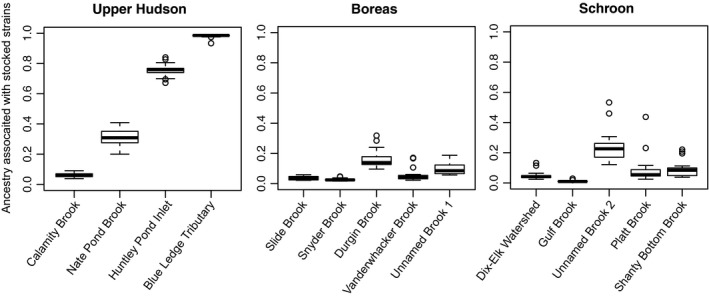
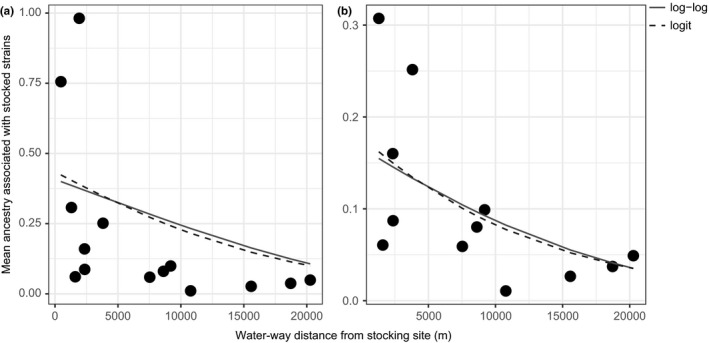
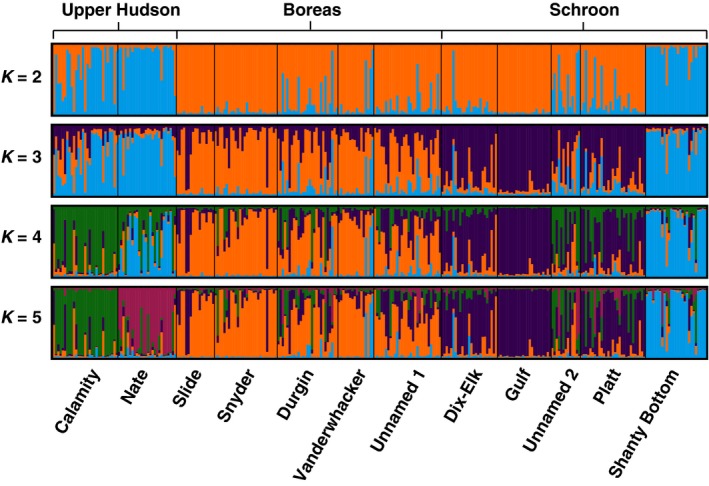
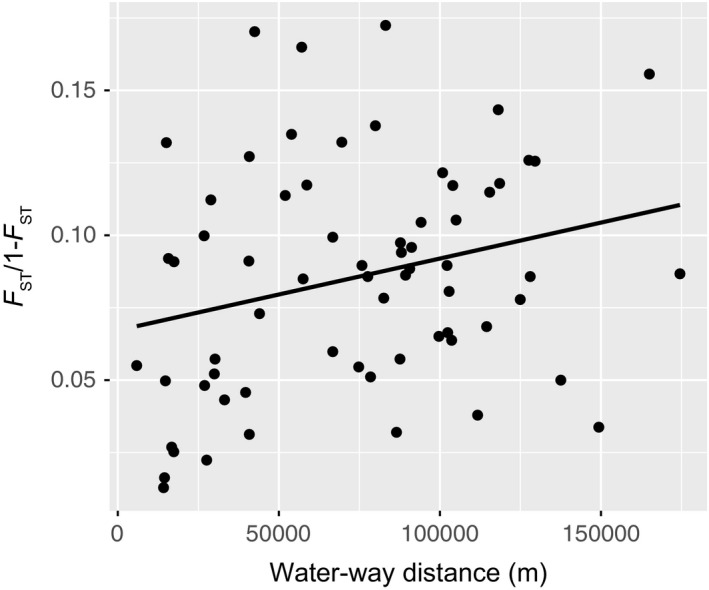
As anthropogenic impacts accelerate changes to landscapes across the globe, understanding how genetic population structure is influenced by habitat features and dispersal is key to preserving evolutionary potential at the species level. Furthermore, knowledge of these interactions is essential to identifying potential constraints on local adaptation and for the development of effective management strategies. We examined these issues in Brook Trout () populations residing in the Upper Hudson River watershed of New York State by investigating the spatial genetic structure of over 350 fish collected from 14 different sampling locations encompassing three river systems. Population genetic analyses of microsatellite data suggest that fish in the area exhibit varying degrees of introgression from nearby State-directed supplementation activities. Levels of introgression in these populations correlate with water-way distance to stocking sites, although genetic population structure at the level of individual tributaries as well as their larger, parent river systems is also detectable and is dictated by migration and influenced by habitat connectivity. These findings represent a significant contribution to the current literature surrounding Brook Trout migration and dispersal, especially as it relates to larger interconnected systems. This work also suggests that stocking activities may have far-reaching consequences that are not directly limited to the immediate area where stocking occurs. The framework and data presented here may aid in the development of other local aquatic species-focused conservation plans that incorporate molecular tools to answer complex questions regarding diversity mapping, and genetically important conservation units.
随着人为影响加速全球景观的变化,了解遗传种群结构如何受到栖息地特征和扩散的影响,是在物种层面保护进化潜力的关键。此外,了解这些相互作用对于识别本地适应的潜在限制以及制定有效的管理策略至关重要。我们通过调查从涵盖三个河流系统的14个不同采样地点收集的350多条鱼类的空间遗传结构,研究了纽约州上哈得逊河流域的溪红点鲑()种群中的这些问题。微卫星数据的种群遗传分析表明,该地区的鱼类表现出来自附近国家指导的补充活动的不同程度的基因渗入。这些种群中的基因渗入水平与到放流地点的水路距离相关,尽管在各个支流及其更大的母河系统层面的遗传种群结构也是可检测的,并且由迁移决定并受栖息地连通性影响。这些发现对当前围绕溪红点鲑迁移和扩散的文献做出了重大贡献,特别是与更大的相互连接系统相关的文献。这项工作还表明,放流活动可能产生深远影响,而不仅限于放流发生的直接区域。这里提出的框架和数据可能有助于制定其他以当地水生物种为重点的保护计划,这些计划纳入分子工具以回答有关多样性测绘和具有重要遗传意义的保护单位的复杂问题。