Russell Kathleen, Van Sanford David
Department of Plant and Soil Sciences University of Kentucky Lexington Kentucky.
Ecol Evol. 2018 Nov 8;8(23):12090-12100. doi: 10.1002/ece3.4668. eCollection 2018 Dec.
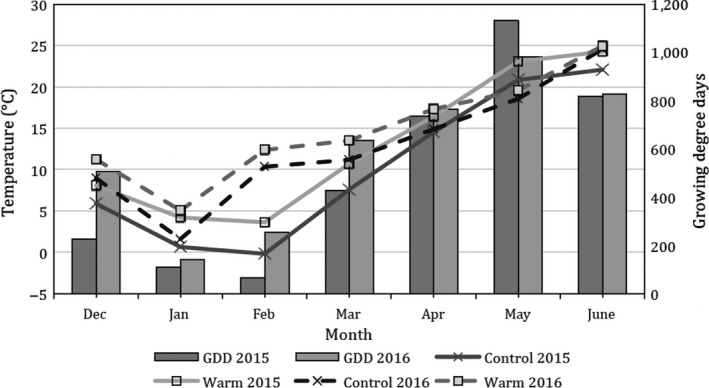
Breeding for resilience to climate change is a daunting prospect. Crop and climate models tell us that global wheat yields are likely to decline as the climate warms, causing a significant risk to global food security. High temperatures are known to affect crop development yet breeding for tolerance to heat stress is difficult to achieve in field environments. We conducted an active warming study over two years to quantify the effects of heat stress on genetic variation of soft red winter (SRW) wheat ( L.). Forty SRW cultivars and breeding lines were chosen based on marker genotypes at photoperiod sensitivity and reduced height loci. These genotypes were planted in a randomized complete block design replicated twice across two environments, ambient and artificially warmed. Average heading date occurred 5 days earlier in the warmed environment than in the ambient environment over both years ( ≤ 0.05). On average, grain yield was significantly reduced in the warmed environment by 211.41 kg/ha ( ≤ 0.05) or 4.84%, though we identified 13 genotypes with increased yield in response to warming in both years. Of these genotypes, eight had significantly increased N uptake while six showed significantly increased N utilization efficiency under warming. Under warming, genotypes with wild-type alleles at the Rht-D1 locus display significantly greater yields ( ≤ 0.01) and biomass ( ≤ 0.001) than genotypes with reduced height alleles. Of the 13 genotypes with higher ( ≤ 0.01) yields under warming, nine have the wild-type allele at the Rht-D1 locus in addition to being photoperiod insensitive. The next steps will be to validate these findings in other populations and to develop an efficient breeding/phenotyping scheme that will lead to more resilient cultivars.
培育适应气候变化的能力是一项艰巨的任务。作物模型和气候模型告诉我们,随着气候变暖,全球小麦产量可能会下降,这对全球粮食安全构成重大风险。高温会影响作物发育,但在田间环境中培育耐热胁迫的品种却很难实现。我们进行了一项为期两年的主动升温研究,以量化热胁迫对软红冬小麦(SRW)(L.)遗传变异的影响。根据光周期敏感性和矮秆基因座的标记基因型,选择了40个SRW品种和育种系。这些基因型以随机完全区组设计种植,在两种环境(环境温度和人工升温)下重复两次。在这两年中,升温环境下的平均抽穗期比环境温度下提前了5天(≤0.05)。平均而言,升温环境下的谷物产量显著降低,每公顷减产211.41公斤(≤0.05),即4.84%,不过我们鉴定出13个基因型在这两年中对升温的产量有所增加。在这些基因型中,8个基因型的氮吸收显著增加,而6个基因型在升温条件下的氮利用效率显著提高。在升温条件下,Rht-D1基因座具有野生型等位基因的基因型比具有矮秆等位基因的基因型产量显著更高(≤0.01),生物量也显著更高(≤0.001)。在升温条件下产量较高(≤0.01)的13个基因型中,有9个除了对光周期不敏感外,在Rht-D1基因座还具有野生型等位基因。接下来的步骤将是在其他群体中验证这些发现,并制定一个高效的育种/表型分析方案,以培育出更具适应能力的品种。