Department of Internal Medicine and Liver Research Institute, Seoul National University College of Medicine, Seoul.
Department of Internal Medicine, Dongguk University Ilsan Hospital, Goyang, Korea.
Gut Liver. 2019 May 15;13(3):373-379. doi: 10.5009/gnl18339.
BACKGROUND/AIMS: Recurrent pyogenic cholangitis (RPC) is a chronic progressive disease frequently accompanied by cholangiocarcinoma (CCA). This study aimed to investigate the natural course of RPC and identify factors associated with CCA.
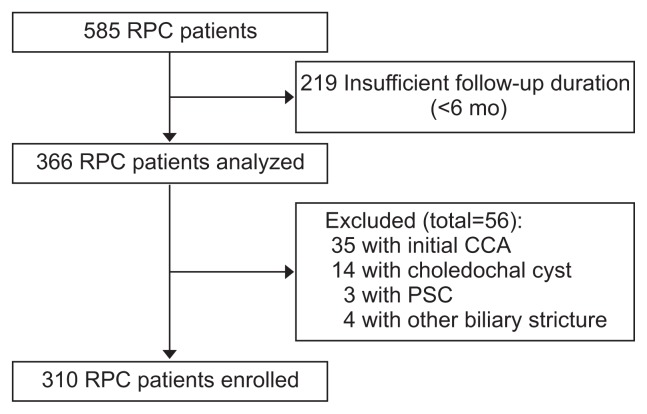
From January 2005 to December 2016, 310 patients diagnosed with RPC at Seoul National University Hospital were included. Complications and management during follow-up were recorded. CCA-free probability was estimated by Kaplan-Meier method, and risk factors associated with CCA were analyzed using log-rank test and Coxs proportional hazard regression model.
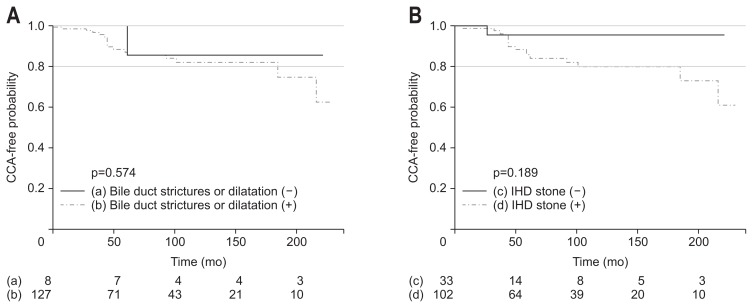
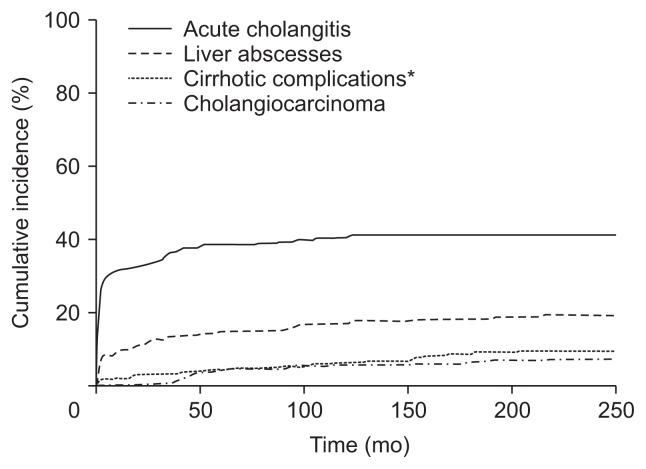
Mean age at diagnosis was 59.1±10.9 years and mean follow-up duration was 84.0±64.1 months. An intrahepatic duct stone was found in 253 patients (81.6%). Liver atrophy was identified in 185 patients (59.7%) and most commonly located at the left lobe (65.4%). Acute cholangitis, liver abscesses, cirrhotic complications, and CCA developed in 41.3%, 19.4%, 9.7%, and 7.4%, respectively. During follow-up, complete resolution rate after hepatectomy, biliary bypass surgery, and choledocholithotomy with T-tube insertion reached 82.3%, 55.2%, and 42.1%, respectively. None of the patients who maintained complete resolution by the last follow-up day developed CCA. In univariate analysis, female, both-sided intrahepatic duct stones, and liver atrophy at any location were associated with increased risk of CCA. Multivariate analysis revealed that both-sided atrophy significantly increased risk of CCA (hazard ratio, 4.56; 95% confidence interval, 1.48 to 14.09; p=0.008). In 21 patients who developed intrahepatic CCA, tumor was located mostly in the atrophied lobe (p=0.023).
In RPC patients, acute cholangitis, liver abscess, cirrhotic complications, and CCA frequently developed. Both-sided liver atrophy was a significant risk factor for developing CCA.
背景/目的:复发性化脓性胆管炎(RPC)是一种慢性进行性疾病,常伴有胆管癌(CCA)。本研究旨在探讨 RPC 的自然病程,并确定与 CCA 相关的因素。
本研究纳入了 2005 年 1 月至 2016 年 12 月在首尔国立大学医院诊断为 RPC 的 310 例患者。记录随访期间的并发症和治疗情况。通过 Kaplan-Meier 法估计无 CCA 生存率,采用对数秩检验和 Cox 比例风险回归模型分析与 CCA 相关的危险因素。
患者的平均年龄为 59.1±10.9 岁,平均随访时间为 84.0±64.1 个月。253 例(81.6%)患者存在肝内胆管结石。185 例(59.7%)患者存在肝萎缩,最常见于左叶(65.4%)。急性胆管炎、肝脓肿、肝硬化并发症和 CCA 的发生率分别为 41.3%、19.4%、9.7%和 7.4%。随访期间,肝切除术、胆管旁路手术和经 T 管胆管取石术的完全缓解率分别达到 82.3%、55.2%和 42.1%。最后一次随访日无 CCA 患者仍保持完全缓解。单因素分析显示,女性、双侧肝内胆管结石和任何部位的肝萎缩与 CCA 风险增加相关。多因素分析显示,双侧肝萎缩显著增加 CCA 的风险(危险比,4.56;95%置信区间,1.48 至 14.09;p=0.008)。在 21 例发生肝内 CCA 的患者中,肿瘤主要位于萎缩的肝叶(p=0.023)。
在 RPC 患者中,急性胆管炎、肝脓肿、肝硬化并发症和 CCA 经常发生。双侧肝萎缩是发生 CCA 的显著危险因素。