Ahn In-Young, Lee So-Jin, Han Yong-Seop, Park Chul-Soo, Kim Bong-Jo, Lee Cheol-Soon, Cha Boseok, Seo Ji-Yeong, Choi Jae-Won, Lee Dongyun
Department of Psychiatry, Gyeongsang National University Changwon Hospital, Changwon, Republic of Korea.
Department of Psychiatry, Gyeongsang National University Hospital, Jinju, Republic of Korea.
Psychiatry Investig. 2019 Jan;16(1):93-96. doi: 10.30773/pi.2018.11.13. Epub 2019 Jan 7.
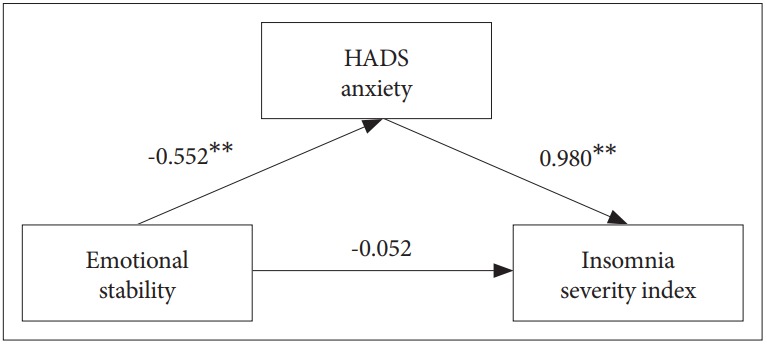
This study investigated the effect of emotional stability (ES) on insomnia through anxiety in preoperative patients with cataracts. Fifty-four subjects completed a self-questionnaire that included the Insomnia Severity Index (ISI), the International Personality Item Pool (IPIP) for ES, and the Hospital Anxiety and Depression scale (HADS). Pathway analysis was performed to analyze the mediating effects of ES, the anxiety subscale scores of the HADS, and the ISI scores. The low-ES group exhibited an insomnia severity that was significantly higher than that of the high-ES group (p=0.048). According to the pathway analysis, the significant indirect effect of ES on the ISI scores was mediated by the scores on the anxiety subscale of the HADS. Cataract patients with low ES waiting to undergo surgery have a high risk of experiencing insomnia due to anxiety. Before surgery, it is essential to identify patients' personality characteristics and provide appropriate intervention.
本研究通过术前白内障患者的焦虑情绪,调查了情绪稳定性(ES)对失眠的影响。54名受试者完成了一份自我调查问卷,其中包括失眠严重程度指数(ISI)、用于评估ES的国际个性项目池(IPIP)以及医院焦虑抑郁量表(HADS)。进行路径分析以分析ES、HADS焦虑分量表得分和ISI得分的中介效应。低ES组的失眠严重程度显著高于高ES组(p = 0.048)。根据路径分析,ES对ISI得分的显著间接效应是由HADS焦虑分量表得分介导的。等待手术的低ES白内障患者因焦虑而出现失眠的风险较高。手术前,识别患者的个性特征并提供适当干预至关重要。