Lin Xianchai, Chen Ziyan, Jin Ling, Gao Wuyou, Qu Bo, Zuo Yajing, Liu Rongjiao, Yu Minbin
State Key Laboratory of Ophthalmology, Zhongshan Ophthalmic Center, Sun Yat-sen University, Guangzhou, China.
PLoS One. 2017 Sep 26;12(9):e0185287. doi: 10.1371/journal.pone.0185287. eCollection 2017.
To analyze the validity of the Hospital Anxiety and Depression Scale (HADS) among Chinese cataract population.
A total of 275 participants with unilateral or bilateral cataract were recruited to complete the Chinese version of HADS. The patients' demographic and ophthalmic characteristics were documented. Rasch analysis was conducted to examine the model fit statistics, the thresholds ordering of the polytomous items, targeting, person separation index and reliability, local dependency, unidimentionality, differential item functioning (DIF) and construct validity of the HADS individual and summary measures.
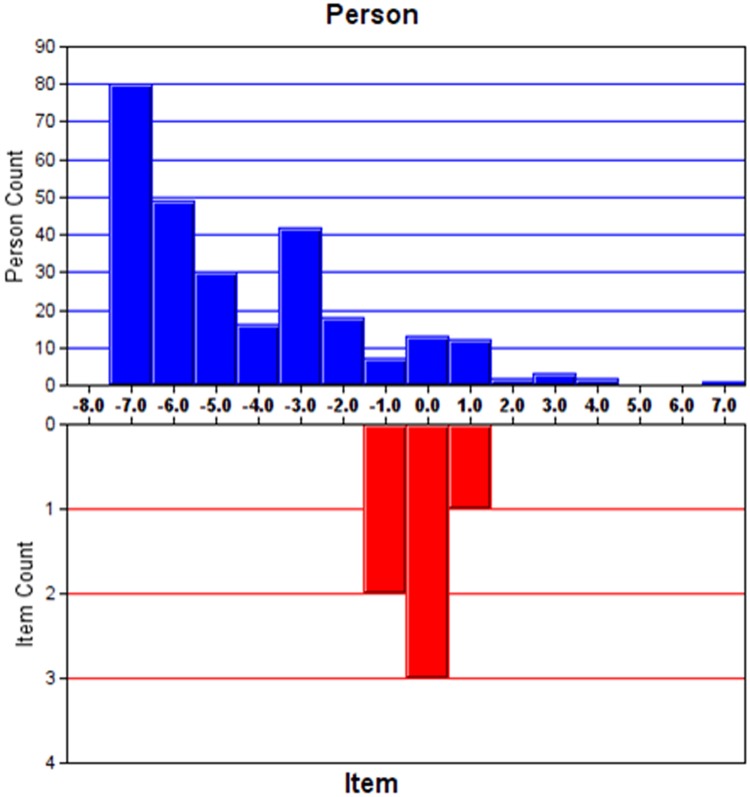
Rasch analysis was performed on anxiety and depression subscales as well as HADS-Total score respectively. The items of original HADS-Anxiety, HADS-Depression and HADS-Total demonstrated evidence of misfit of the Rasch model. Removing items A7 for anxiety subscale and rescoring items D14 for depression subscale significantly improved Rasch model fit. A 12-item higher order total scale with further removal of D12 was found to fit the Rasch model. The modified items had ordered response thresholds. No uniform DIF was detected, whereas notable non-uniform DIF in high-ability group was found. The revised cut-off points were given for the modified anxiety and depression subscales.
The modified version of HADS with HADS-A and HADS-D as subscale and HADS-T as a higher-order measure is a reliable and valid instrument that may be useful for assessing anxiety and depression states in Chinese cataract population.
分析医院焦虑抑郁量表(HADS)在中国白内障患者群体中的有效性。
共招募275例单侧或双侧白内障患者完成中文版HADS。记录患者的人口统计学和眼科特征。进行拉施分析以检验模型拟合统计量、多分类项目的阈值排序、靶向性、人员分离指数和信度、局部依赖性、单维度性、差异项目功能(DIF)以及HADS个体和总分测量的结构效度。
分别对焦虑和抑郁子量表以及HADS总分进行拉施分析。原始HADS-焦虑、HADS-抑郁和HADS-总分的项目显示出不符合拉施模型的证据。去除焦虑子量表的项目A7并重新计分抑郁子量表的项目D14显著改善了拉施模型拟合。发现进一步去除D12后的12项高阶总量表符合拉施模型。修改后的项目具有有序的反应阈值。未检测到一致的DIF,而在高能力组中发现了显著的非一致DIF。给出了修改后的焦虑和抑郁子量表的修订临界点。
以HADS-A和HADS-D为子量表、HADS-T为高阶测量的修订版HADS是一种可靠且有效的工具,可能有助于评估中国白内障患者群体的焦虑和抑郁状态。