Rabindrakumar Miruna Sudharshani Kalaimani, Pujitha Wickramasinghe V, Gooneratne Lallindra, Arambepola Carukshi, Senanayake Hemantha, Thoradeniya Tharanga
1Department of Biochemistry and Molecular Biology, Faculty of Medicine, University of Colombo, Colombo, Sri Lanka.
2Department of Paediatrics, Faculty of Medicine, University of Colombo, Colombo, Sri Lanka.
BMC Hematol. 2018 Dec 22;18:37. doi: 10.1186/s12878-018-0131-2. eCollection 2018.
Early detection and treatment of iron deficiency during pregnancy is crucial for optimum pregnancy outcomes. Anaemia is a late indictor of iron deficiency measured as Hb < 11 g/dL, and is widely used as a proxy for iron deficiency. We aimed to evaluate the role of red cell indices as a screening tool for early detection of iron deficiency among pregnant women in an urban area of Sri Lanka.
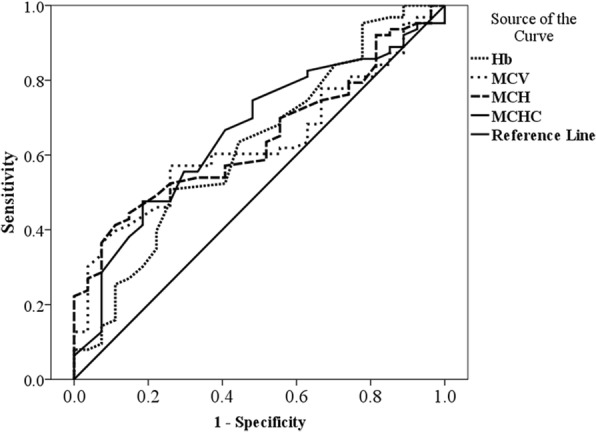
A cross-sectional study was conducted among 110 apparently healthy pregnant women ≤12 weeks of gestation attending antenatal clinics in Colombo, Sri Lanka. Women already on nutritional supplements were excluded. Full blood count, serum ferritin (SF) and high sensitive C-reactive protein (hs-CRP) assessments were performed. The women with evidence of inflammation as indicated by hs-CRP > 10 mg/L were excluded ( = 20) from data analysis. Anaemia (Hb < 11 g/dL) and iron deficiency (SF < 30 μg/L) were defined according to WHO guidelines. Receiver operating characteristics curves were used to derive red blood cell indices that showed the optimal cut-offs in detecting early iron deficiency.
Of the 90 women, 63 (70.0%) were iron deficient (SF < 30 μg/L), out of whom 10 (15.9%) were identified as having iron deficiency anaemia (Hb < 11 g/dL). A high sensitivity (> 70%) in the prediction of iron deficiency was obtained for the optimal cut-off values of Hb < 12.2 g/dL, MCV < 83.2 fl, MCH < 26.9 pg and MCHC 33.2 g/dL while maintaining a specificity > 40%.
Iron deficiency can be predicted in early stages using Hb and red cell indices, which is much less expensive. This could be a useful method in areas with limited resources and a high prevalence of iron deficiency.
孕期缺铁的早期检测和治疗对于实现最佳妊娠结局至关重要。贫血是缺铁的晚期指标,以血红蛋白(Hb)<11g/dL来衡量,并且被广泛用作缺铁的替代指标。我们旨在评估红细胞指数作为斯里兰卡一个城市地区孕妇缺铁早期检测筛查工具的作用。
对斯里兰卡科伦坡产前诊所中110名妊娠≤12周的表面健康孕妇进行了一项横断面研究。已服用营养补充剂的妇女被排除在外。进行了全血细胞计数、血清铁蛋白(SF)和高敏C反应蛋白(hs-CRP)评估。hs-CRP>10mg/L表明有炎症迹象的妇女(n=20)被排除在数据分析之外。根据世界卫生组织指南定义贫血(Hb<11g/dL)和缺铁(SF<30μg/L)。使用受试者工作特征曲线得出在检测早期缺铁时显示最佳临界值的红细胞指数。
在这90名妇女中,63名(70.0%)缺铁(SF<30μg/L),其中10名(15.9%)被确定为缺铁性贫血(Hb<11g/dL)。对于Hb<12.2g/dL、平均红细胞体积(MCV)<83.2fL、平均红细胞血红蛋白含量(MCH)<26.9pg和平均红细胞血红蛋白浓度(MCHC)33.2g/dL的最佳临界值,在预测缺铁方面获得了高灵敏度(>70%),同时保持特异性>40%。
使用Hb和红细胞指数可以在早期预测缺铁,成本要低得多。这在资源有限且缺铁患病率高的地区可能是一种有用的方法。