Department of Epidemiology, Columbia University, New-York, USA.
Divison of Environment and Sustainability, The Hong Kong University of Science and Technology, Hong Kong, People's Republic of China.
BMC Womens Health. 2023 Apr 17;23(1):184. doi: 10.1186/s12905-023-02291-6.
Iron deficiency anemia is a common public health issue among women of reproductive age (WRA) because it can result in adverse maternal and birth outcomes. Although studies are undertaken to assess iron efficacy, some gaps and limitations in the existing literature need to be addressed. To fill the gaps, we conducted a systematic review and meta-analysis of randomized controlled trials (RCTs) assessing the role of iron in reducing anemia among WRA in low-middle-income countries (LMICs).
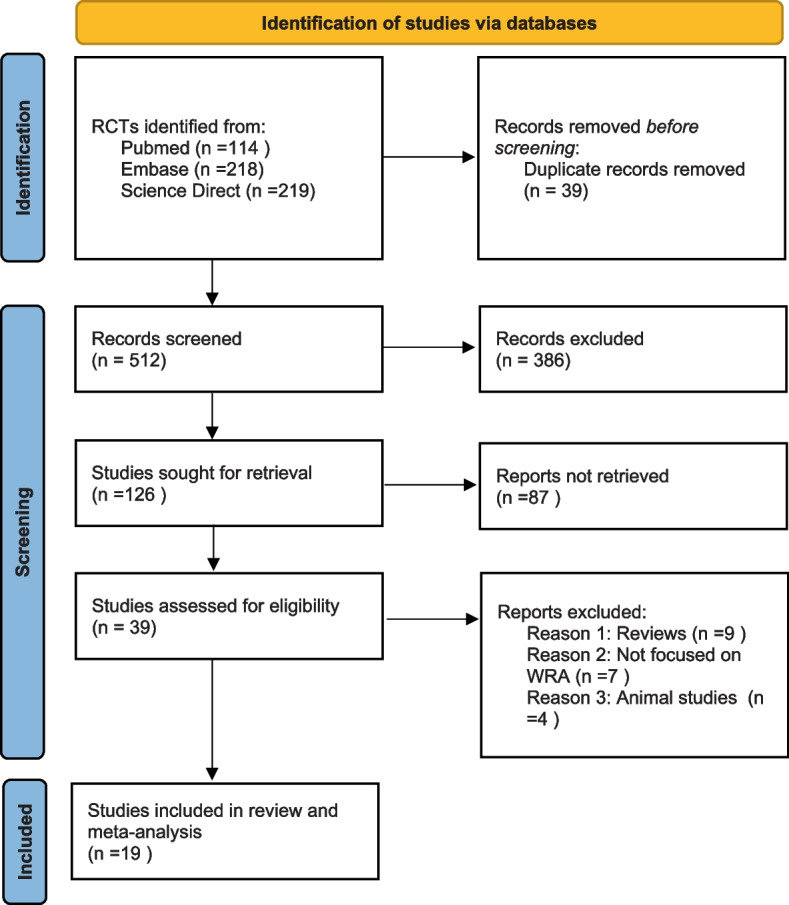
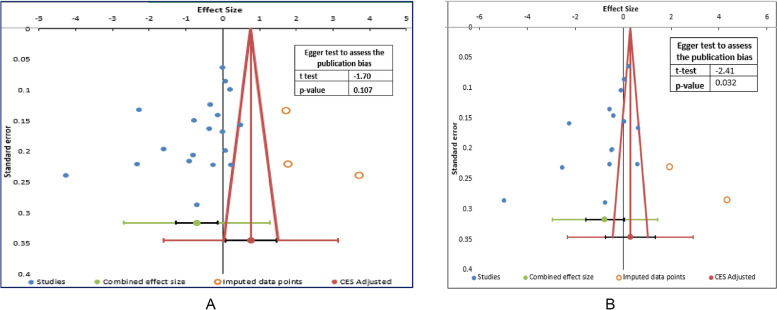
A comprehensive search strategy was used to search Medline through PubMed, Embase, and Science Direct for RCTs published between 2000 and 2020. The primary outcome was the mean change in hemoglobin level. We used standardized mean differences and their respective 95% CI to estimate the pooled effect. We used I statistics and Egger's test to assess heterogeneity and publication bias, respectively. This review was carried out in accordance with revised guidelines based on the Preferred Reporting Items for Systematic Review and Meta-analysis.
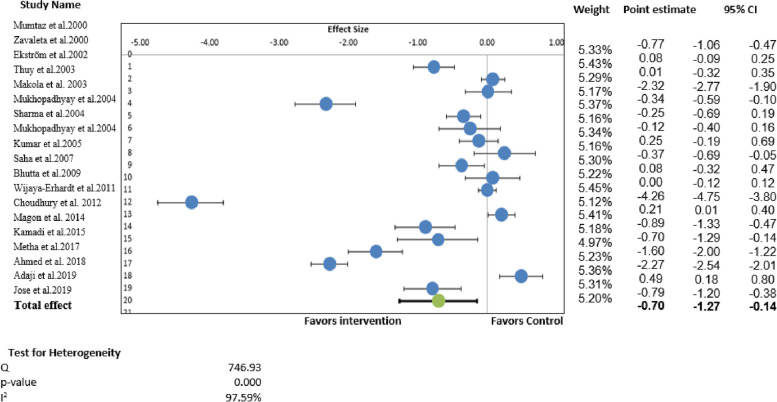
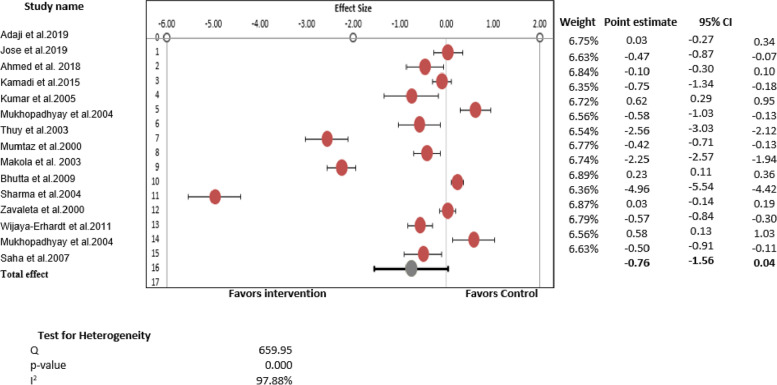
The findings showed that iron therapy improved hemoglobin and ferritin levels, though the results varied across studies. An overall pooled effect estimate for the role of iron therapy in improving the hemoglobin levels among WRA was -0.71 (95% CI: -1.27 to -0.14) (p = 0.008). Likewise, the overall pooled effect estimate for the role of iron therapy in improving the ferritin levels among WRA was -0.76 (95% CI: -1.56 to 0.04) (p = 0.04). The heterogeneity (I) across included studies was found to be statistically significant for studies assessing hemoglobin (Q = 746.93, I = 97.59%, p = 0.000) and ferritin level (Q = 659.95, I = 97.88%, p = 0.000).
Iron therapy in any form may reduce anemia's burden and improve hemoglobin and ferritin levels, indicating improvement in iron-deficiency anemia. More evidence is required, however, to assess the morbidity associated with iron consumption, such as side effects, work performance, economic outcomes, mental health, and adherence to the intervention, with a particular focus on married but non-pregnant women planning a pregnancy in the near future.
Registered with PROSPERO and ID is CRD42020185033.
缺铁性贫血是育龄妇女(WRA)常见的公共卫生问题,因为它会导致不良的母婴和生育结局。尽管有研究评估铁的疗效,但现有文献中仍存在一些差距和局限性。为了填补这些空白,我们对评估中低收入国家(LMIC)WRA 中缺铁性贫血的铁治疗作用的随机对照试验(RCT)进行了系统评价和荟萃分析。
我们采用综合检索策略,通过 Medline 下的 PubMed、Embase 和 Science Direct 检索 2000 年至 2020 年发表的 RCT。主要结局是血红蛋白水平的平均变化。我们使用标准化均数差值及其各自的 95%置信区间来估计汇总效应。我们使用 I ²统计量和 Egger 检验分别评估异质性和发表偏倚。本综述是根据基于系统评价和荟萃分析的首选报告项目的修订指南进行的。
研究结果表明,铁治疗可以改善血红蛋白和铁蛋白水平,但结果因研究而异。铁治疗在改善 WRA 血红蛋白水平中的作用的总体汇总效应估计值为-0.71(95%CI:-1.27 至-0.14)(p=0.008)。同样,铁治疗在改善 WRA 铁蛋白水平中的作用的总体汇总效应估计值为-0.76(95%CI:-1.56 至 0.04)(p=0.04)。纳入研究的异质性(I)在评估血红蛋白的研究中具有统计学意义(Q=746.93,I=97.59%,p=0.000)和铁蛋白水平(Q=659.95,I=97.88%,p=0.000)。
任何形式的铁治疗都可能减轻贫血的负担,并改善血红蛋白和铁蛋白水平,表明缺铁性贫血得到改善。然而,需要更多的证据来评估铁摄入相关的发病率,如副作用、工作表现、经济结果、心理健康和对干预的依从性,特别是关注近期有怀孕计划的已婚但未怀孕的妇女。
在 PROSPERO 注册,ID 是 CRD42020185033。