Department of Psychology, Virginia Commonwealth University, Richmond, Virginia, USA.
David Geffen School of Medicine, University of California, Los Angeles, California, USA.
J Sleep Res. 2019 Aug;28(4):e12809. doi: 10.1111/jsr.12809. Epub 2019 Jan 4.
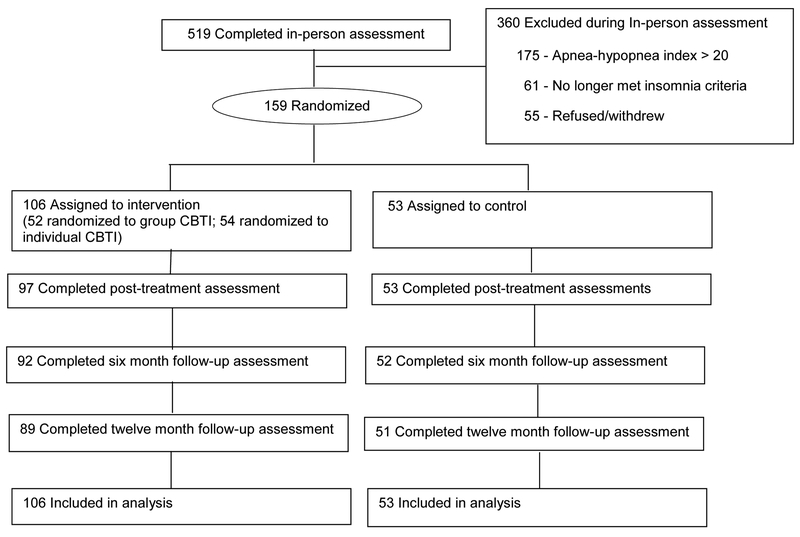
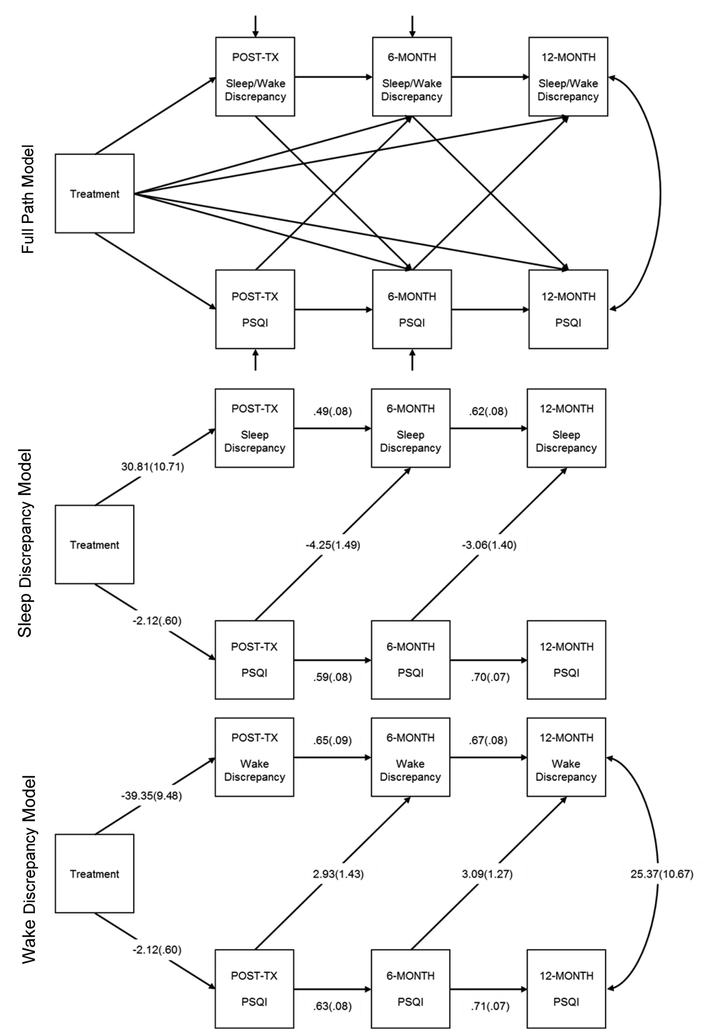
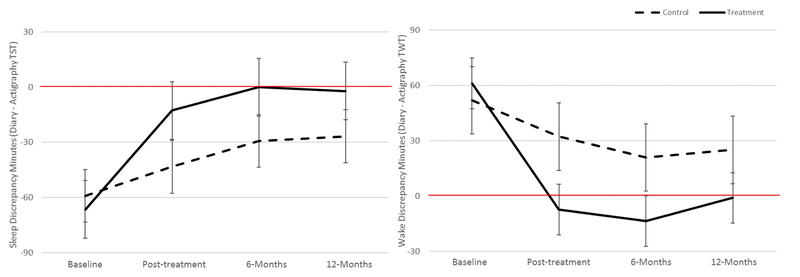
Subjective and objective estimates of sleep are often discordant among individuals with insomnia who typically under-report sleep time and over-report wake time at night. This study examined the impact and durability of cognitive-behavioural therapy for insomnia on improving the accuracy of sleep and wake perceptions in older adults, and tested whether changes in sleep quality were related to changes in the accuracy of sleep/wake perceptions. One-hundred and fifty-nine older veterans (97% male, mean age 72.2 years) who met diagnostic criteria for insomnia disorder were randomized to: (1) cognitive-behavioural therapy for insomnia (n = 106); or (2) attention control (n = 53). Assessments were conducted at baseline, post-treatment, 6-months and 12-months follow-up. Sleep measures included objective (via wrist actigraphy) and subjective (via self-report diary) total sleep time and total wake time, along with Pittsburgh Sleep Quality Index score. Discrepancy was computed as the difference between objective and subjective estimates of wake and sleep. Minutes of discrepancy were compared between groups across time, as were the relationships between Pittsburgh Sleep Quality Index scores and subsequent changes in discrepancy. Compared with controls, participants randomized to cognitive-behavioural therapy for insomnia became more accurate (i.e. minutes discrepancy was reduced) in their perceptions of sleep/wake at post-treatment, 6-months and 12-months follow-up (p < .05). Improved Pittsburgh Sleep Quality Index scores at each study assessment preceded and predicted reduced discrepancy at the next study assessment (p < .05). Cognitive-behavioural therapy for insomnia reduces sleep/wake discrepancy among older adults with insomnia. The reductions may be driven by improvements in sleep quality. Improving sleep quality appears to be a viable path to improving sleep perception and may contribute to the underlying effectiveness of cognitive-behavioural therapy for insomnia.
主观和客观的睡眠估计在失眠患者中经常不一致,这些患者通常会少报睡眠时间,多报夜间醒来的时间。本研究探讨了认知行为疗法治疗失眠对改善老年人睡眠和觉醒感知准确性的影响和持久性,并测试了睡眠质量的变化是否与睡眠/觉醒感知准确性的变化有关。159 名符合失眠障碍诊断标准的老年退伍军人(97%为男性,平均年龄 72.2 岁)被随机分为:(1)认知行为疗法治疗失眠组(n=106);或(2)注意力对照组(n=53)。在基线、治疗后、6 个月和 12 个月的随访时进行评估。睡眠评估包括客观(通过腕部活动记录仪)和主观(通过自我报告日记)总睡眠时间和总清醒时间,以及匹兹堡睡眠质量指数评分。差异计算为客观和主观估计的清醒和睡眠时间之间的差异。比较组间不同时间的差异分钟数,以及匹兹堡睡眠质量指数评分与随后差异变化之间的关系。与对照组相比,随机接受认知行为疗法治疗失眠的参与者在治疗后、6 个月和 12 个月的随访中对睡眠/觉醒的感知变得更加准确(即差异分钟数减少)(p<0.05)。在每个研究评估中,匹兹堡睡眠质量指数评分的改善先于并预测了下一个研究评估中的差异减少(p<0.05)。认知行为疗法治疗失眠可减少老年失眠患者的睡眠/觉醒差异。减少可能是由睡眠质量的改善驱动的。改善睡眠质量似乎是改善睡眠感知的可行途径,并可能有助于认知行为疗法治疗失眠的潜在有效性。