Division of Pharmacology, Department of molecular and Translational Medicine, University of Brescia, Viale Europa 11, 25123, Brescia, Italy.
Department of Clinical Neurosciences, Clifford Allbutt Building, University of Cambridge, Cambridge CB2 0AH, UK.
Int J Mol Sci. 2019 Jan 2;20(1):141. doi: 10.3390/ijms20010141.
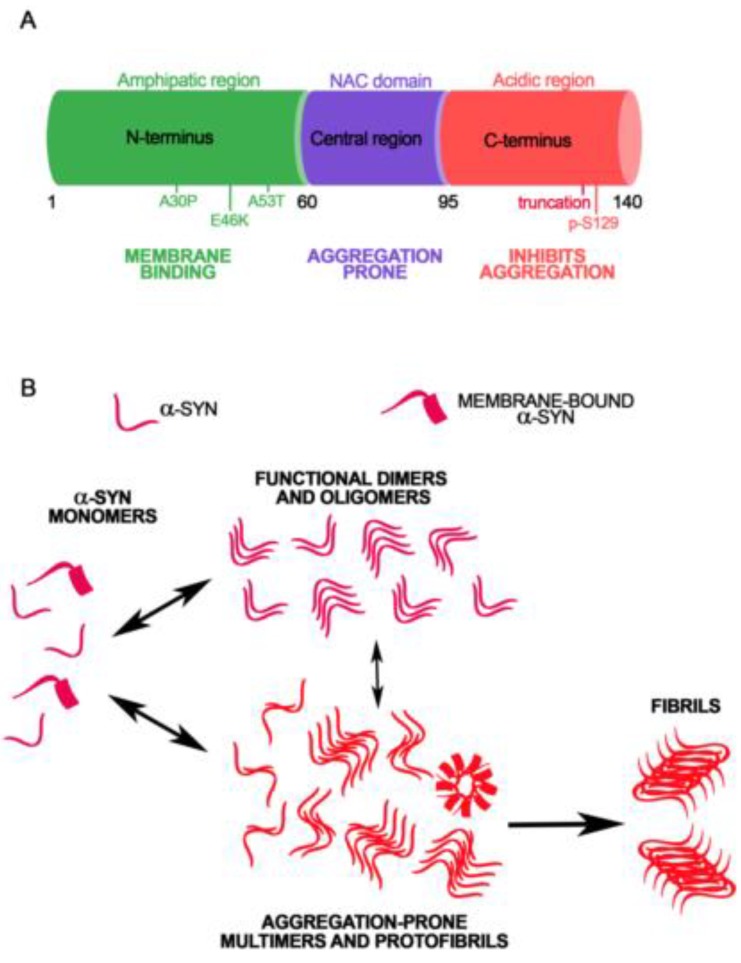
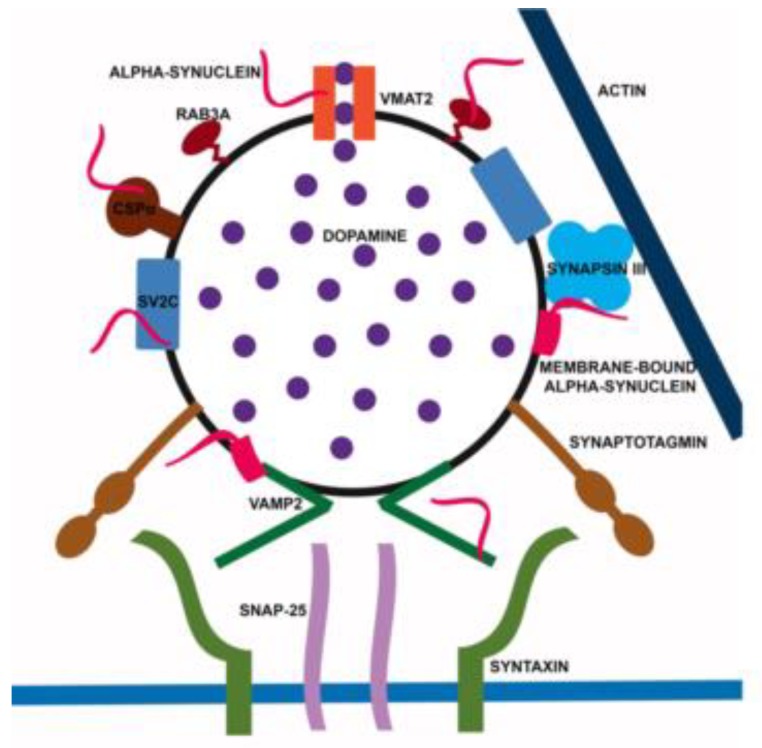
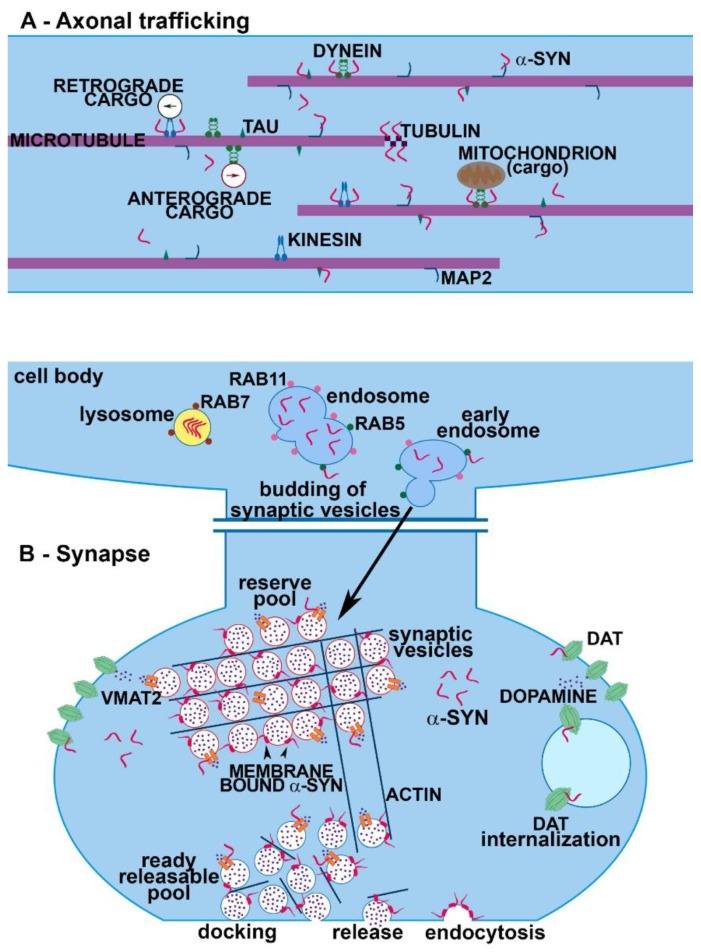
Alpha-synuclein (α-syn) is a small protein that, in neurons, localizes predominantly to presynaptic terminals. Due to elevated conformational plasticity, which can be affected by environmental factors, in addition to undergoing disorder-to-order transition upon interaction with different interactants, α-syn is counted among the intrinsically disordered proteins (IDPs) family. As with many other IDPs, α-syn is considered a hub protein. This function is particularly relevant at synaptic sites, where α-syn is abundant and interacts with many partners, such as monoamine transporters, cytoskeletal components, lipid membranes, chaperones and synaptic vesicles (SV)-associated proteins. These protein⁻protein and protein⁻lipid membrane interactions are crucial for synaptic functional homeostasis, and alterations in α-syn can cause disruption of this complex network, and thus a failure of the synaptic machinery. Alterations of the synaptic environment or post-translational modification of α-syn can induce its misfolding, resulting in the formation of oligomers or fibrillary aggregates. These α-syn species are thought to play a pathological role in neurodegenerative disorders with α-syn deposits such as Parkinson's disease (PD), dementia with Lewy bodies (DLB), and multiple system atrophy (MSA), which are referred to as synucleinopathies. Here, we aim at revising the complex and promiscuous role of α-syn at synaptic terminals in order to decipher whether α-syn molecular interactants may influence its conformational state, contributing to its aggregation, or whether they are just affected by it.
α-突触核蛋白(α-syn)是一种小蛋白,在神经元中主要定位于突触前末梢。由于构象可塑性增加,这可能受到环境因素的影响,并且在与不同相互作用物相互作用时经历无序到有序的转变,α-syn 被归入无序蛋白(IDPs)家族。与许多其他 IDPs 一样,α-syn 被认为是一种枢纽蛋白。这种功能在突触部位尤为重要,α-syn 在突触部位丰富,并与许多伴侣相互作用,如单胺转运体、细胞骨架成分、脂质膜、伴侣蛋白和突触小泡(SV)相关蛋白。这些蛋白-蛋白和蛋白-脂质膜相互作用对于突触功能的动态平衡至关重要,α-syn 的改变会破坏这个复杂的网络,从而导致突触机制的失败。突触环境的改变或 α-syn 的翻译后修饰会诱导其错误折叠,导致寡聚体或纤维状聚集体的形成。这些α-syn 物种被认为在帕金森病(PD)、路易体痴呆(DLB)和多系统萎缩(MSA)等具有α-syn 沉积的神经退行性疾病中发挥病理作用,这些疾病被称为突触核蛋白病。在这里,我们旨在修正 α-syn 在突触末梢的复杂和混杂作用,以阐明其分子相互作用物是否会影响其构象状态,促进其聚集,或者它们是否只是受其影响。