Fang Y, Wang L, Qian Y, Zhao W L
State Key Laboratory of Medical Genomics; Shanghai Institute of Hematology, Shanghai Rui Jin Hospital, Shanghai 200025, China.
Zhonghua Xue Ye Xue Za Zhi. 2018 Dec 14;39(12):1017-1020. doi: 10.3760/cma.j.issn.0253-2727.2018.12.009.
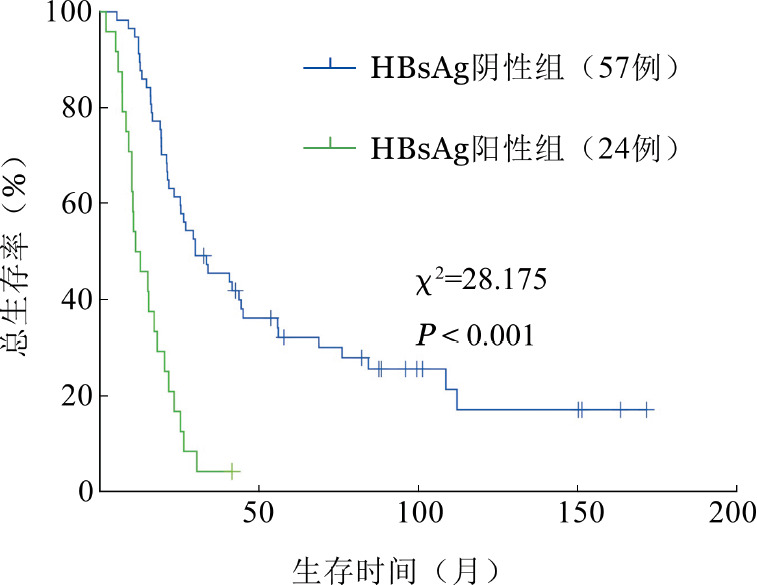
To evaluate the clinical and prognostic significance of hepatitis B virus infection on patients with relapsed/refractory diffuse large B-cell lymphoma (DLBCL). A retrospective analysis was performed in 81 relapsed/refractory DLBCL cases who were treated with salvage regimens from January 2004 to November 2016. The patients were divided into two group, HBsAg positive and HBsAg negative group, and assessed the clinical features and survival time of two groups. Twenty-four (29.6%) patients were HBsAg positive and 57(70.4%) were negative. HBsAg-positive DLBCL patients showed unique clinical features, including more younger patients (=0.005), more advanced Ann Arbor stage (<0.001), high-risk IPI (=0.010), more hypohemoglobin (=0.015), especially extra-nodal involvement (=0.038) and recurrence (=0.002). Overall response rate (29.2% 68.4%, (2)=10.720, =0.001) and median overall survival time [(11.3±2.9) months (30.0±7.6) months, (2)=28.175, <0.001] were inferior in HBsAg-positive patients, respectively. To strictly control HBV infection plays an important role on the survival and prognosis of relapsed/refractory lymphoma patients.
评估乙型肝炎病毒感染对复发/难治性弥漫性大B细胞淋巴瘤(DLBCL)患者的临床及预后意义。对2004年1月至2016年11月期间接受挽救方案治疗的81例复发/难治性DLBCL病例进行回顾性分析。将患者分为两组,HBsAg阳性组和HBsAg阴性组,并评估两组的临床特征及生存时间。24例(29.6%)患者HBsAg阳性,57例(70.4%)患者HBsAg阴性。HBsAg阳性的DLBCL患者表现出独特的临床特征,包括更多年轻患者(P=0.005)、更高的Ann Arbor分期(P<0.001)、高危国际预后指数(IPI)(P=0.010)、更多低血红蛋白患者(P=0.015),尤其是结外受累(P=0.038)和复发(P=0.002)。HBsAg阳性患者的总缓解率(29.2%对68.4%,χ²=10.720,P=0.001)和中位总生存时间[(11.3±2.9)个月对(30.0±7.6)个月,χ²=28.175,P<0.001]均较差。严格控制HBV感染对复发/难治性淋巴瘤患者的生存和预后起着重要作用。