Department of Neurology, Epilepsy Center Frankfurt Rhine-Main, Goethe University, Frankfurt am Main, Germany.
Department of Neurology, Epilepsy Center Hessen, Philipps University, Marburg, Germany.
Acta Neurol Scand. 2019 Apr;139(4):369-376. doi: 10.1111/ane.13061. Epub 2019 Jan 20.
Novel treatments are needed to control treatment-resistant status epilepticus (SE). We report a summary of clinical cases where perampanel was used in established SE, refractory SE (RSE), or super-refractory SE (SRSE).
Medical records were retrospectively reviewed for perampanel administration in SE at five European hospitals between 2011 and 2015.
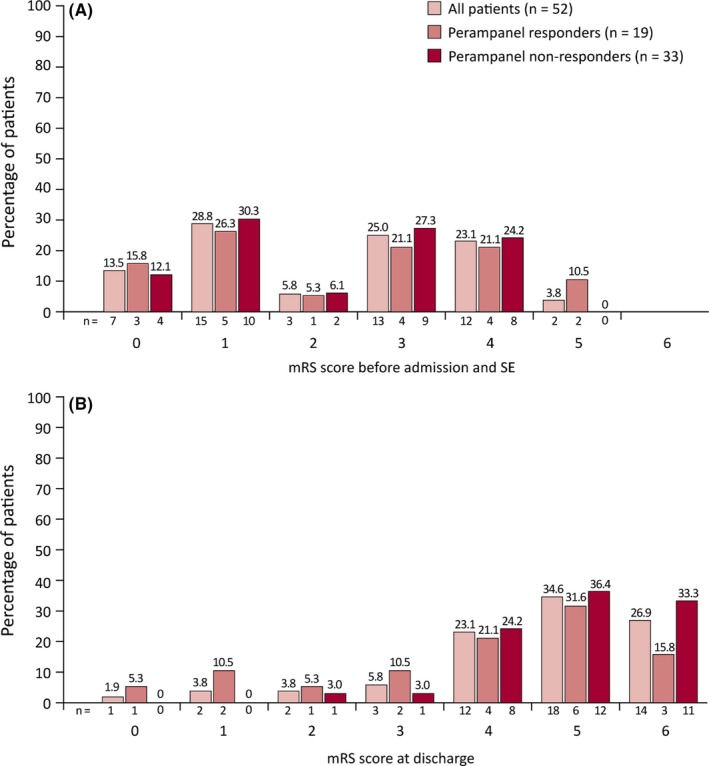
Of 1319 patients identified as experiencing SE, 52 (3.9%) received perampanel. Median latency from SE onset to perampanel initiation was 10 days. Patients with SE had previously failed benzodiazepines (when received) and a median of five other antiepileptic drugs (AEDs). Median initial perampanel dose was 6 mg/d, up-titrated to a median maximum dose of 10 mg/d. Perampanel was the last drug added in 32/52 (61.5%) patients, with response attributed to perampanel in 19/52 (36.5%) patients. A greater proportion of perampanel non-responders had SRSE (51.5%; 17/33) vs perampanel responders (31.6%; 6/19), and had failed a higher mean number of AEDs before initiating perampanel (5.9 vs 5.1, respectively). Most commonly reported adverse effects during perampanel treatment were dizziness (n = 1 [1.9%]) and somnolence (n = 1 [1.9%]). No serious adverse effects were documented, and none led to discontinuation of perampanel.
Perampanel was administered to patients with established SE, RSE, or SRSE at greater initial doses than those administered in clinical practice to patients with epilepsy. The SE cases reported here represent a refractory and heterogeneous population, and rate of seizure cessation attributed to perampanel treatment (36.5%) represents a notable response. These data should be confirmed in a larger patient population.
需要新的治疗方法来控制治疗抵抗性癫痫持续状态(SE)。我们报告了一些临床病例的总结,这些病例中使用了吡仑帕奈治疗已确立的 SE、难治性 SE(RSE)或超难治性 SE(SRSE)。
对 2011 年至 2015 年期间,五家欧洲医院中接受吡仑帕奈治疗 SE 的患者的医疗记录进行了回顾性分析。
在确定的 1319 例 SE 患者中,有 52 例(3.9%)接受了吡仑帕奈治疗。从 SE 发作到开始使用吡仑帕奈的中位潜伏期为 10 天。SE 患者此前曾使用过苯二氮䓬类药物(若有使用),且中位数使用了五种其他抗癫痫药物(AEDs)。中位初始吡仑帕奈剂量为 6mg/d,逐步滴定至最大剂量 10mg/d。在 52 例患者中,有 32 例(61.5%)患者为最后添加的药物,有 19 例(36.5%)患者的反应归因于吡仑帕奈。吡仑帕奈无反应者中更大多数为 SRSE(51.5%,17/33),而吡仑帕奈有反应者中更大多数为 RSE(31.6%,6/19),且在开始使用吡仑帕奈之前,失败的 AED 中位数数量更高(分别为 5.9 和 5.1)。在吡仑帕奈治疗期间最常报告的不良反应为头晕(n=1 [1.9%])和嗜睡(n=1 [1.9%])。未记录到严重不良事件,也没有导致吡仑帕奈停药。
在 SE、RSE 或 SRSE 患者中,初始剂量大于在接受吡仑帕奈治疗的癫痫患者中的剂量。此处报告的 SE 病例代表了一种难治性和异质性人群,归因于吡仑帕奈治疗的癫痫发作停止率(36.5%)代表了显著的反应。这些数据应在更大的患者人群中得到证实。