Kwan Wilson C, Shavelle David M, Laughrun David R
Division of Cardiovascular Medicine, Keck School of Medicine of the University of Southern California, Los Angeles, California.
Clin Cardiol. 2019 Mar;42(3):334-338. doi: 10.1002/clc.23151. Epub 2019 Feb 27.
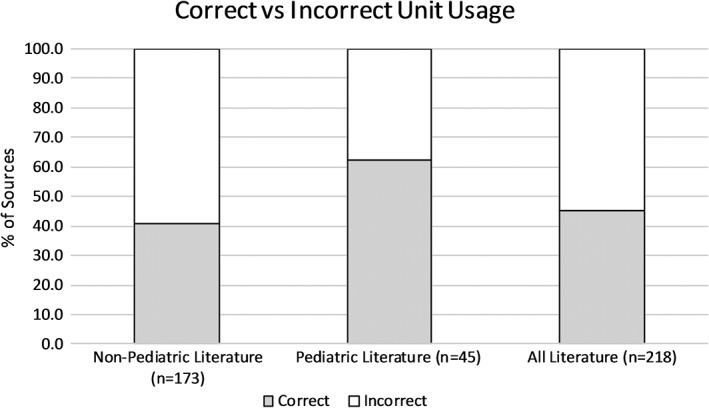
Pulmonary vascular resistance (PVR) and PVR index (PVRI) are key variables in a broad range of contexts, including prediction of outcomes in heart and liver transplantation, determining candidacy for closure of atrial or ventricular septal defects, and guiding treatment of pulmonary hypertension. Significant variability exists among the units used to report PVRI in current literature, making the interpretation of data and translation into clinical practice difficult. Here, we will review the measurement and derivation of PVR and PVRI and demonstrate the extent of confusion in the literature. We conducted a literature search of all published articles in PubMed using the term "PVRI." This yielded 218 sources with defined units for PVRI, including 33 unique variants. Among all reviewed literature, 45.4% of sources reported PVRI with units ending in m (meters squared), which we defined as correct, whereas 54.6% reported PVRI with units not ending in m , which we defined as incorrect. This lack of uniformity has led to considerable confusion among researchers and clinicians, with potentially life-altering consequences.
肺血管阻力(PVR)和肺血管阻力指数(PVRI)在广泛的情况下都是关键变量,包括预测心脏和肝移植的结果、确定房间隔或室间隔缺损封堵的候选资格以及指导肺动脉高压的治疗。目前文献中用于报告PVRI的单位存在显著差异,这使得数据解读和转化为临床实践变得困难。在此,我们将回顾PVR和PVRI的测量及推导过程,并展示文献中的混淆程度。我们使用术语“PVRI”在PubMed上对所有已发表的文章进行了文献检索。这产生了218个具有PVRI定义单位的来源,包括33个独特变体。在所有综述文献中,45.4%的来源报告的PVRI单位以m(平方米)结尾,我们将其定义为正确的,而54.6%报告的PVRI单位不以m结尾,我们将其定义为不正确的。这种缺乏一致性导致了研究人员和临床医生之间的相当大的困惑,可能会产生改变生命的后果。