Jiang Ming, Zhang Ju, Qian Lili, Miao Yuhui, Song Weiguo, Liu Hanyuan, Li Rui
School of Life Science, University of Science and Technology of China, Hefei 230027, Anhui, China.
Department of Laboratory Medicine, Anhui Provincial Hospital, Hefei 230001, Anhui, China; Department of Laboratory Medicine, First Affiliated Hospital of University of Science and Technology of China, Hefei 230001, Anhui, China.
iScience. 2019 Jan 25;11:189-204. doi: 10.1016/j.isci.2018.12.016. Epub 2018 Dec 21.
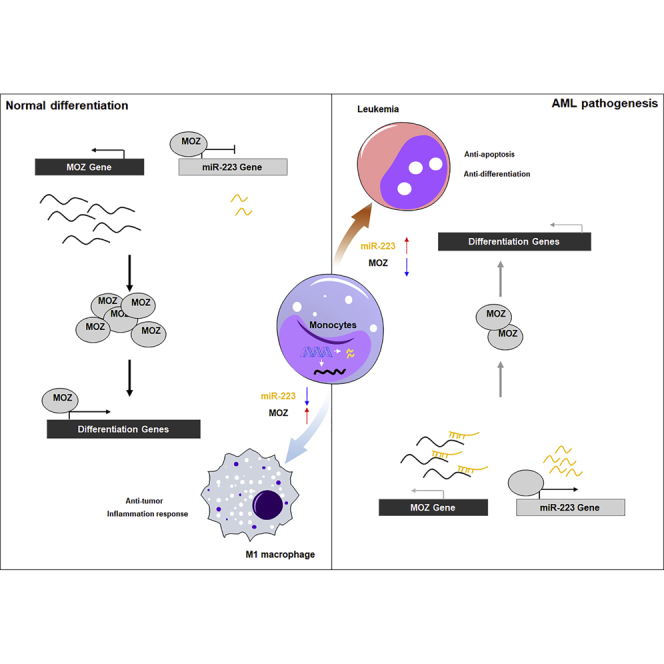
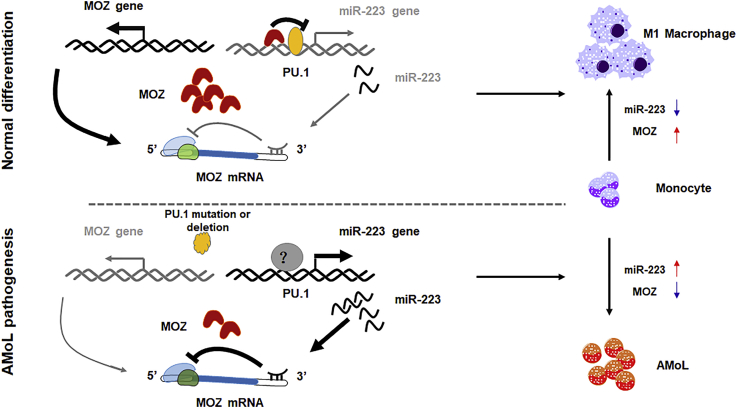
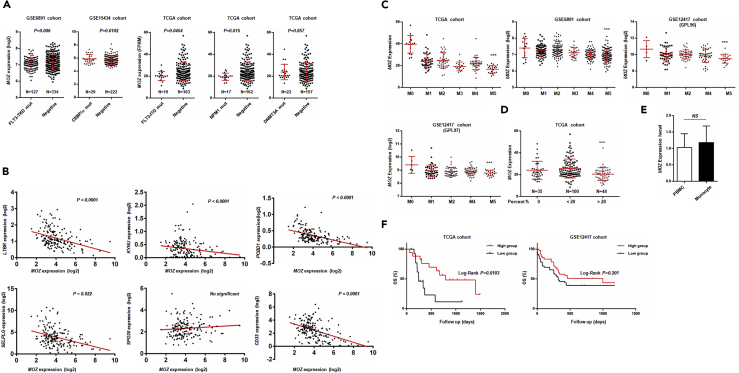
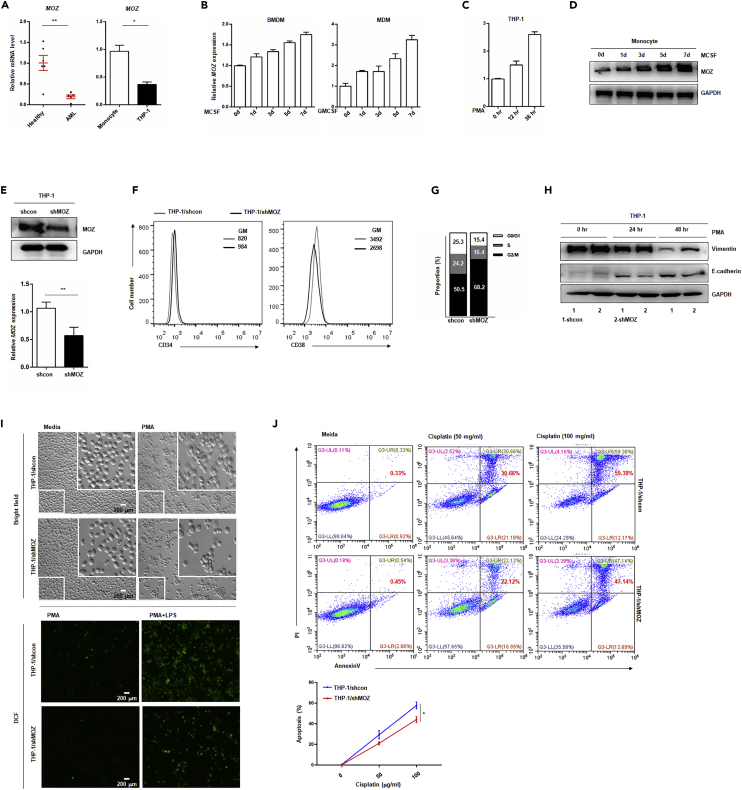
Monocytic leukemia zinc-finger protein (MOZ) has been found to form fusion proteins with many regulators in acute myeloid leukemia (AML). However, the molecular functions and underlying mechanism of MOZ in AML is not well understood. Here, clinical MOZ expression analysis combined with data integration from the TCGA and GEO databases indicated that a low level of MOZ was associated with poor prognosis. MOZ knockdown inhibited monocyte differentiation and increased resistance to chemotherapeutic drug-induced apoptosis in THP-1 or U937 cells. In addition, we found that genetic silencing of MOZ suppressed AP-1 and AKT activity in the context of lipopolysaccharide stimulation, resulting in diminished M1 activation of macrophages. We further showed that MOZ was a validated target of miR-223 and functioned as a repressor of miR-223 expression. Our study indicates that a molecular network involving MOZ and miR-223 contributes to the monocyte differentiation and polarization program, which is deregulated in AML.
单核细胞白血病锌指蛋白(MOZ)已被发现在急性髓系白血病(AML)中与许多调节因子形成融合蛋白。然而,MOZ在AML中的分子功能及潜在机制尚未完全明确。在此,临床MOZ表达分析结合来自TCGA和GEO数据库的数据整合表明,MOZ低表达与预后不良相关。敲低MOZ可抑制单核细胞分化,并增加THP-1或U937细胞对化疗药物诱导凋亡的抗性。此外,我们发现,在脂多糖刺激的情况下,MOZ基因沉默可抑制AP-1和AKT活性,导致巨噬细胞M1活化减弱。我们进一步表明,MOZ是miR-223的一个经过验证的靶标,并作为miR-223表达的抑制因子发挥作用。我们的研究表明,一个涉及MOZ和miR-223的分子网络有助于单核细胞分化和极化程序,而这一程序在AML中失调。