Chen Xiu-Lin, Li Guang-Wei, Xu Xiang-Li, Wu Jun-Xiang
Key Laboratory of Plant Protection Resources and Pest Management (Northwest A&F University), Ministry of Education, Yangling, China.
Shaanxi Province Key Laboratory of Jujube, College of Life Science, Yan' an University, Yan'an, China.
Front Physiol. 2018 Dec 10;9:1762. doi: 10.3389/fphys.2018.01762. eCollection 2018.
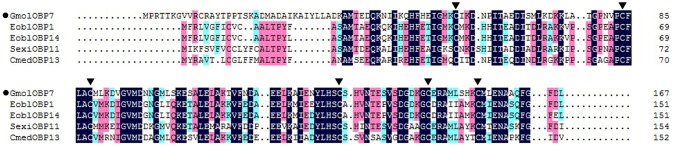
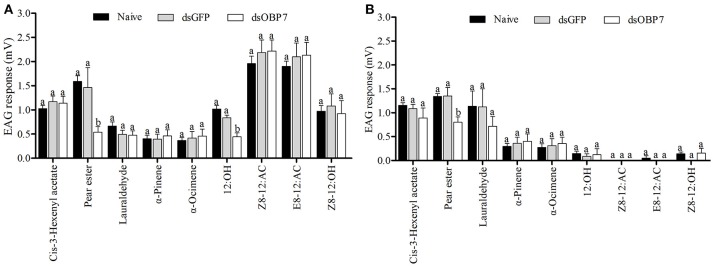
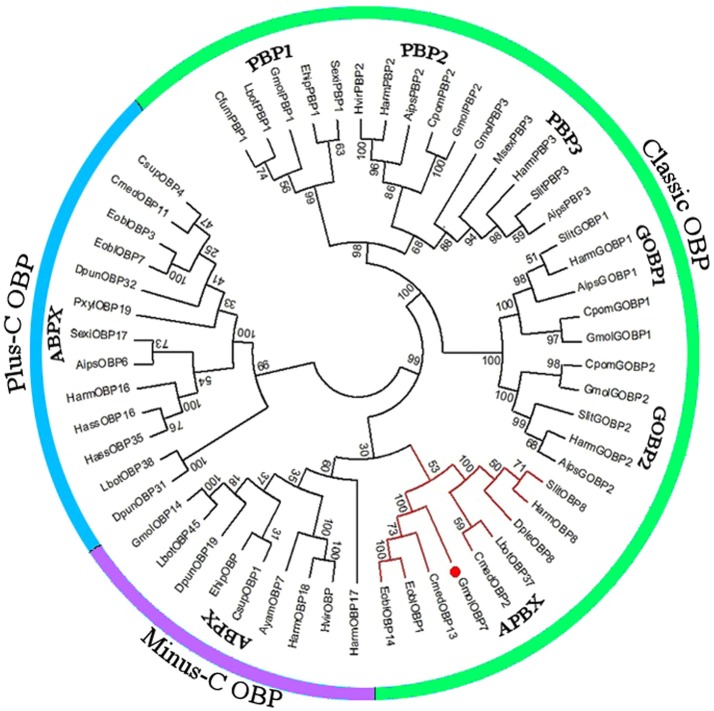
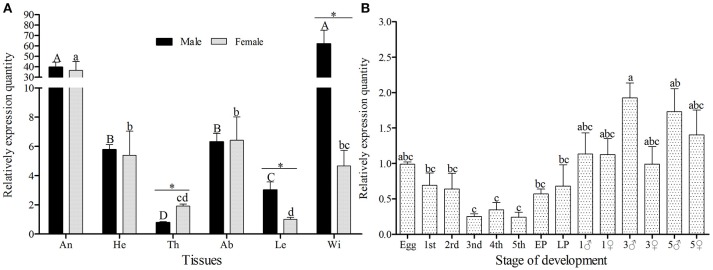
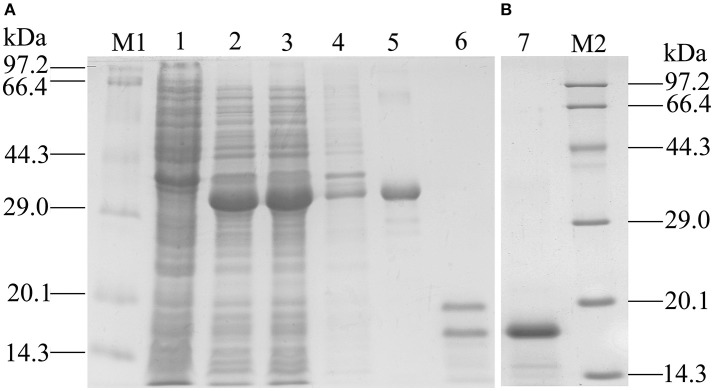
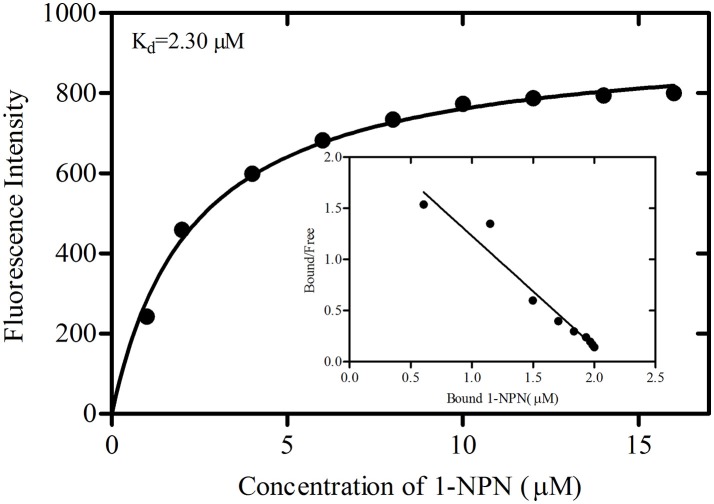
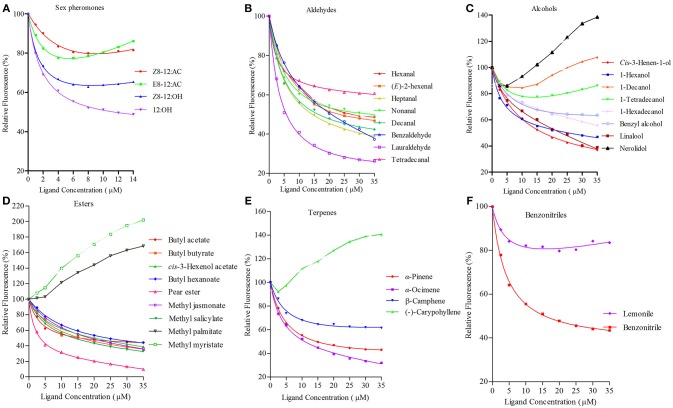
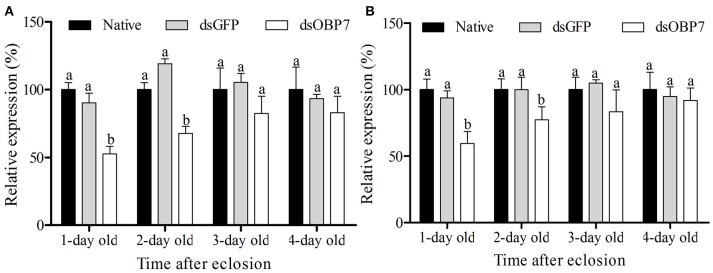
Odorant-binding proteins (OBPs) are widely and abundantly distributed in the insect sensillar lymph and are essential for insect olfactory processes. The OBPs can capture and transfer odor molecules across the sensillum lymph to odorant receptors and trigger the signal transduction pathway. In this study, a putative OBP gene, 7, was cloned using specific-primers, based on the annotated unigene which forms the antennal transcriptome of . Real-time PCR (qRT-PCR) analysis revealed that 7 was highly expressed in the wings of males and the antennae of both male and female adult moths, while low levels were expressed in other tissues. The recombinant GmolOBP7 (rGmolOBP7) was successfully expressed and purified via Ni-ion affinity chromatography. The results of binding assays revealed that rGmolOBP7 exhibited a high binding affinity to the minor sex pheromone 1-dodecanol containing of 7.48 μM and had high binding capacities to the host-plant volatiles, such as pear ester, lauraldehyde and α-ocimene. RNA-interference experiments were performed to further assess the function of GmolOBP7. qRT-PCR showed that the levels of mRNA transcripts significantly declined in 1 and 2 day old male and female moths, treated with 7 dsRNA, compared with non-injection controls. The EAG responses of dsRNA-injected males and females to pear ester, as well as the EAG responses of dsRNA-injected males to 1-dodecanol, were significantly reduced compared to the GFP-dsRNA-injected and non-injected controls. We therefore infer that GmolOBP7 has a dual function in the perception and recognition of the host-plant volatiles and sex pheromones.
气味结合蛋白(OBPs)广泛且大量分布于昆虫的感器淋巴中,对昆虫嗅觉过程至关重要。OBPs 可捕获气味分子并将其穿过感器淋巴传递给气味受体,从而触发信号转导通路。在本研究中,基于构成[昆虫名称]触角转录组的注释单基因,使用特异性引物克隆了一个假定的 OBP 基因 GmolOBP7。实时荧光定量 PCR(qRT-PCR)分析表明,GmolOBP7 在雄虫翅膀以及雌雄成虫触角中高表达,而在其他组织中表达水平较低。重组 GmolOBP7(rGmolOBP7)通过镍离子亲和层析成功表达并纯化。结合试验结果显示,rGmolOBP7 对次要性信息素 1-十二醇表现出高结合亲和力,解离常数为 7.48 μM,并且对寄主植物挥发物如梨酯、月桂醛和α-罗勒烯具有高结合能力。进行 RNA 干扰实验以进一步评估 GmolOBP7 的功能。qRT-PCR 表明,与未注射对照相比,用 GmolOBP7 dsRNA 处理的 1 日龄和 2 日龄雌雄蛾中,mRNA 转录本水平显著下降。与注射 GFP-dsRNA 和未注射的对照相比,注射 dsRNA 的雌雄蛾对梨酯的触角电位(EAG)反应以及注射 dsRNA 的雄蛾对 1-十二醇的 EAG 反应均显著降低。因此,我们推断 GmolOBP7 在寄主植物挥发物和性信息素的感知与识别中具有双重功能。