Robillard Rebecca, Carpenter Joanne S, Feilds Kristy-Lee, Hermens Daniel F, White Django, Naismith Sharon L, Bartlett Delwyn, Whitwell Bradley, Southan James, Scott Elizabeth M, Hickie Ian B
Sleep Research Unit, The Royal Institute for Mental Health Research, Ottawa, ON, Canada.
School of Psychology, Faculty of Social Sciences, University of Ottawa, Ottawa, ON, Canada.
Front Psychiatry. 2018 Dec 11;9:624. doi: 10.3389/fpsyt.2018.00624. eCollection 2018.
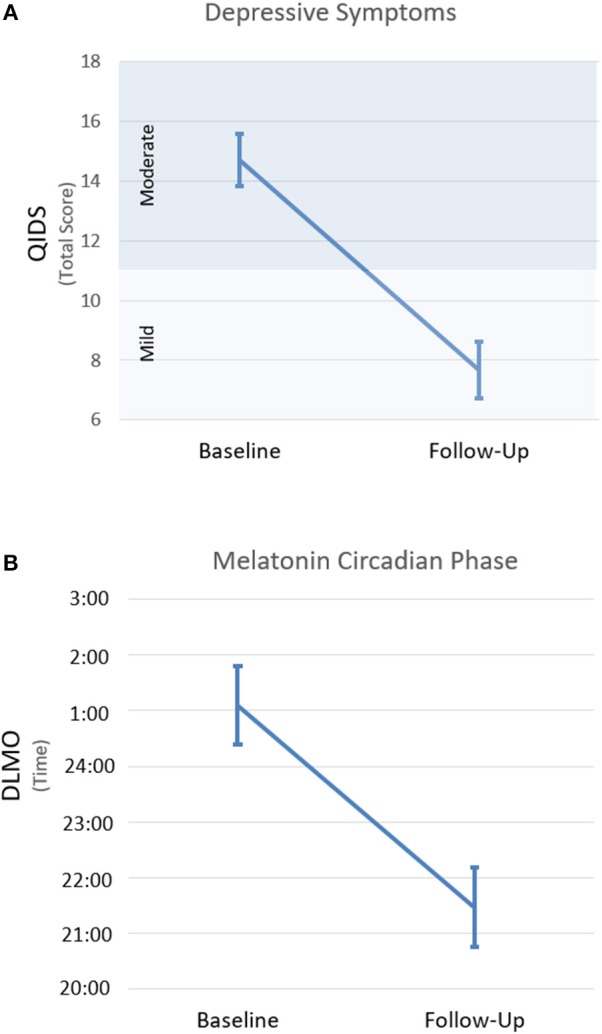
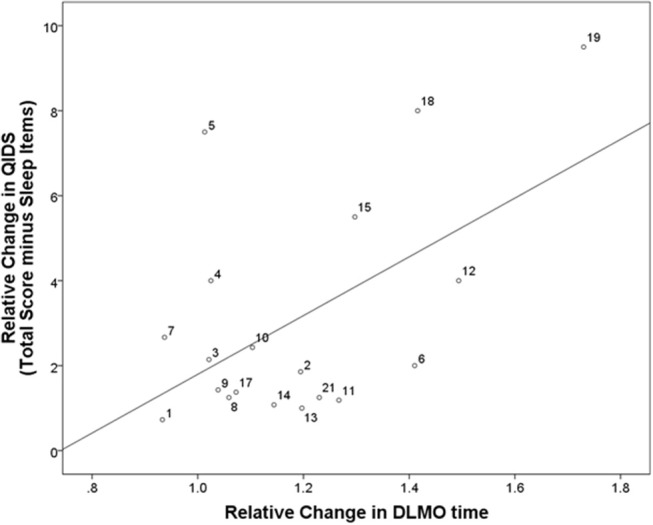
Agomelatine is a melatonin agonist and 5HT antagonist developed for the treatment of major depressive disorder which also has some effects on the circadian system. Since circadian dysfunctions are thought to play a role in the pathophysiology of depression, some of the mechanism of action of this drug may relate to improvements in circadian rhythms. This proof of concept open-label study sought to determine if improvements in depressive symptoms following an adjunctive multimodal intervention including agomelatine intake are associated with the magnitude of circadian realignment. This was investigated in young people with depression, a subgroup known to have high rates of delayed circadian rhythms. Young people with depression received a psychoeducation session about sleep and circadian rhythms, were asked to progressively phase advance their wake up time, and completed an 8 weeks course of agomelatine (25-50 mg). Participants underwent semi-structured psychological assessments, ambulatory sleep-wake monitoring and measurement of melatonin circadian phase before and after the intervention. Twenty-four young adults with depression (17-28 years old; 58% females) completed the study. After the intervention, depressive symptoms were significantly reduced [ = 6.9, < 0.001] and, on average, the timing of dim light melatonin onset (DLMO) shifted 3.6 h earlier [ = 4.4, < 0.001]. On average, sleep onset was phase shifted 28 min earlier [ = 2.1, = 0.047] and total sleep time increased by 24 min [ = -2.6, = 0.018]. There was no significant change in wake-up times. A strong correlation ( = 0.69, = 0.001) was found between the relative improvements in depression severity and the degree of phase shift in DLMO. Although this needs to be replicated in larger randomized controlled trials, these findings suggest that the degree of antidepressant response to a multimodal intervention including psychoeducation and agomelatine intake may be associated with the degree of change in evening melatonin release in young people with depression. This offers promising avenues for targeted treatment based on the prior identification of objective individual characteristics.
阿戈美拉汀是一种褪黑素激动剂和5-羟色胺拮抗剂,被开发用于治疗重度抑郁症,它对昼夜节律系统也有一些作用。由于昼夜节律功能障碍被认为在抑郁症的病理生理学中起作用,这种药物的一些作用机制可能与昼夜节律的改善有关。这项概念验证开放标签研究旨在确定在包括服用阿戈美拉汀在内的辅助多模式干预后抑郁症状的改善是否与昼夜节律重新调整的程度相关。这在抑郁症青少年中进行了研究,这是一个已知昼夜节律延迟发生率高的亚组。患有抑郁症的青少年接受了一次关于睡眠和昼夜节律的心理教育课程,被要求逐步提前起床时间,并完成一个为期8周的阿戈美拉汀(25 - 50毫克)疗程。参与者在干预前后接受了半结构化心理评估、动态睡眠-觉醒监测以及褪黑素昼夜节律相位测量。24名患有抑郁症的年轻人(17 - 28岁;58%为女性)完成了该研究。干预后,抑郁症状显著减轻[ = 6.9, < 0.001],平均而言,暗光褪黑素起始(DLMO)时间提前了3.6小时[ = 4.4, < 0.001]。平均而言,入睡时间提前了28分钟[ = 2.1, = 0.047],总睡眠时间增加了24分钟[ = -2.6, = 0.018]。起床时间没有显著变化。在抑郁严重程度的相对改善与DLMO的相位偏移程度之间发现了强烈的相关性( = 0.69, = 0.001)。尽管这需要在更大规模的随机对照试验中重复验证,但这些发现表明,对包括心理教育和服用阿戈美拉汀在内的多模式干预的抗抑郁反应程度可能与抑郁症青少年夜间褪黑素释放的变化程度相关。这为基于客观个体特征的先前识别进行靶向治疗提供了有前景的途径。