Abreu Celina Monteiro, Gama Lucio, Krasemann Susanne, Chesnut Megan, Odwin-Dacosta Shelly, Hogberg Helena T, Hartung Thomas, Pamies David
Department of Molecular and Comparative Pathobiology, Johns Hopkins School of Medicine, Baltimore, MD, United States.
Vaccine Research Center, National Institute of Allergy and Infectious Diseases, NIH, Bethesda, MD, United States.
Front Microbiol. 2018 Dec 4;9:2766. doi: 10.3389/fmicb.2018.02766. eCollection 2018.
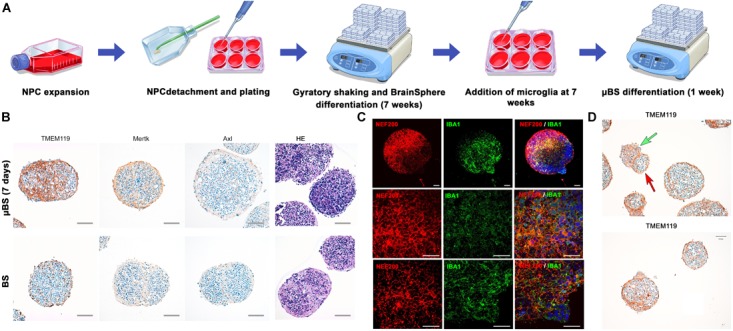
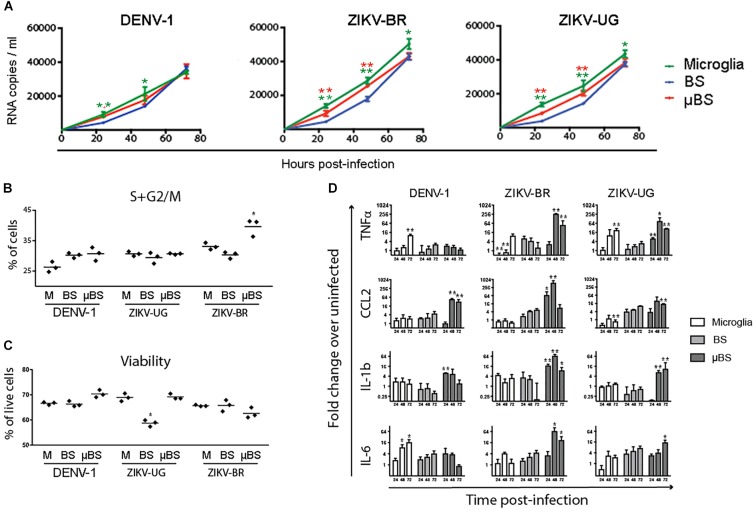
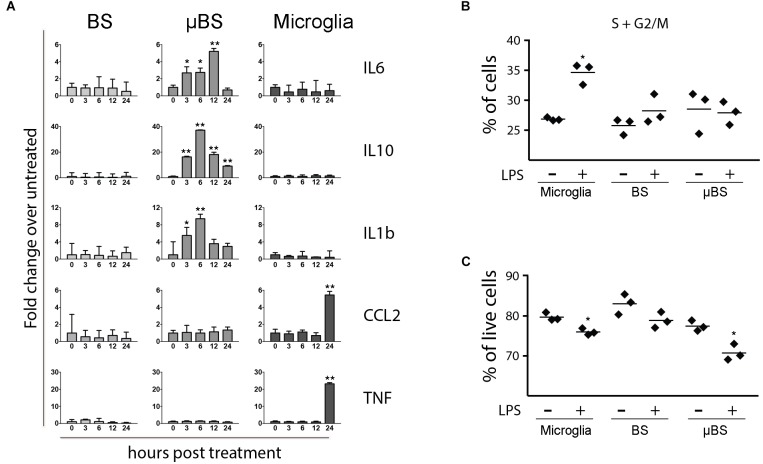
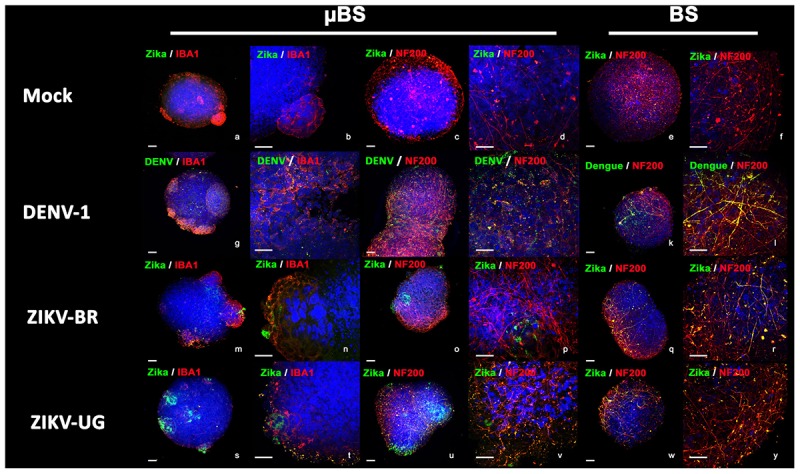
Human induced pluripotent stem cells (iPSCs), together with 21st century cell culture methods, have the potential to better model human physiology with applications in toxicology, disease modeling, and the study of host-pathogen interactions. Several models of the human brain have been developed recently, demonstrating cell-cell interactions of multiple cell types with physiologically relevant 3D structures. Most current models, however, lack the ability to represent the inflammatory response in the brain because they do not include a microglial cell population. Microglia, the resident immunocompetent phagocytes in the central nervous system (CNS), are not only important in the inflammatory response and pathogenesis; they also function in normal brain development, strengthen neuronal connections through synaptic pruning, and are involved in oligodendrocyte and neuronal survival. Here, we have successfully introduced a population of human microglia into 3D human iPSC-derived brain spheres (BrainSpheres, BS) through co-culturing cells of the Immortalized Human Microglia - SV40 cell line with the BS model (μBS). We detected an inflammatory response to lipopolysaccharides (LPS) and flavivirus infection, which was only elicited in the model when microglial cells were present. A concentration of 20 ng/mL of LPS increased gene expression of the inflammatory cytokines interleukin-6 (), , and , with maximum expression at 6-12 h post-exposure. Increased expression of the , tumor necrosis factor alpha (), and chemokine (C-C motif) ligand 2 () genes was observed in μBS following infection with Zika and Dengue Virus, suggesting a stronger inflammatory response in the model when microglia were present than when only astrocyte, oligodendrocyte, and neuronal populations were represented. Microglia innately develop within cerebral organoids (Nature communications), our findings suggest that the μBS model is more physiologically relevant and has potential applications in infectious disease and host-pathogen interactions research.
人类诱导多能干细胞(iPSC)与21世纪的细胞培养方法相结合,有潜力更好地模拟人类生理学,应用于毒理学、疾病建模以及宿主-病原体相互作用的研究。最近已经开发出几种人类大脑模型,展示了多种细胞类型之间具有生理相关性的3D结构的细胞间相互作用。然而,目前大多数模型缺乏代表大脑炎症反应的能力,因为它们不包括小胶质细胞群体。小胶质细胞是中枢神经系统(CNS)中具有免疫活性的常驻吞噬细胞,不仅在炎症反应和发病机制中起重要作用;它们还在正常大脑发育中发挥作用,通过突触修剪加强神经元连接,并参与少突胶质细胞和神经元的存活。在这里,我们通过将永生化人类小胶质细胞-SV40细胞系的细胞与BS模型(μBS)共培养,成功地将一群人类小胶质细胞引入3D人类iPSC衍生的脑球(BrainSpheres,BS)中。我们检测到对脂多糖(LPS)和黄病毒感染的炎症反应,这种反应仅在模型中存在小胶质细胞时才会引发。20 ng/mL的LPS浓度增加了炎症细胞因子白细胞介素-6()、、和的基因表达,在暴露后6-12小时达到最大表达。在感染寨卡病毒和登革热病毒后,在μBS中观察到、肿瘤坏死因子α()和趋化因子(C-C基序)配体2()基因的表达增加,这表明当存在小胶质细胞时,模型中的炎症反应比仅存在星形胶质细胞、少突胶质细胞和神经元群体时更强。小胶质细胞在类脑器官中自然发育(《自然通讯》),我们的研究结果表明,μBS模型在生理上更相关,在传染病和宿主-病原体相互作用研究中具有潜在应用。